
SYLLABUS
GS-3: Achievements of Indians in science & technology; indigenization of technology and developing new technology; Awareness in the fields of IT.
Context: NITI Aayog has released India’s first comprehensive 10-year roadmap, ” Future of India’s Semiconductor Industry”, aimed at building a USD 120–150 billion semiconductor value chain by 2035 and positioning India as an indispensable player in the global semiconductor ecosystem.
Key Highlights of the Roadmap
• Why India Must Act Now:
- Nearly 90–95% of India’s semiconductor demand is met through imports.
- Dependence on imported chips poses strategic risks to defence, aerospace and critical infrastructure systems.
- India spent nearly USD 150 billion on semiconductor imports during FY17–FY25, resulting in significant foreign exchange outflows.
- Domestic semiconductor production is essential for making future technologies such as 5G/6G devices more affordable and accessible.
- Global supply-chain diversification and the China-plus-One strategy have created a narrow but critical window of opportunity for India to enter the semiconductor value chain.
• India’s Semiconductor Opportunity:
- The global semiconductor market is expected to exceed USD 1.5 trillion by 2035.
- India’s semiconductor demand is projected to reach around USD 200 billion by 2035.
- At present, nearly 90–95% of India’s semiconductor demand is met through imports.
- Global supply-chain realignments and the search for trusted manufacturing destinations provide India with a historic opportunity to strengthen its position in the value chain.
• Vision 2035: Becoming Indispensable, Not Imitative
- India aims to capture 10–13% of the global semiconductor market by 2035.
- The roadmap seeks to retain 55–70% of semiconductor value capture within India through local design, packaging, materials and manufacturing ecosystems.
- The roadmap targets the creation of a USD 120–150 billion semiconductor value chain by 2035.
• The strategy is based on three pillars:
1. Strategic self-sufficiency.
2. Ecosystem strength.
3. Global indispensability.
- The emphasis is on building leadership in areas where India possesses structural advantages rather than competing directly in every segment of the semiconductor industry.
- India aims to achieve 15–25% chip self-sufficiency by 2030.
- Self-sufficiency is expected to increase to 35–50% by 2035.
• Leadership in Advanced Packaging and OSAT:
- India aims to emerge as one of the top three global destinations for advanced packaging and OSAT (Outsourced Semiconductor Assembly and Testing).
- Focus areas include Chiplets, 2.5D and 3D integration, Fan-Out Wafer Level Packaging (FOWLP), Panel-Level Packaging (PLP) and System-in-Package (SiP) technologies.
- Advanced packaging is identified as a major opportunity in the emerging “More-than-Moore” era.
• Focus on Compound and Wide-Bandgap Semiconductors:
- The roadmap prioritises leadership in Silicon Carbide (SiC) and Gallium Nitride (GaN) technologies.
- India aims to become a major supplier of wide-bandgap semiconductor materials.
- These technologies are critical for electric vehicles, renewable energy systems, power electronics, telecom infrastructure and defence applications.
• Strengthening Semiconductor Design Capabilities:
- Tiered subsidies for Electronic Design Automation (EDA) tools are proposed to reduce design costs and improve access for startups and researchers.
- An AI-enabled Semiconductor Engineering Mission is proposed to shorten chip-design cycles through agentic AI tools and automation.
- The roadmap targets the creation of more than 100 advanced semiconductor design IPs by 2035.
- Priority areas include AI-native chip design, high-performance computing, quantum computing, system architecture and chiplet-based design.
- The objective is to move from a design-services hub to a creator of globally competitive semiconductor IP.
• Building Domestic Manufacturing Capacity:
- Wafer fabrication efforts will primarily focus on mature logic nodes between 28 nm and 65 nm.
- Special emphasis is placed on analog, mixed-signal and power-management chips used in automotive, IoT and industrial applications.
- The roadmap recommends exploring Small Modular Reactors (SMRs) to provide reliable dedicated power for semiconductor fabrication clusters.
• Alignment with India Semiconductor Mission (ISM) 2.0:
- The roadmap complements the objectives of India Semiconductor Mission (ISM) 2.0 announced in Union Budget 2026.
- It marks India’s transition from ecosystem creation to ecosystem deepening.
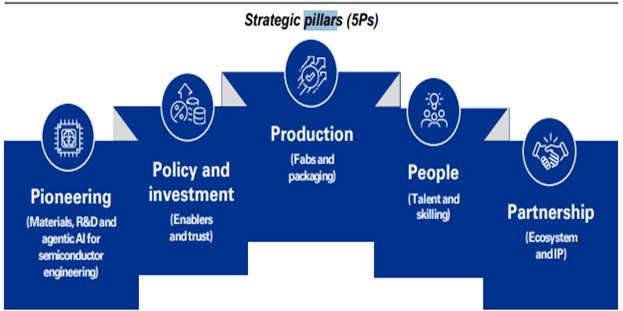
- Greater emphasis is placed on design, manufacturing, packaging, materials, talent development, research and innovation and global partnerships.
• Major Challenges Identified:
- Rising technological complexity is making semiconductor design and manufacturing increasingly difficult.
- India faces shortages of specialised talent required for fabrication, packaging and advanced research.
- Semiconductor manufacturing requires high capital investments, energy resources and water availability.
- Building trust and acceptance for India-made chips within global supply chains will require sustained efforts.
- Long gestation periods and slow returns increase the financial risks associated with semiconductor investments.
• Roadmap’s Key Solutions:
- Establish a National Frontier Semiconductor Research Programme to accelerate frontier semiconductor R&D.
- Create a National Design and Packaging Co-Design Platform to strengthen indigenous design capabilities.
- Develop a National Fab Academy to build a semiconductor-ready workforce.
- Establish a National Semiconductor Capital Framework to mobilise long-term investments.
- Build sovereign capabilities in semiconductor design, research and advanced packaging.
- Develop a robust domestic manufacturing ecosystem focused on strategic and high-value segments.
- Create a complete semiconductor talent pyramid from technicians to solution architects.
- Mobilise long-term capital through government support and private-sector participation.
- Strengthen trusted international partnerships to accelerate technology acquisition and ecosystem growth.