
SYLLABUS
GS-3: Achievements of Indians in science & technology; indigenization of technology and developing new technology.
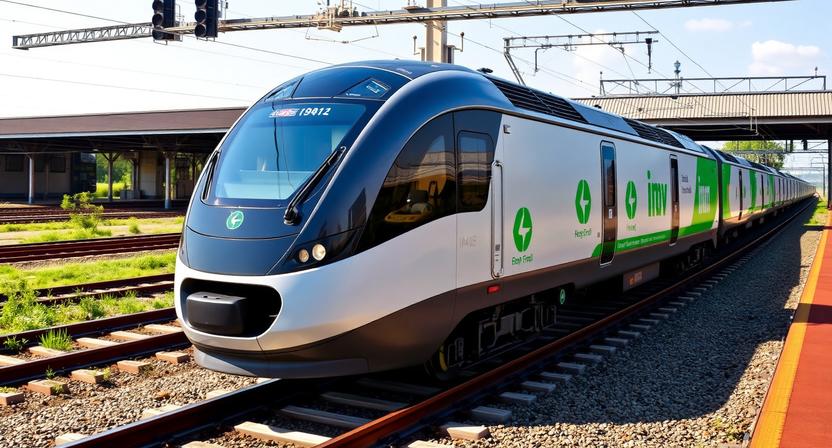
Context: Indian Railways has approved the introduction of India’s first indigenous Hydrogen Fuel Cell-based trainset on the Jind–Sonipat section of Northern Railway, marking a major step towards green and sustainable rail transportation.
More on the News
- The Railway Board has sanctioned the introduction of a 10-car Hydrogen Fuel Cell-based DEMU trainset on the dedicated Jind–Sonipat section of Northern Railway.
- The train successfully completed its oscillation trials conducted by the Research Designs and Standards Organisation (RDSO), paving the way for commercial operations.
- Initially, the approval is limited to the Jind–Sonipat route, while its scheduled maintenance will be carried out at Shakurbasti.
- With the launch of this train, India joins a select group of countries such as Germany, Japan, China, Sweden and the United States that are exploring or operating hydrogen-powered rail systems.
- The initiative reflects Indian Railways’ broader commitment to innovation, energy efficiency and environmentally sustainable mobility.
About the Hydrogen-Powered Train
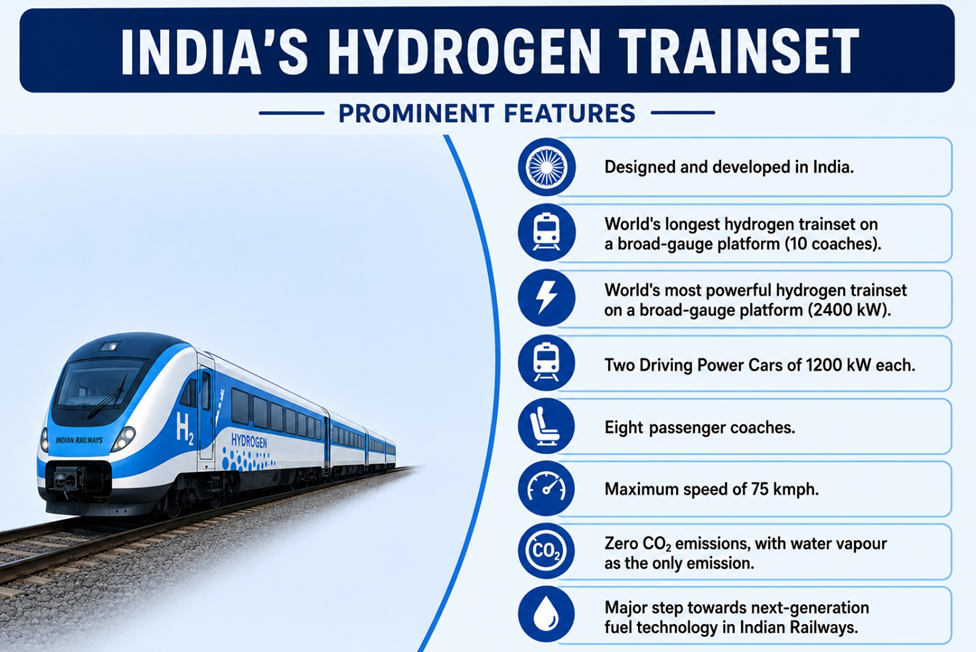
- The hydrogen train is designed and developed in India, demonstrating Indian Railways’ commitment to the vision of Atmanirbhar Bharat and indigenous technological development.
- Presently, it is the world’s longest hydrogen trainset on a broad-gauge platform, consisting of 10 coaches.
- It is also the most powerful hydrogen trainset on a broad-gauge platform, with a total installed power of 2400 kW.
- The trainset comprises two Driving Power Cars (DPCs) of 1200 kW each, along with eight passenger coaches.
- It will operate on the 89-km Jind–Sonipat route in Haryana.
How Hydrogen Fuel Cell Technology Works
- Hydrogen fuel-cell technology generates electricity through an electrochemical reaction between hydrogen and oxygen.
- The electricity produced powers the train’s electric motors, eliminating the need for diesel-based traction systems.
- Inside the fuel cell, hydrogen molecules are split into protons and electrons.
- The electrons travel through an external circuit, generating electricity, while the protons pass through a membrane.
- At the cathode, the protons, electrons and oxygen combine to form water, which is released as water vapour.
- As a result, water vapour is the only emission, making hydrogen fuel cells one of the cleanest transportation technologies currently available.
Hydrogen Production and Refuelling Infrastructure
- To support train operations, an indigenous hydrogen storage and refuelling facility has been established at Jind.
- The facility has received the necessary approval from the Petroleum and Explosives Safety Organisation (PESO) for the storage and dispensing of compressed hydrogen gas.
- The project is supported by a hydrogen compression system for refuelling operations, along with critical spare components and technical support systems to ensure reliable and fail-safe functioning.
- A standby compressor unit has also been provided to ensure uninterrupted operations.
- The hydrogen required for the project is produced through electrolysis, a process in which water is split into hydrogen and oxygen using electricity.
- Under the broader vision of the National Green Hydrogen Mission, renewable energy-based electrolysers are expected to play a crucial role in producing green hydrogen.
Safety and Operational Arrangements
- The approval mandates 24×7 monitoring of the hydrogen refuelling system, deployment of trained and certified personnel for critical operations, and periodic inspection and maintenance schedules.
- Operation and maintenance manuals for both the hydrogen trainset and hydrogen plant have been approved by RDSO.
- In addition, the proposed maintenance facility at Shakurbasti will operate under comprehensive safety provisions, standard operating procedures and regular audits.
Significance
- Green and Sustainable Transportation: The train produces zero CO₂ emissions, with water vapour as the only exhaust, helping reduce the environmental footprint of railway operations.
- Advancement of Clean Energy: Supports the objectives of India’s National Green Hydrogen Mission (2023) and promotes the use of hydrogen as a next-generation clean fuel.
- Technological Self-Reliance: Demonstrates indigenous capabilities in hydrogen propulsion, storage, refuelling and railway engineering under the Atmanirbhar Bharat initiative.
- Energy Security and Reduced Fossil Fuel Dependence: Encourages the adoption of alternative fuels and reduces long-term dependence on imported fossil fuels for transportation.
- Progress Towards Net-Zero Goals: Contributes to India’s clean energy transition and supports the country’s commitment to achieving net-zero emissions by 2070 through the decarbonisation of the transport sector.