SYLLABUS
GS-3: Conservation, environmental pollution and degradation, environmental impact assessment.
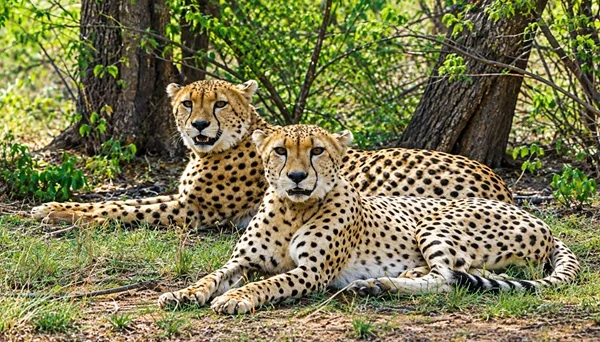
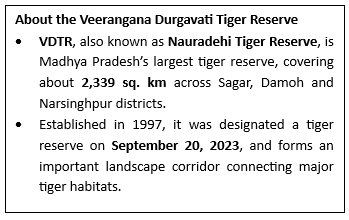
Context: Madhya Pradesh has expanded Project Cheetah to a third habitat with the release of two cheetahs in the Veerangana Durgavati Tiger Reserve (VDTR) in Sagar district.
More on the News
- Chief Minister released two cheetahs, Vyom and Neera, brought from Kuno National Park, into VDTR on the concluding day of Wildlife Conservation Week.
- After Kuno National Park and Gandhi Sagar Wildlife Sanctuary, VDTR has become the third cheetah habitat in Madhya Pradesh.
- The release marks the expansion of the cheetah conservation project to other suitable forest areas in Madhya Pradesh.
- Two more cheetahs are expected to be brought to VDTR next month.
Status of Cheetah Population
- India’s cheetah population has risen to 60, including 41 cheetahs born in India.
- Following the release in VDTR, 54 cheetahs are in Kuno National Park, four in Gandhi Sagar Wildlife Sanctuary and two in VDTR.
- The population growth has been supported by successful breeding and survival of India-born cubs.
- The birth of five cubs to Indian-born cheetah KJP21 also marked the beginning of the Botswana lineage in India
About the Project Cheetah
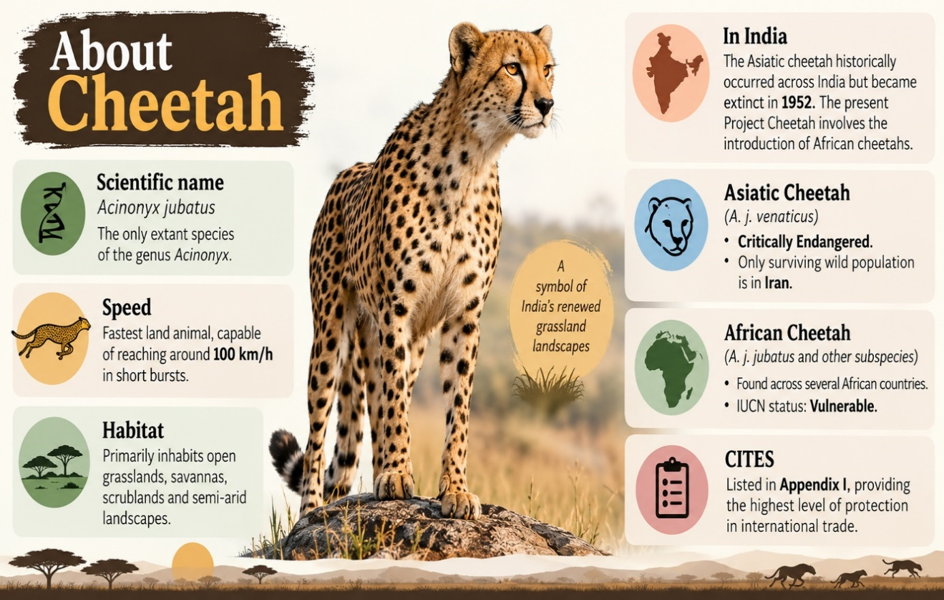
- The cheetah was declared extinct in India in 1952, with habitat loss, prey decline and hunting among the major causes.
- In 2020, the Supreme Court permitted the introduction of a limited number of African cheetahs on an experimental basis.
- Project Cheetah was launched on 17 September 2022 at Kuno National Park.
- The first batch of eight cheetahs from Namibia arrived in September 2022, followed by 12 from South Africa in February 2023 and nine from Botswana in February 2026.
- This constitutes the world’s first intercontinental translocation of a large wild carnivore.
- The programme seeks to establish a viable, self-sustaining cheetah population managed as a metapopulation, while restoring the species’ ecological role in suitable open ecosystems.
- The programme is under the Ministry of Environment, Forest and Climate Change (MoEFCC) and is spearheaded by the National Tiger Conservation Authority (NTCA), with the Wildlife Institute of India and State Forest Departments playing key roles.
- Kuno National Park was developed as the primary habitat, followed by Gandhi Sagar Wildlife Sanctuary and now Veerangana Durgavati Tiger Reserve.