

SYLLABUS
GS-3: Indian Economy and issues relating to planning, mobilization of resources, growth, development and employment.
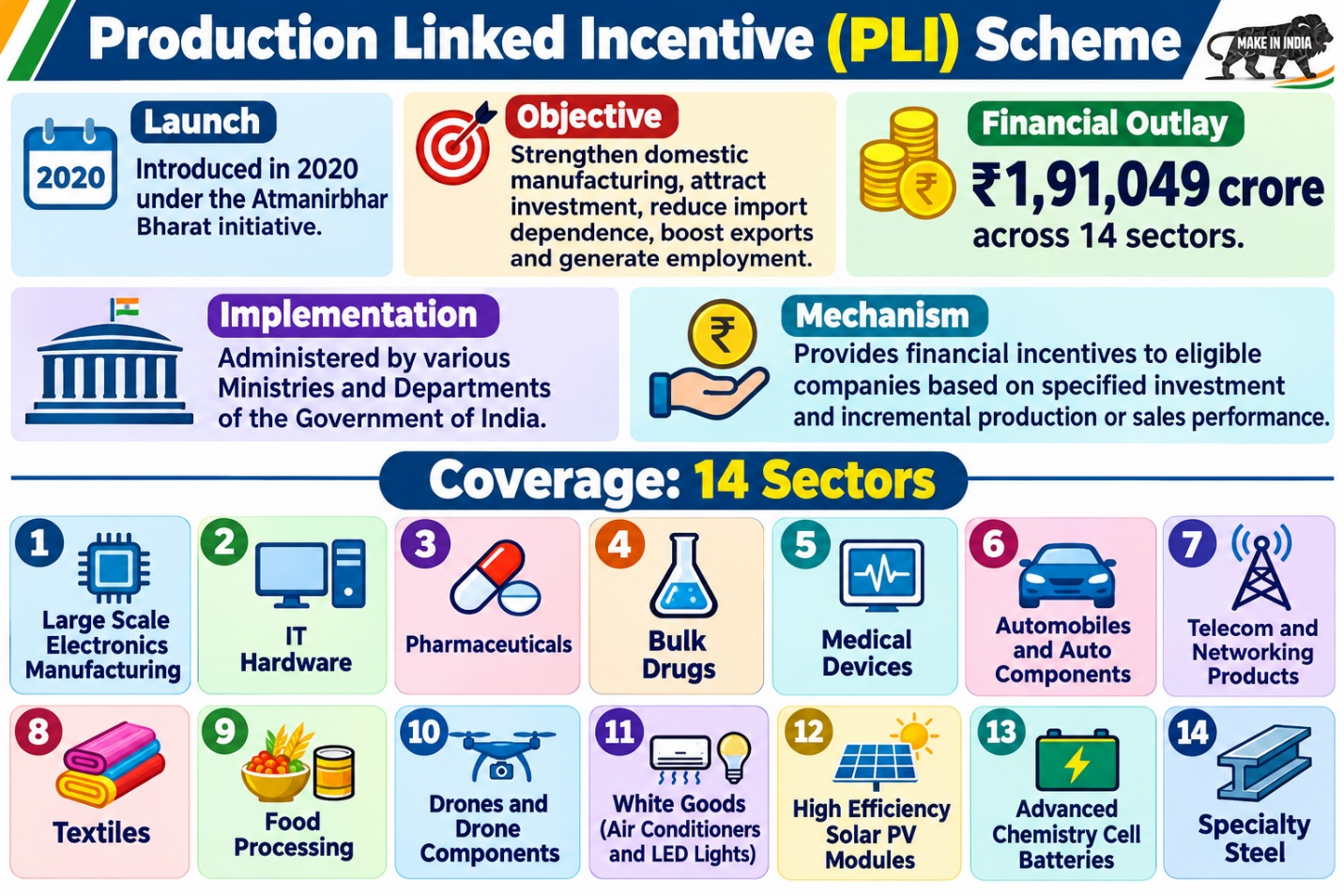
Context: NITI Aayog released the report ‘Impact Assessment of PLI Schemes’, prepared in collaboration with the Indian Institute of Management (IIM), Ahmedabad, evaluating the impact of PLI schemes across 14 sectors on investment, production, exports and employment.
Key Findings of Report
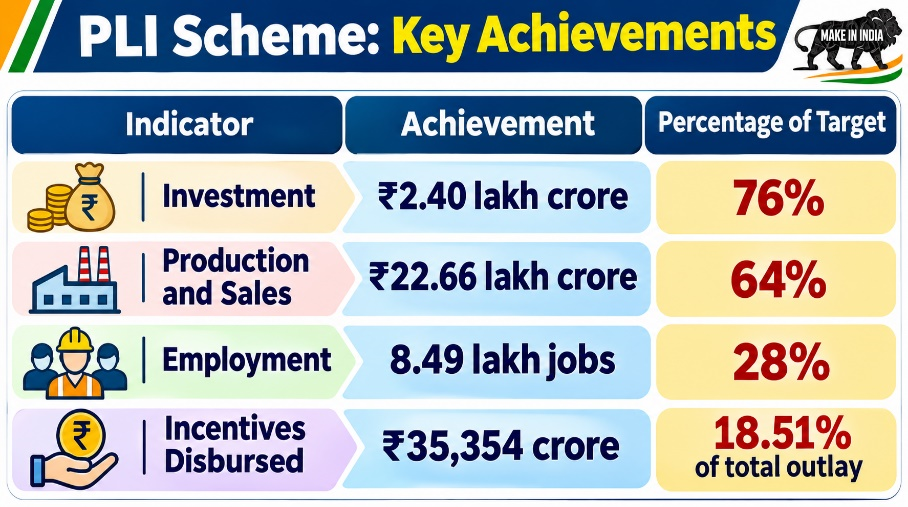
• Overall Performance:
- Nearly 70% of targeted segments are broadly on track.
- Around 58% of the combined implementation period had elapsed, with 42% remaining.
- Investment and production have progressed faster than employment generation.
• Sector-wise Performance
- Strong performers: Pharmaceuticals, Mobile Manufacturing under Large Scale Electronics Manufacturing (LSEM), Food Processing, Telecom, White Goods, Automobiles and Drones have shown encouraging progress.
- Mobile Manufacturing: Recorded investment of ₹20,580 crore, production and sales of ₹11.61 lakh crore and employment for 1.69 lakh people.
- Food Processing: Generated investment exceeding ₹9,200 crore and employment for approximately 3.29 lakh people.
- White Goods: Domestic value addition increased from 20% to 55%, reflecting greater localisation of components.
- Solar PV Modules: Domestic manufacturing capacity increased from 8 GW to nearly 116 GW, of which approximately 24 GW was directly attributable to PLI-supported projects.
- Textiles: Recorded investment of ₹8,117 crore, sales of ₹11,241 crore and employment for 33,427 people.
- Advanced Chemistry Cell (ACC) Batteries: Against a target of 50 GWh domestic manufacturing capacity, only 1.4 GWh had been developed, with commercial production yet to begin.
- Drones: Emerged as an early implementation success, with 77.5% of allocated funds disbursed.
• Major Challenges:
- Employment gap: Employment generation reached only 28% of the target, partly due to capital-intensive and automated manufacturing.
- MSME participation: Smaller enterprises face constraints relating to finance, technology, skills and market access.
- Import dependence: Several sectors continue to depend on imported high-value components and critical materials.
- Domestic value addition: Expansion of final assembly has not always translated into deeper domestic manufacturing of components.
- Data gaps: Inconsistent reporting of exports and employment across sectors limits impact assessment.
• Key Recommendations:
- Strengthen MSME participation through improved access to finance, technology, skills and markets.
- Promote domestic value addition and deeper integration of local suppliers into manufacturing value chains.
- Align manufacturing capacity with market demand and strengthen domestic procurement and export markets.
- Improve coordination between the Centre and State Governments to address implementation bottlenecks.
- Introduce harmonised data-reporting systems and regular monitoring of investment, production, exports and employment.