
SYLLABUS
GS-2: Welfare schemes for vulnerable sections of the population by the Centre and States
GS-1: Modern Indian history from about the middle of the eighteenth century until the present- significant events, personalities, issues.
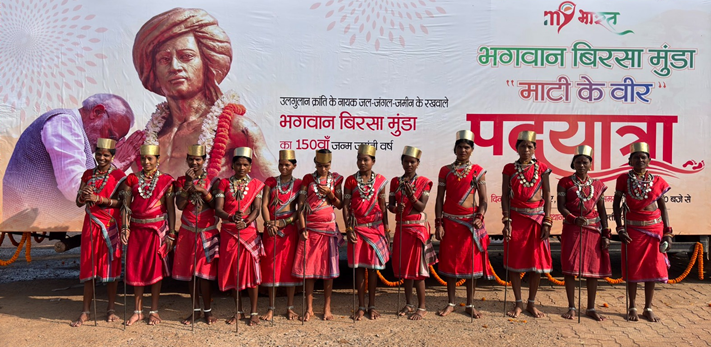
Context: The Government observes Janjatiya Gaurav Diwas on 15 November, Birsa Munda’s birth anniversary, to honour tribal contributions to the freedom struggle, cultural heritage and nation-building.
About Janjatiya Gaurav Diwas
• In 2021, the Government of India designated 15 November as Janjatiya Gaurav Diwas to commemorate the birth anniversary of Bhagwan Birsa Munda.
• Objective: To recognise the contribution of tribal freedom fighters, preserve tribal cultural heritage and promote the socio-economic development of tribal communities.
• Janjatiya Gaurav Pakhwada 2026: The Ministry of Tribal Affairs observed a nationwide fortnight from 1 to 15 November 2026 to accelerate flagship tribal welfare programmes and ensure last-mile delivery of government schemes.
- Digital Initiatives: The Jan-HIT Portal, developed with ICMR, will provide tribe-disaggregated health data across 20 States, while the National FRA Digital Platform will digitise the Forest Rights Act, 2006 claims process.
About Bhagwan Birsa Munda
• Early Life:
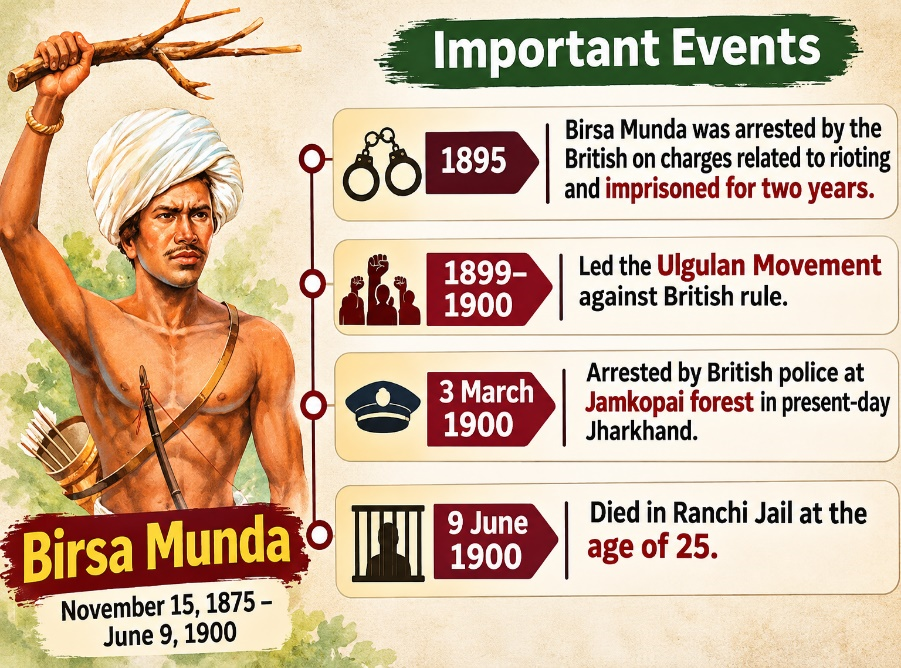
- Birth: 15 November 1875 at Ulihatu village in present-day Khunti district, Jharkhand.
- He belonged to the Munda tribe, traditionally associated with the Chotanagpur region.
- He witnessed the exploitation of tribal communities under British rule through land alienation, forced labour and oppressive practices by landlords, moneylenders and outsiders, locally known as Dikus.
- He initially came into contact with Christianity but later rejected missionary influence and established the Birsait religious movement.
- His followers addressed him as Bhagwan (God) and Dharti Aaba (Father of the Earth).
• Ulgulan Movement (1899–1900):
- Also known as the Munda Rebellion or the Great Tumult, it was led by Birsa Munda against British colonial rule and the exploitation of tribal communities.
- Objective: To establish Abua Raj (Our Rule), restore tribal self-governance and protect traditional community land rights under the Khuntkatti system.
- Birsa mobilised tribal communities against the exploitation of Dikus, landlords, moneylenders and colonial authorities.
- He encouraged tribal people to resist colonial domination and restore their traditional social and political institutions.
- His movement also challenged forced labour, land alienation and economic exploitation.
• Impact of the Movement:
- The movement exposed tribal exploitation and strengthened demands for protection of traditional land rights.
- It contributed to colonial land reforms, particularly the Chotanagpur Tenancy Act, 1908, which restricted the transfer of tribal land to non-tribals.
- Birsa Munda became a symbol of tribal resistance, identity, dignity and self-governance.
• Ideology of Birsa Munda:
- Abua Raj and Land Rights: Advocated self-rule, freedom from colonial rule and protection of tribal ancestral lands.
- Social and Cultural Reform: Opposed exploitation by Dikus, landlords and moneylenders, while promoting tribal identity and opposing alcoholism and indebtedness.
Government Initiatives for Tribal Welfare
• Pradhan Mantri Janjatiya Vikas Mission (PMJVM): Launched in 2021–22, it aims to strengthen tribal livelihoods through value addition of Minor Forest Produce (MFP), community-owned enterprises and market linkages.
• PM-JANMAN (Pradhan Mantri Janjati Adivasi Nyaya Maha Abhiyan): Aims to improve the socio-economic conditions of Particularly Vulnerable Tribal Groups (PVTGs) by providing access to basic facilities and essential services.
• Dharti Aaba Janjatiya Gram Utkarsh Abhiyan: Focuses on bridging infrastructure and essential service gaps in tribal-majority villages through coordinated implementation of government schemes.
• Forest Rights Act, 2006: Recognises individual and community forest rights of Scheduled Tribes and other traditional forest dwellers, including rights over Minor Forest Produce.
• PESA Act, 1996: Extends Panchayati Raj provisions to Scheduled Areas and empowers Gram Sabhas and Panchayats, including ownership over Minor Forest Produce.