
SYLLABUS
GS-3: Science and Technology- developments and their applications and effects in everyday life.
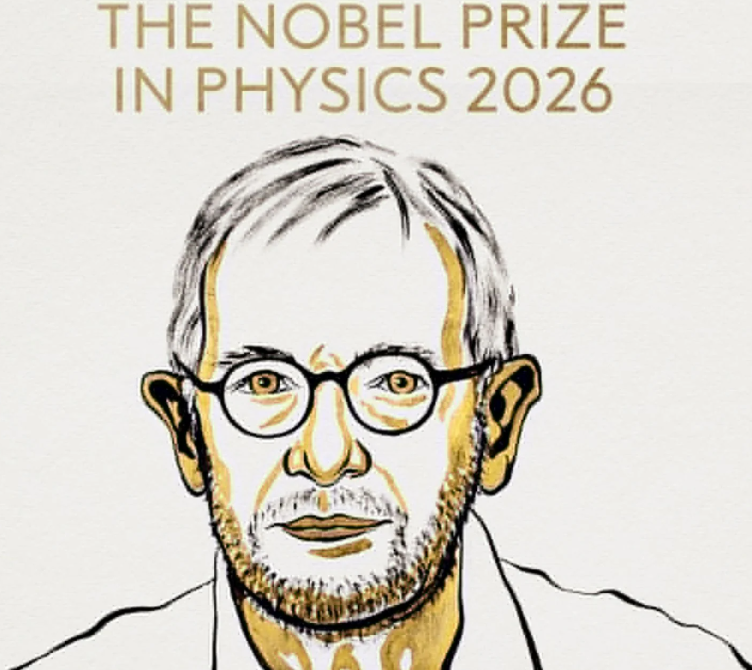
Context: The 2026 Nobel Prize in Physics has been awarded to Francis Halzen of the University of Wisconsin–Madison, USA, “for decisive contributions to the IceCube Neutrino Observatory and the discovery of high-energy neutrinos of astrophysical origin.”
Key Discovery of Nobel Laureate 2026
• Vision for Neutrino Detection: Francis Halzen first presented his vision for capturing neutrinos at the South Pole in 1988, proposing the use of ice as both the target and Cherenkov radiator medium.
- When a neutrino interacts with an atomic nucleus, it produces charged particles that generate Cherenkov light, which can be detected by optical sensors.
• Discovery of High-Energy Astrophysical Neutrinos: Halzen led the development of IceCube as its Principal Investigator, creating a sufficiently large, instrumented volume of Antarctic ice to detect high-energy neutrinos.
- In 2013, IceCube detected two PeV-scale neutrino events, providing the first evidence of high-energy astrophysical neutrinos; subsequent observations established a diffuse astrophysical neutrino flux extending to petaelectronvolt (PeV) energies.
• New Window to the Universe: Neutrinos are electrically neutral and are not deflected by magnetic fields, while they can also escape dense cosmic sources with little attenuation.
- Thus, they provide relatively undistorted information about distant and violent cosmic environments and open a new observation window on the high-energy universe.
About the IceCube Observatory
• The IceCube Neutrino Observatory is a cubic-kilometre-scale detector located about 2 km beneath the Antarctic ice, near the Amundsen-Scott South Pole Station.
• It consists of 86 strings carrying more than 5,000 optical sensors, deployed between about 1,450 and 2,450 metres below the surface.
• When a neutrino interacts with an atomic nucleus in the ice, it produces charged particles that generate Cherenkov light.
• The optical sensors detect this light, while the number and arrival time of photons help determine the deposited energy and direction of the neutrino.
• IceCube has operated with more than 99% uptime since its completion in 2011.
• Its observations have opened a new window on the high-energy universe and strengthened multi-messenger astronomy, combining neutrinos with cosmic rays, gamma-rays and gravitational waves to understand cosmic particle accelerators.
About the Nobel Prize
• The Nobel Prizes were established through the will of Alfred Nobel, the Swedish inventor, scientist and entrepreneur.
• In his 1895 will, Nobel directed that his fortune should be used to reward those who had conferred the “greatest benefit to humankind.”
• The first Nobel Prizes were awarded in 1901.
• Nobel originally specified five prize categories: Physics, Chemistry, Physiology or Medicine, Literature and Peace.
• The Sveriges Riksbank Prize in Economic Sciences in Memory of Alfred Nobel was established in 1968 and is administered within the Nobel Prize system, although it was not one of the prizes specified in Nobel’s original will.
• The Nobel Prize in Physiology or Medicine is selected by the Nobel Assembly at Karolinska Institutet, Sweden.
- The Assembly has 50 members, while the Nobel Committee evaluates nominations and prepares recommendations before the Assembly makes the final decision.