SYLLABUS
GS-2: Bilateral, regional and global groupings and agreements involving India and/or affecting India’s interests.
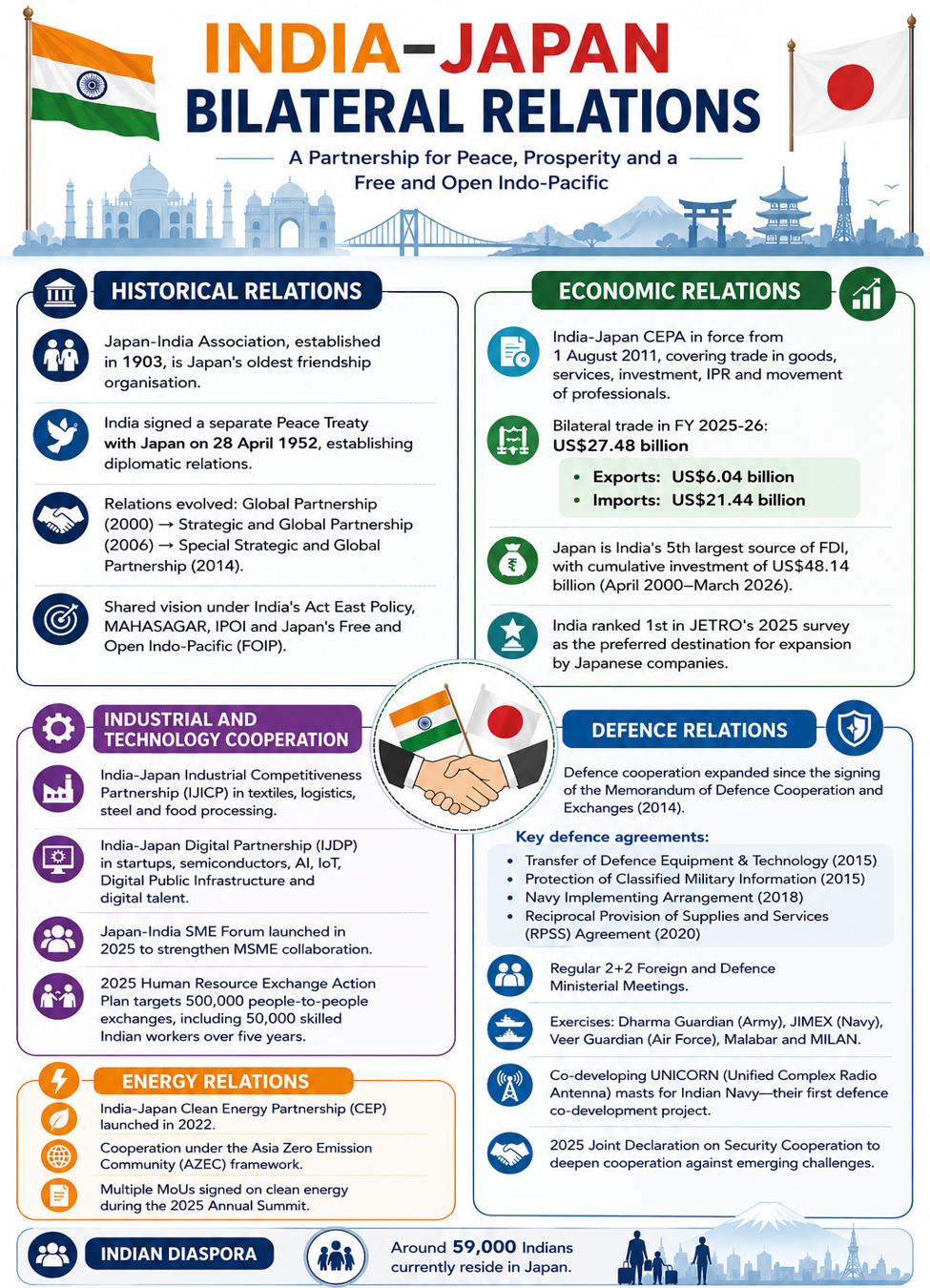
Context: Prime Minister Narendra Modi and Japanese Prime Minister Sanae Takaichi held the 16th India-Japan Annual Summit in New Delhi, adopting several agreements to deepen the Special Strategic and Global Partnership.
About the 16th India-Japan Annual Summit
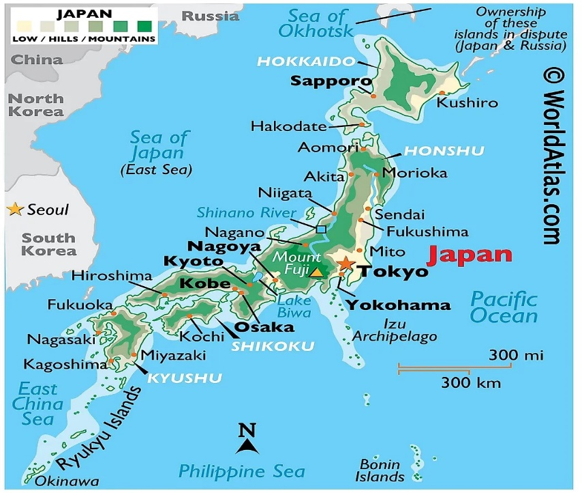
- It was held during Japanese Prime Minister Sanae Takaichi’s first official visit to India from 1–3 July 2026.
- Both leaders reviewed the progress made since the 15th India-Japan Annual Summit (2025) and reaffirmed their commitment to strengthening the Special Strategic and Global Partnership.
- The Summit identified three priority pillars for future cooperation:
- Defence & Security Cooperation
- Economic Partnership (including Economic Security, Energy Resilience, Technology & Innovation)
- People-to-People Exchanges
- India welcomed Japan’s updated Free and Open Indo-Pacific (FOIP) vision, which aligns with India’s Indo-Pacific Oceans’ Initiative (IPOI) and MAHASAGAR vision.
Key Outcomes of the 16th India-Japan Annual Summit
- Defence & Security: Agreed to hold the 4th India-Japan 2+2 Ministerial Meeting in Tokyo in 2026.
- Decided to expand maritime security cooperation through exercises, Maritime Domain Awareness (MDA), MRO and defence technology collaboration under Make in India.
- Reached an agreement in principle on the UNICORN (Unified Complex Radio Antenna) project.
- Economic Security & Trade: Adopted the India-Japan Joint Declaration on Economic Security covering cooperation in semiconductors, critical minerals, ICT (including AI), clean energy and pharmaceuticals.
- Agreed to strengthen resilient supply chains, accelerate the review of the India-Japan CEPA, and continue progress towards the 10 trillion Yen investment target.
- Launched the India-Japan SME Forum and expanded startup and MSME cooperation under Japan-India Startup Support Initiative (JISSI).
- Exchange of Letters between the International Financial Services Centres Authority (IFSCA) and Japan’s Financial Services Agency (JFSA) to strengthen cooperation in financial regulation, supervision, FinTech, RegTech and exchange of financial market best practices.
- Energy Cooperation: Adopted the Joint Statement on Energy Resilience and agreed to cooperate on strategic petroleum reserves, maritime energy transport and energy supply chains.
- Launched the India-Japan Cooperative Biogas for Growth (CBG) Initiative to support India’s target of establishing 1,000 biogas and organic fertilizer plants.
- Signed MoUs on Batteries and reaffirmed cooperation in green hydrogen, clean ammonia, solar PV and nuclear energy.
- Technology & Innovation: Adopted the India-Japan Joint Statement on AI Cooperation and held the inaugural India-Japan AI Strategic Dialogue.
- Signed MoUs on IndiaAI Mission–METI, LLMs, internet governance (NIXI–JPNIC), pharmaceuticals & medical devices, geology & critical minerals, and life sciences research (RIKEN partnerships).
- Welcomed cooperation in Quantum Technologies and the LUPEX Mission.
- Infrastructure & Connectivity: Reaffirmed commitment to the Mumbai-Ahmedabad High-Speed Rail Project and India’s 7,000-km High-Speed Rail Network vision.
- Signed the Next Generation Mobility Partnership (NGMP) covering railways, automobiles, aviation, shipbuilding, ports, logistics and urban development.
- Welcomed progress in Japan-supported metro, healthcare, education and horticulture projects.
- People-to-People & Regional Cooperation: Declared 2027 as the India-Japan Year of Shared Horizons to celebrate 75 years of diplomatic relations.
- Expanded cooperation in education, tourism, Japanese language, science exchanges and State–Prefecture partnerships.
- Reaffirmed cooperation through the Quad, ASEAN, BIMSTEC, supported UNSC reforms, and condemned terrorism in all its forms.