SYLLABUS
GS-3: Indian Economy and issues relating to planning, mobilization of resources, growth, development and employment.
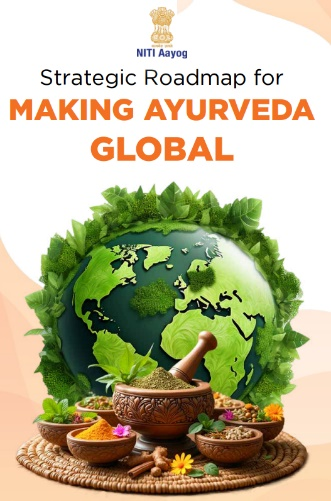
Context: The NITI Aayog released a report titled “Strategic Roadmap for Making Ayurveda Global” presenting a comprehensive assessment of Ayurveda’s global footprint and a phased roadmap to strengthen its international presence.
More on the News:
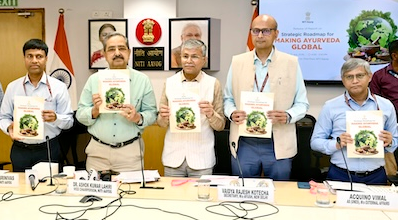
• The report was launched by Dr. Ashok Kumar Lahiri, Vice Chairman, NITI Aayog.
• The study was undertaken by the Health Division of NITI Aayog in collaboration with PricewaterhouseCoopers (PwC).
• The report proposes a phased strategy extending up to 2047, aligned with the vision of Viksit Bharat@2047.
Key Highlights of the Report
• Objectives:
- To assess Ayurveda’s global footprint, identify barriers and enablers, evaluate regulatory frameworks, map global demand, and develop a roadmap for its globalisation.
• Methodology:
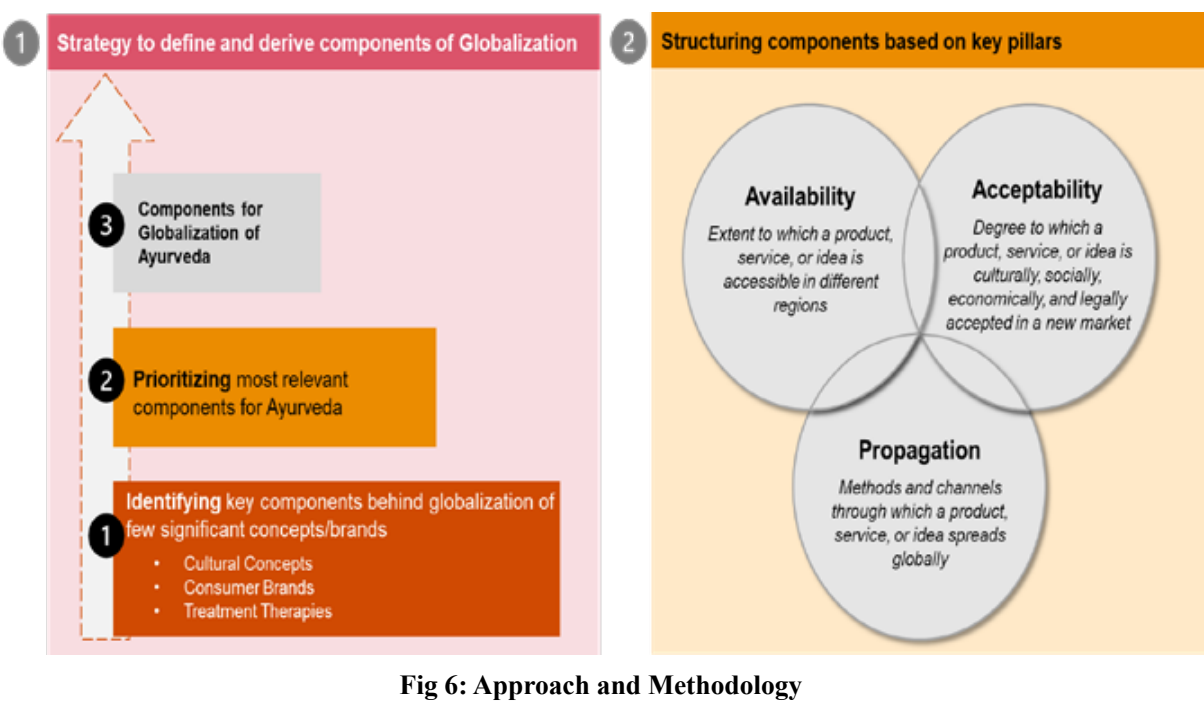
- Its assessment is based on three pillars:
Availability – Workforce, manufacturing, exports, research and education.
Acceptability – Regulation, collaborations, insurance and cultural adaptability.
Propagation – Branding, visibility, Medical Value Travel and global engagement.
• Current Status of Ayurveda’s Globalisation
- Ayurveda is formally recognised in nearly 30 countries through licensing models, academic collaborations and national health policies.
- India has over 3.55 lakh trained Ayurveda practitioners, with nearly 95% based within the country.
- Ayurveda exports doubled from USD 1.09 billion (2014) to USD 2.16 billion (2023), reaching around 150 countries.
- Ayurveda research spans nearly 70 countries, supported by international collaborations and the WHO Global Traditional Medicine Centre (GTMC), Jamnagar.
Key Challenges
• Despite significant progress, Ayurveda’s global expansion remains uneven.
• Availability: International practice is largely limited to wellness and complementary therapy settings due to the lack of globally accepted practitioner licensure, internationally recognised micro-credential programmes, harmonised educational standards and multi-country clinical research.
- Despite rising exports, finished Ayurvedic pharmaceutical products face regulatory barriers, particularly in the United States and European Union.
• Acceptability: India needs greater alignment with international regulations by upgrading Ayush GMP to WHO-GMP, strengthening Quality Assurance, expanding insurance coverage and integrating Ayurveda into national healthcare systems.
• Propagation: Fragmented branding, limited consumer awareness, inconsistent communication, quality concerns, and underdeveloped Medical Value Travel (MVT) and international visibility hinder Ayurveda’s global image.
Strategic Roadmap (2025–2047)
• Short-term phase (2025–2029): Focuses on creating the foundational ecosystem by establishing a centralised export database, Global Professional Registry, international branding campaigns, flagship overseas Ayurveda centres, WHO-GMP certification for manufacturers and standardised clinical protocols.
• Medium-term phase (till 2035): Aims to deepen market integration through Traditional Herbal Medicinal Products Directive (THMPD) registrations, insurance pilot programmes, professional mobility initiatives and stronger regulatory harmonisation.
• Long-term vision (till 2047): Seeks formal recognition of Ayurveda in at least 20 national health systems, supported by sustainable evidence-generation mechanisms, robust quality assurance and integration into Universal Health Coverage (UHC).
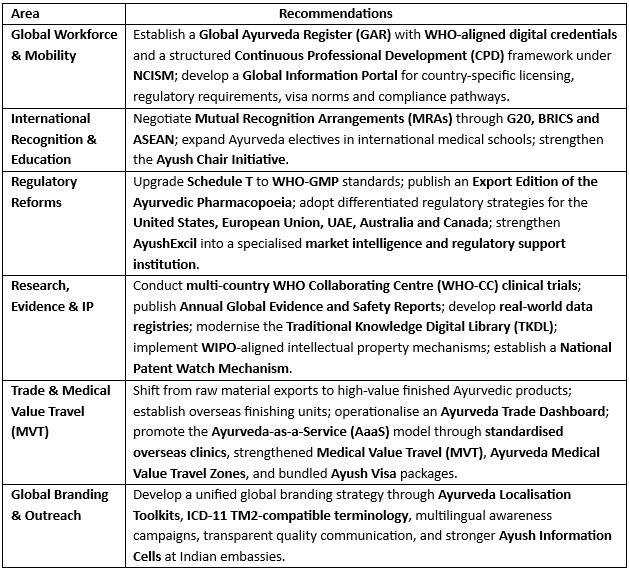
Major Recommendations