SYLLABUS
GS-2: Bilateral, Regional and Global Groupings and Agreements involving India and/or affecting India’s interests.
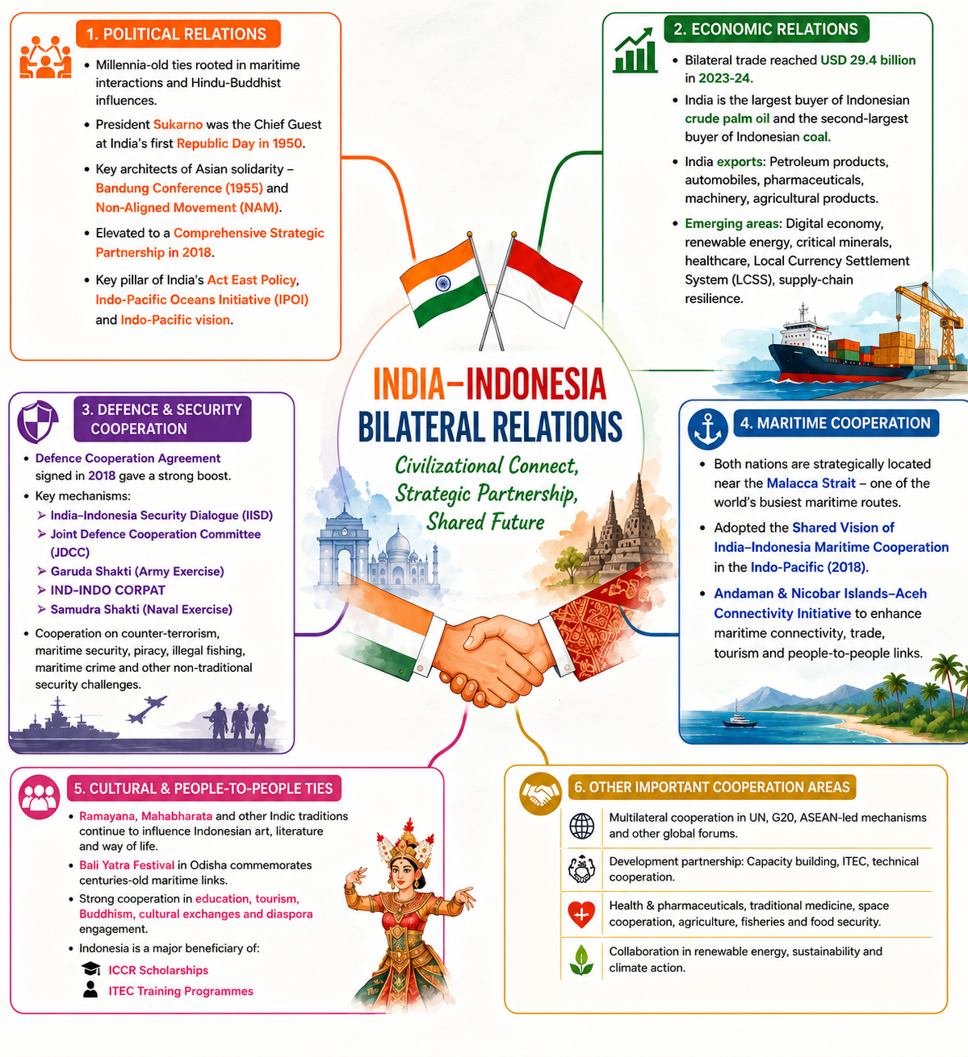
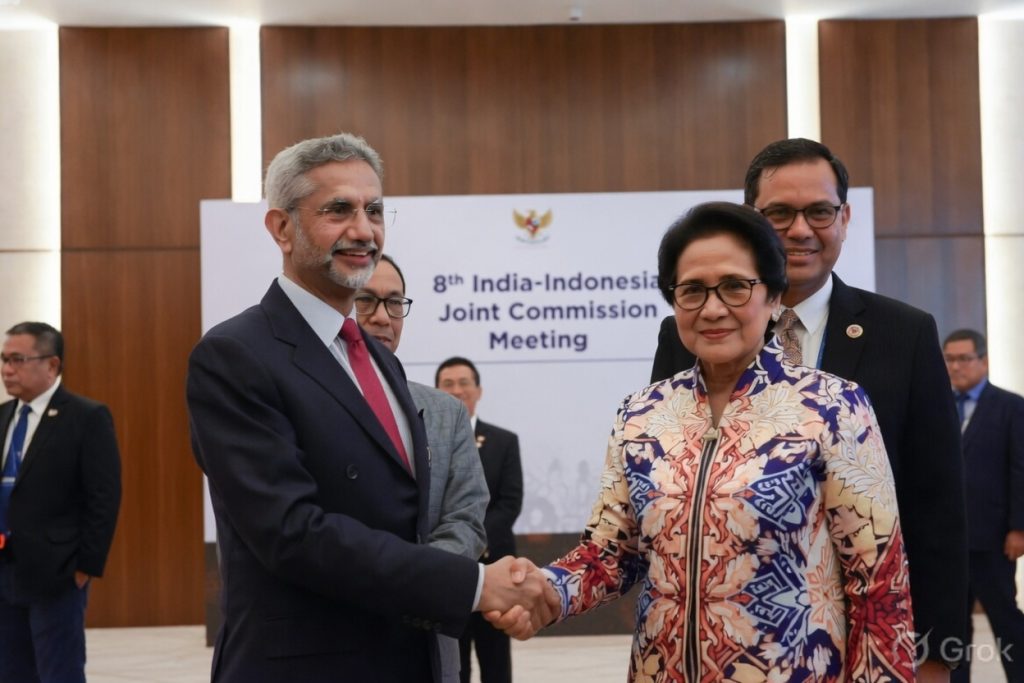
Context: Recently, India’s External Affairs Minister and his Indonesian counterpart co-chaired the 8th India–Indonesia Joint Commission Meeting (JCM) in New Delhi, which reviewed the entire spectrum of bilateral relations and identified new areas of cooperation under the India–Indonesia Comprehensive Strategic Partnership.
More on the News
- The ministers reviewed progress across political, defence, maritime, economic, digital, health, energy and people-to-people cooperation, while also discussing regional and global developments.
- Both sides exchanged views on developments in the Indo-Pacific, Myanmar, and other regional issues, reaffirming support for ASEAN centrality and a rules-based international order.
Key Outcomes of the 8th Joint Commission Meeting
- Political and Strategic Cooperation
- Both sides agreed to intensify high-level political engagement and strengthen cooperation in regional and multilateral forums, including ASEAN-led mechanisms, the United Nations and the G20.
- They reaffirmed support for a free, open, inclusive and rules-based Indo-Pacific and emphasized the importance of ASEAN centrality in the evolving regional architecture.
- Economic and Emerging Technology Cooperation
- The ministers agreed to expand cooperation in trade, investment, manufacturing, digital economy, fintech, Digital Public Infrastructure (DPI), Artificial Intelligence (AI) and other emerging technologies.
- Both sides also identified opportunities for collaboration in critical minerals, supply-chain resilience and sustainable economic development.
- Defence and Maritime Cooperation
- India and Indonesia agreed to further strengthen defence exchanges, military training, defence industry cooperation and maritime security engagement.
- The meeting reviewed progress under the Shared Vision of India–Indonesia Maritime Cooperation in the Indo-Pacific (2018) and emphasized cooperation in maritime domain awareness, blue economy initiatives and regional maritime stability.
- Sectoral and Development Cooperation
- Both countries agreed to enhance collaboration in healthcare, pharmaceuticals, traditional medicine, renewable energy, agriculture, fisheries, food security and space cooperation.
- India reiterated its commitment to capacity building through training programmes and initiatives under the Indian Technical and Economic Cooperation (ITEC) framework.
Significance of Indonesia for India
- Pillar of India’s Act East Policy: As Southeast Asia’s largest economy and a leading ASEAN member, Indonesia is critical to India’s engagement with Southeast Asia and the wider Indo-Pacific region.
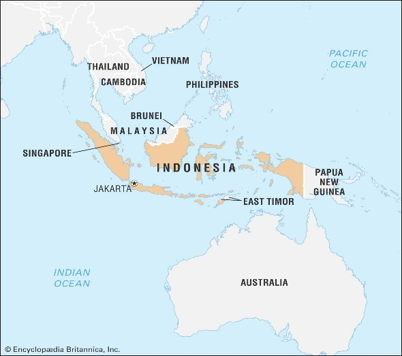
- Strategic Maritime Partner: Indonesia’s location near the Malacca Strait makes it vital for India’s maritime security, trade connectivity, energy flows and Indo-Pacific strategy.
- Partner in the Indo-Pacific: Both countries support a free, open, inclusive and rules-based Indo-Pacific and share convergent positions on freedom of navigation, maritime security and regional stability.
- Voice of the Global South: As influential developing countries and members of the G20, India and Indonesia play an important role in advancing inclusive, development-oriented and representative global governance.
- Gateway to ASEAN: Stronger engagement with Indonesia enhances India’s strategic, economic and diplomatic outreach to ASEAN and strengthens its role in the evolving Asian regional architecture.
- Critical Minerals and Supply Chains: Indonesia’s vast reserves of nickel and other critical minerals make it an important partner for India’s clean-energy transition and resilient supply chains.