
SYLLABUS
GS-3: Indian Economy and issues relating to planning, mobilization of resources, growth, development and employment.
Context: India has the third-largest start-up ecosystem in the world, but with most start-ups concentrated in urban areas, the Start-up Village Entrepreneurship Programme (SVEP) was launched to promote rural entrepreneurship and sustainable non-farm livelihoods.
About the Start-up Village Entrepreneurship Programme (SVEP)
- Launched: 2016 (approved in May 2015 as a sub-scheme of DAY-NRLM; implementation began in 2016-17).
- Nodal Ministry: Ministry of Rural Development.
- Parent Scheme: Deendayal Antyodaya Yojana–National Rural Livelihoods Mission (DAY-NRLM).
- Objective: To help rural poor establish and sustain small non-farm enterprises, thereby reducing poverty, generating employment and promoting self-employment.
- Target Beneficiaries: Self-Help Groups (SHGs) and their family members, with preference to women, SCs, STs, OBCs, minorities, persons with disabilities, rural artisans and other vulnerable households.
- Vision: To promote village entrepreneurship by creating an enabling ecosystem of knowledge, advisory and financefor rural enterprises.
Key Features
- Provides financial assistance, business management training, soft skills development and business development services.
- Facilitates bank credit, Community Enterprise Fund (CEF) support and convergence with schemes such as Pradhan Mantri Mudra Yojana.
- Promotes community-based decision-making, where community institutions identify entrepreneurs, assess enterprise viability and monitor business performance.
- Encourages both new enterprises and support for existing enterprises in manufacturing, services and trading sectors.
- Integrates digital tools for business planning, loan appraisal, enterprise tracking and programme monitoring through a centralized Management Information System (MIS).
Implementation Mechanism
- Implemented through State Rural Livelihoods Missions (SRLMs).
- Block Resource Centres–Enterprise Promotion (BRC-EPs) act as the nodal institutions at the block level.
- Community Resource Persons–Enterprise Promotion (CRP-EPs) provide mentoring, business planning, credit facilitation and market linkage support.
- SHGs, Village Organisations (VOs), Cluster Level Federations (CLFs) and other community institutions identify entrepreneurs, manage Community Enterprise Fund loans and monitor enterprise growth.
- Each block receives financial support of ₹6.50 crore, with an average investment of ₹27,083 per enterprise.
- At least 90% of CRP-EPs are selected from SHG households, while women constitute a minimum of 60% of the cadre.
- Each trained CRP-EP mentors up to 50 enterprises.
- The programme mandates that at least 60% of beneficiaries are women while ensuring representation of SC, ST, minority communities and persons with disabilities.
Key Achievements of SVEP
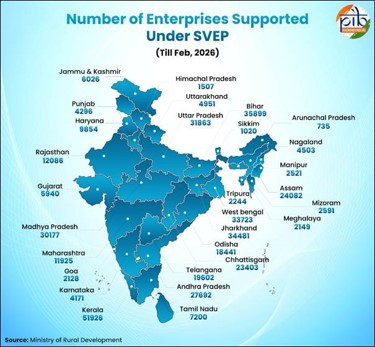
- Expansion of Rural Enterprises: SVEP has supported over 4.32 lakh rural enterprises (as on 30 June 2026) and builds upon the 10.29 crore rural households mobilised into Self Help Groups (SHGs) under DAY-NRLM.
- Inclusive Growth: Around 86%of entrepreneurs belong to SC, ST, OBC and Minority communities, while around 75% of enterprises are owned or managed by women.
- Strengthening Rural Entrepreneurship: SVEP promotes first-generation entrepreneurs, supports manufacturing, services and trading enterprises, and encourages non-farm livelihoods to diversify rural incomes.
- Community Institution-Based Model: The programme strengthens the community entrepreneurship ecosystem through SHGs, CRP-EPs, and BRC-EPs, which provide enterprise identification, funding, mentoring and continuous handholding support.
- Positive Outcomes (QCI Mid-term Evaluation): The Quality Council of India (QCI) found that 99% of SVEP enterprises were profitable, contributed 57% of household income, earned an average monthly revenue of ₹39,000 (with manufacturing enterprises earning ₹47,800), while 96% of entrepreneurs reported increased savings.
Issues in the Start-up Village Entrepreneurship Programme
- Urban-Centric Start-up Ecosystem: Despite India being the world’s third-largest start-up ecosystem, most start-ups remain concentrated in urban areas, limiting entrepreneurship opportunities in rural India.
- Employment Gap: Around 12 million people enter the workforce annually, while less than 1 million obtain meaningful formal employment, highlighting the need for rural entrepreneurship.
- Limited Entrepreneurship Ecosystem: Rural areas continue to face a limited innovation ecosystem, weak entrepreneurship support, inadequate incubation and advisory services, and limited-service delivery mechanisms.
- Gap in Capital and Support: A consistent gap in capital and institutional support for rural enterprises necessitates continued finance, mentoring, and enterprise support.
- Need for Stronger Entrepreneurship Ecosystem: Strengthening the knowledge, advisory, and finance ecosystems, along with better access to credit and market linkages, remains essential for the long-term sustainability and growth of rural enterprises.