
SYLLABUS
GS-2: Devolution of powers and finances up to local levels and challenges therein.
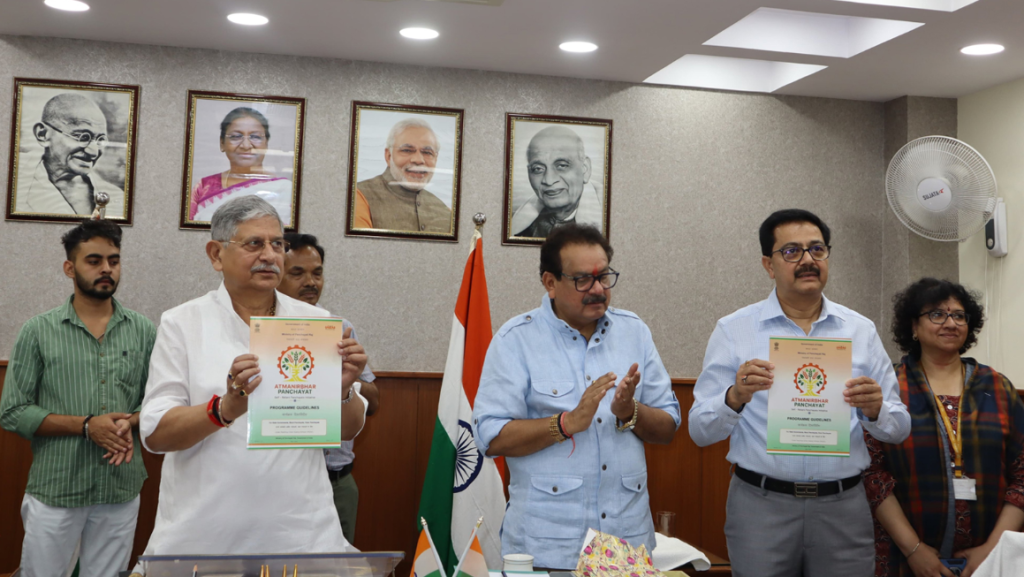
Context: The Union Ministry of Panchayati Raj has launched the Atmanirbhar Panchayat Programme, SAMARTH Panchayat Portal, and released the Model Own Source of Revenue (OSR) Rules to strengthen the financial autonomy and digital governance of Panchayati Raj Institutions (PRIs).
More on the News
• They are aligned with the recommendations of the Sixteenth Finance Commission, which emphasised strengthening the Own Source Revenue (OSR) of Panchayati Raj Institutions and Urban Local Bodies for greater financial sustainability.
• The Ministry of Panchayati Raj also received the Gold Award under the National Awards for e-Governance (NAeG) 2026 for the Panchayat Advancement Index (PAI) – Data Driven Governance for Viksit Bharat, while four Panchayati Raj initiatives won three Gold Awards and one Silver Award at the 29th National Conference on e-Governance.
About the Atmanirbhar Panchayat Programme
• It is an initiative of the Ministry of Panchayati Raj, implemented under the Rashtriya Gram Swaraj Abhiyan (RGSA), to transform Panchayats from grant-dependent institutions into financially self-reliant local governments.
• It enables Gram Panchayats and Block Panchayats to identify local assets and opportunities and convert them into bankable, revenue-generating projects, with dedicated technical support from the Ministry.
• Financing is facilitated through Public-Private Partnerships (PPP), Corporate Social Responsibility (CSR) contributions, convergence with government schemes, and bank finance, with NABARD and HUDCO serving as institutional partners.
• Panchayats submit project ideas through the eGramSwaraj Portal, with mandatory participation of the Gram Sabha.
• Proposals are screened by States, shortlisted through a national challenge process, supported technically by the Ministry, and monitored through digital systems.
• 350 projects will be developed over four years—50 projects in the first year and 100 projects annually during the next three years.
• Eligibility: Gram Panchayats with a minimum Own Source Revenue (OSR) of ₹50 lakh and Block Panchayats with at least ₹1 crore OSR, each having a minimum remaining tenure of three years. Relaxed eligibility norms are applicable for special category States.
• Outreach workshops have already been conducted for Panchayat representatives across 10 States.
About the SAMARTH Panchayat Portal
• SAMARTH is a unified, configurable national digital platform developed by the Ministry of Panchayati Raj to strengthen the financial capacity of Gram Panchayats through technology-enabled management of Own Source Revenue (OSR).
• It enables Gram Panchayats to digitally manage the complete OSR lifecycle, including taxpayer registration, demand generation, online payments, revenue collection, and real-time monitoring.
• The portal facilitates the collection of property tax, professional tax, sanitation tax, market tax, entertainment tax, user charges, fees, and other non-tax revenues through an integrated online payment system.
• Key features include a unified configurable platform, digital revenue planning and management, online demand notices, multiple payment options, mobile-friendly interface, dashboards and analytics, transparent record-keeping, and citizen-centric services.
• Current Progress:
- Chhattisgarh and Himachal Pradesh have been onboarded.
- More than 51 lakh taxpayers have been registered.
- Demand notices worth ₹95 crore have been generated.
- More than ₹27 crore has been collected.
- Onboarding is underway in Maharashtra, Mizoram, Assam, Haryana, West Bengal, and Uttar Pradesh.
About the Model OSR Rules for Panchayati Raj Institutions
• They have been prepared by the Ministry of Panchayati Raj as a guiding framework for States and Union Territories to strengthen the financial independence of Panchayati Raj Institutions.
• Based on the recommendations of the Sixteenth Finance Commission, the Rules seek to establish a transparent, uniform, and efficient system for the assessment, collection, and management of Panchayat revenues.
• They cover property tax, user charges, fees, and other non-tax revenues.
• The Rules are advisory in nature and may be adopted or adapted by States and Union Territories according to their existing legal framework and local requirements.
• They aim to improve revenue mobilisation, strengthen local governance, and enhance service delivery through financially self-reliant Panchayats.
Significance
• Promotes financial self-reliance by strengthening the Own Source Revenue (OSR) of Panchayats and reducing dependence on Central and State Government grants.
• Encourages community-led local economic development by converting local assets and opportunities into sustainable revenue-generating projects.
• Strengthens digital governance through technology-enabled revenue management, online payments, and real-time monitoring.
• Enhances transparency, accountability, and citizen-centric governance through digital records, analytics, and simplified taxpayer services.
• Improves the capacity of Panchayats to deliver better public services and supports the vision of Viksit Bharat @2047 through financially empowered and technologically enabled local governments.