
SYLLABUS
GS-2: India and its neighborhood- relations.
Context: India has rejected Nepal’s objection to conducting the Kailash Mansarovar Yatra via the Lipulekh Pass, calling Nepal’s territorial claims “untenable” while reiterating openness to dialogue.
Background of the Dispute
• The dispute traces back to the Treaty of Sugauli, which defined the boundary along the Kali River.
• The core issue is the uncertain origin of the Kali River, with:
- Early British maps (1819–1856), placing their origin at Limpiyadhura (supporting Nepal’s claim).
- Later maps (1879 onward) identify a different stream (Kuti Yangti) as the Kali (supporting India’s position).
• The dispute intensified after:
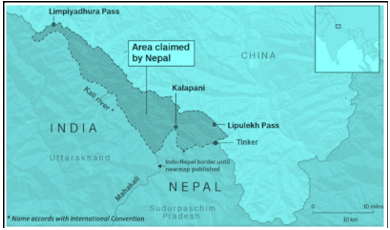
- India’s 2019 political map showing Kalapani within its territory.
- Nepal’s 2020 revised map and constitutional amendment claiming Kalapani–Lipulekh–Limpiyadhura.
• Tensions also arose over road construction, trade routes, and pilgrimage access through Lipulekh.
India’s Position
• Lipulekh has been a traditional route for the Kailash Mansarovar Yatra since 1954, used continuously for decades.
• India maintains that:
- Nepal’s claims are “neither justified nor based on historical facts and evidence.”
- Any “unilateral artificial enlargement of territorial claims” is untenable.
• India views the issue as not new, emphasizing continuity of administrative control and usage.
• It has expressed willingness for constructive engagement through dialogue and diplomacy to resolve boundary issues.
Nepal’s Position
• Nepal asserts that Limpiyadhura, Lipulekh, and Kalapani lie east of the Kali River and are therefore integral parts of Nepal under the 1816 treaty.
• It has objected to India–China activities (trade, road building, pilgrimage) in the region without Nepal’s consent.
- Raised the issue diplomatically with both India and China.
• Nepal argues that the dispute should be addressed through:
- Historical treaties, maps, and evidence
- Possibly even trilateral discussions (India–Nepal–China), as suggested by some officials.
Key Issues Involved
• Territorial Sovereignty: Competing interpretations of historical treaties and cartographic evidence.
• Ineffective Joint Mechanisms: Joint mechanisms like the 1981 Border Inspection and 1997 Border Management Committees were set up by India and Nepal but key boundary issues remain unresolved.
• Religious and Cultural Access: The Kailash Mansarovar Yatra is a major pilgrimage for Indians.
• India–China Factor: Trade and connectivity via Lipulekh add a third-party dimension.
• Open Border Dynamics: Despite a traditionally open border (post-1950 treaty), unresolved boundaries persist.
Way Forward
• Revive Bilateral Mechanisms: Expedite boundary talks through existing India–Nepal diplomatic channels.
• Clarify River Origin Scientifically: Joint technical surveys to determine the true source of the Kali River.
• Confidence-Building Measures: Maintain status quo in disputed areas while negotiations continue.
• Separate Pilgrimage from Politics: Ensure the Yatra proceeds smoothly without escalating tensions.
• Strengthen Diplomatic Engagement: Regular high-level dialogue to prevent politicisation of the issue.
• Avoid Unilateral Actions: Both sides should refrain from steps that alter ground realities.
Sources:
Newsonair
The Hindu
Indian Express