
SYLLABUS
GS-3: Indian Economy and issues relating to Planning, Mobilization of Resources; Government Budgeting.
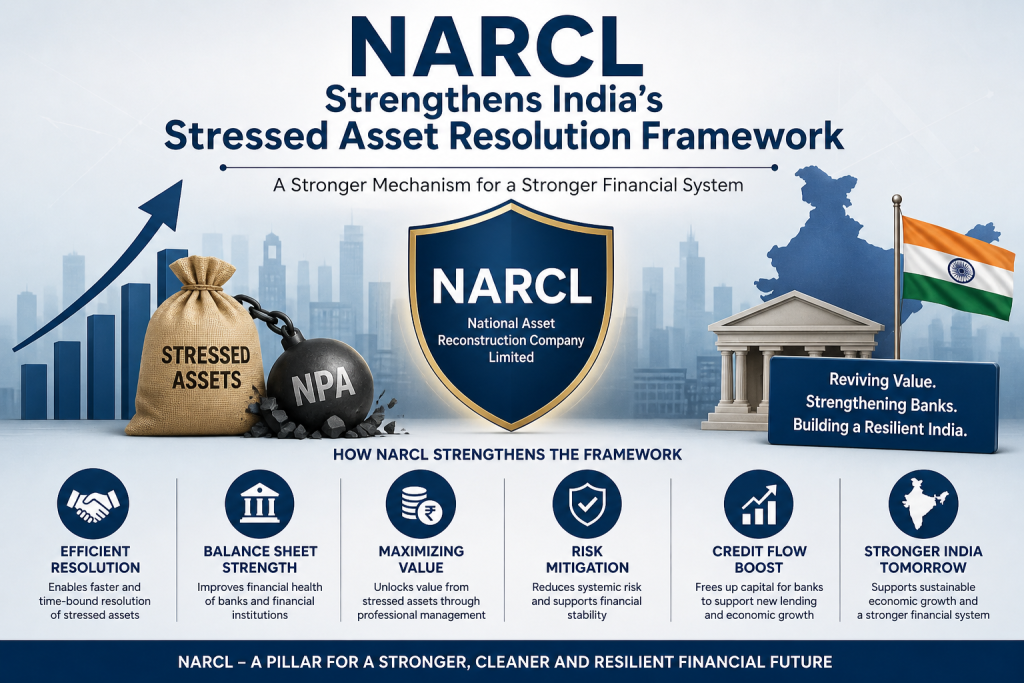
Context: Recent updates on recovery of stressed banking assets indicate that National Asset Reconstruction Company Limited (NARCL) has emerged as a key pillar in the nation’s stressed asset resolution framework, reflecting growing institutional maturity.
Recent Performance and Achievements
• As of March 2026, NARCL has acquired 33 borrower entities with an aggregate debt exposure of ₹1,65,862 crore, moving toward its ₹2 lakh crore target.
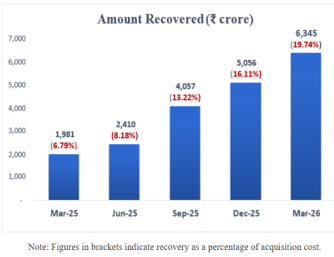
• In FY 2025–26 alone, it recovered ₹4,364 crore, accounting for nearly 70% of total cumulative recoveries.
• Total recoveries have reached around ₹6,345 crore, representing over 48% of the acquisition cost.
• Notably, some accounts have delivered recovery rates exceeding 100%, indicating effective value maximisation.
About NARCL and its Functioning
• National Asset Reconstruction Company Limited is a government-backed Asset Reconstruction Company established to aggregate and resolve large-value NPAs (₹500 crore and above).
• It operates in conjunction with the India Debt Resolution Company Ltd. (IDRCL), which manages the resolution process, including restructuring and asset monetisation.
• Working Mechanism:
- NARCL acquires stressed assets from banks by aggregating multiple lenders’ exposures, thereby overcoming coordination problems.
- Payment is structured as:
15% upfront cash, and
85% Security Receipts (SRs), backed by a sovereign guarantee.
- Resolution is undertaken through IBC processes, restructuring, or market-based sale, with the aim of maximising recovery value.
Role in India’s Stressed Asset Resolution Ecosystem
• Balance Sheet Clean-up: NARCL facilitates the transfer of legacy NPAs from banks, which improves asset quality, strengthens capital adequacy, and enables banks to redirect their focus toward fresh and productive lending.
• Aggregation and Coordination: By consolidating exposures from multiple lenders into a single entity, NARCL reduces inter-creditor conflicts and coordination failures that previously delayed resolution processes.
• Complementing the IBC Framework: NARCL functions as an institutional mechanism that complements the Insolvency and Bankruptcy Code by improving execution efficiency and accelerating the resolution of complex stressed assets.
• Development of Distressed Asset Market: The institution contributes to the development of a secondary market for stressed assets by enhancing price discovery and encouraging participation from domestic and global investors.
Significance for the Economy
• Strengthening Financial Stability: The resolution of large NPAs through NARCL reduces systemic vulnerabilities in the banking sector and enhances overall financial stability.
• Boost to Credit Growth: By cleaning up bank balance sheets, NARCL enables banks to expand lending to key sectors such as infrastructure, manufacturing, and MSMEs, thereby supporting economic growth.
• Efficient Capital Allocation: The recovery and recycling of capital locked in stressed assets promote more efficient allocation of financial resources across the economy.
Challenges in the Framework
• Valuation and Pricing Issues: Differences in valuation expectations between banks and NARCL can delay asset transfers and complicate negotiations, thereby affecting the pace of resolution.
• Dependence on External Processes: The effectiveness of NARCL remains contingent on the efficiency of external mechanisms such as IBC proceedings, judicial timelines, and investor participation, which can be uncertain.
• Limited Depth of Distressed Asset Market: The relatively underdeveloped secondary market for stressed assets in India restricts liquidity and limits the speed of asset monetisation.
• Operational Complexity: The resolution of large and heterogeneous assets, particularly in sectors like infrastructure, requires specialised expertise and often involves prolonged timelines.
Way Forward
• Strengthening Institutional Coordination: Enhanced coordination among NARCL, IDRCL, banks, and insolvency professionals can streamline processes and improve resolution outcomes.
• Improving Price Discovery Mechanisms: The adoption of transparent and market-driven valuation frameworks can reduce disputes and facilitate quicker asset transfers.
• Deepening Distressed Asset Markets: Encouraging greater participation from global investors, alternative investment funds, and asset reconstruction companies can improve liquidity and recovery rates.
• Enhancing Legal and Procedural Efficiency: Streamlining insolvency procedures and reducing judicial delays will be critical to improving the overall effectiveness of the stressed asset resolution framework.