
SYLLABUS
GS-2: Government Policies and Interventions for Development in various sectors and Issues arising out of their Design and Implementation; Issues and challenges pertaining to the federal structure.
GS-3: Conservation, environmental pollution and degradation, environmental impact assessment; Disaster and disaster management.
Context: The Government of India has extended the River Basin Management (RBM) Scheme for the 2026–31 period with an enhanced outlay of about ₹2183 crore, reflecting a renewed focus on integrated water governance.
About the River Basin Management Scheme
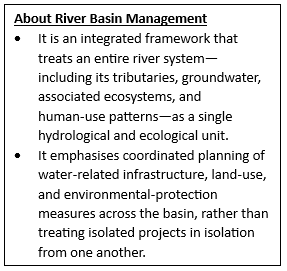
- RBM is a central sector scheme of the Department of Water Resources, River Development, and Ganga Rejuvenation under the Ministry of Jal Shakti.
- The scheme aims to facilitate integrated planning, investigation, and development of water resources at the river basin level, including both surface water and groundwater systems.
- It is implemented through three key organisations—
- Brahmaputra Board
- Central Water Commission (CWC), and
- National Water Development Agency (NWDA)
- It supports activities such as the preparation of basin master plans, the survey and investigation of projects, and the planning of multipurpose projects.
Objectives of the Scheme
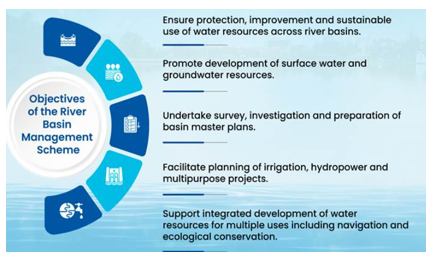
- The Scheme is designed to address the diverse challenges associated with water resource planning and development at the basin level.
- The objective of the scheme is to focus on promoting sustainable use of water while supporting irrigation, hydropower, and flood management.
Key Features and Components
- Basin-Level Planning Approach: The scheme promotes planning based on natural river basins, enabling holistic management of water resources across regions.
- Scientific and Technological Integration: Advanced tools such as GIS, remote sensing, LiDAR, and drone-based surveys are used for accurate mapping and planning.
- Multipurpose Development Focus: It supports projects related to irrigation, hydropower, flood control, and water storage, ensuring multi-sectoral benefits.
- Institutional Coordination: The scheme ensures coordination among central agencies, state governments, and basin-level institutions for effective implementation.
Geographical and Strategic Focus
- Focus on Critical River Basins: The scheme prioritises major river basins such as Brahmaputra, Barak, Teesta, and Indus, which are crucial for water availability and regional stability.
- Emphasis on North-East and Himalayan Regions: Special attention is given to the North-Eastern and Himalayan regions, which are rich in water resources but face challenges like floods, erosion, and underdevelopment.
- Strategic and Transboundary Importance: These river systems have transboundary implications, making basin-level management essential for national security and international water cooperation.
Significance of the Scheme
- Enhancing Water Security: The scheme plays a critical role in ensuring long-term water security by promoting the efficient, equitable, and sustainable utilisation of water resources across different sectors.
- Supporting Economic Development: By facilitating irrigation, hydropower generation, and multipurpose water projects, the scheme contributes significantly to agricultural productivity, energy generation, and overall economic development.
- Disaster Risk Reduction: Basin-level planning enables a more scientific approach to flood control, erosion management, and waterlogging mitigation, thereby reducing disaster risks in vulnerable regions.
- Environmental Sustainability: The scheme promotes the conservation of river ecosystems by integrating environmental considerations into water resource planning, thereby maintaining ecological balance.
Challenges and Constraints
- Inter-State Coordination Issues: Since river basins often extend across multiple states, differences in priorities and interests frequently lead to coordination challenges and disputes, affecting effective implementation.
- Data and Capacity Gaps: The lack of reliable, real-time hydrological data and limited technical capacity in certain regions hinder accurate planning and timely decision-making.
- Institutional Fragmentation: The presence of multiple agencies with overlapping mandates often results in fragmented governance, leading to inefficiencies and delays in project execution.
- Climate Change Uncertainty: Increasing climate variability, including erratic rainfall patterns and extreme weather events, adds a layer of uncertainty to water resource planning and management.
Way Forward
- Strengthening Institutional Mechanisms: There is a need to establish and empower basin-level authorities with clear legal mandates and administrative autonomy to ensure coordinated and effective governance.
- Improving Data and Technology Use: The integration of advanced technologies such as real-time monitoring systems, GIS, and remote sensing can significantly enhance the accuracy and efficiency of water resource management.
- Promoting Cooperative Federalism: Strengthening collaboration between the Centre and states through institutional mechanisms and dialogue is essential for resolving disputes and ensuring coordinated basin-level planning.
- Policy Convergence: There is a need to permanently integrate river basin–based planning into state-level water resource strategies and ensure convergence with major national programmes such as Jal Jeevan Mission, AMRUT, and Namami Gange Programme.
- Encouraging Community Participation: Active involvement of local communities, stakeholders, and grassroots institutions can improve implementation outcomes and ensure that water management practices remain inclusive and sustainable.