
SYLLABUS
GS-3:Indigenization of Technology and Developing New Technology; Awareness in the fields of IT, Space, and Computers.
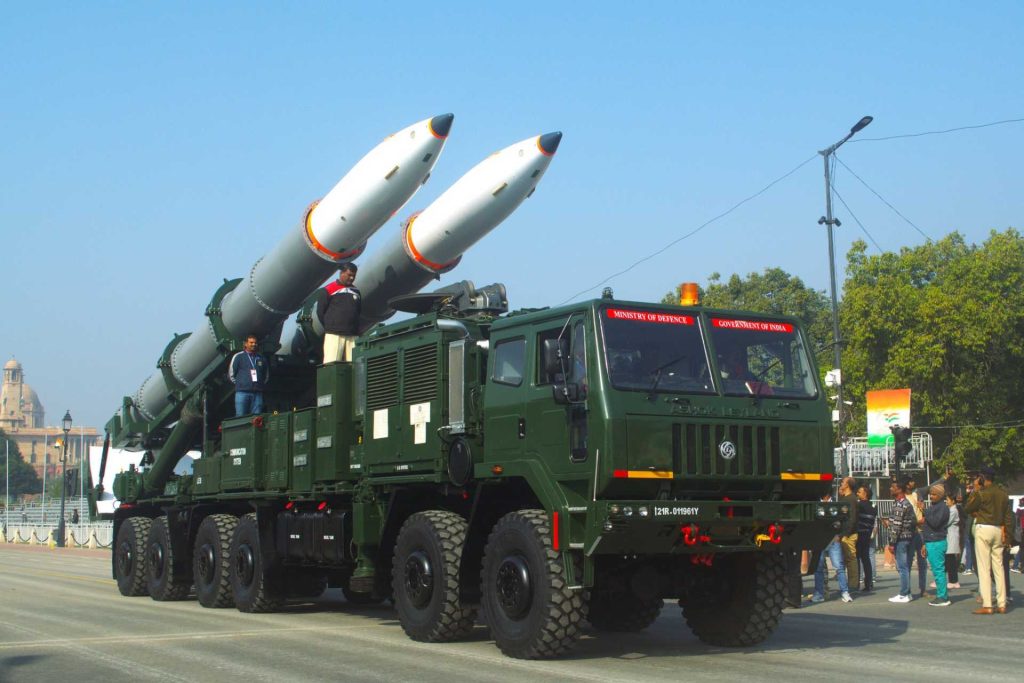
Context: Recently, the Defence Research and Development Organisation (DRDO) successfully carried out a salvo launch of two Pralay missiles in rapid succession by the same launcher from Chandipur, Odisha.
More on the News
- The flight tests of salvo launch, conducted during user evaluation trials, showed both missiles accurately followed their planned trajectories and successfully achieved all mission objectives.
- Salvo is the simultaneous or rapid-succession firing of multiple weapons such as missiles, rockets, or artillery at a single target or area.
- Performance was verified by Integrated Test Range (ITR), Chandipur tracking sensors, with terminal events confirmed via onboard telemetry from ships near the impact points.
About Pralay Missile
- It was designed specifically to fill the tactical gap between the Pinaka multi-barrel rocket system (40–80 km range) and the long-range, nuclear-capable Agni series.
- The Pralay project was sanctioned by the Indian government in March 2015 with a budget of approximately ₹332.88 crore.
- The missile underwent its first successful flight test on December 22, 2021, followed by a second test the next day to validate heavier payloads and varied ranges.
- Pralay missile is an amalgamation of technologies developed for exo-atmospheric interceptor missile Prithvi Defence Vehicle (PDV) from the Indian Ballistic Missile Programme and the ‘Prahar’ tactical missile developed indigenously.
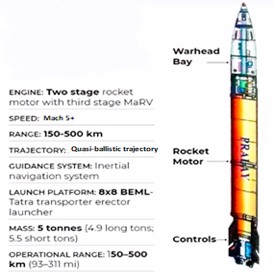
Key Features
- Pralay is a solid-propellant, short–range, quasi-ballistic, surface-to-surface missile equipped with advanced guidance and navigation systems to ensure high accuracy.
- Ballistic missiles are a category of missiles that utilise projectile motion to deliver warheads. During their arched trajectories, the ballistic missiles are powered during their initial travel but later take a gravity-driven path.
- The quasi-ballistic missiles are a class of missiles that have a low trajectory and take the ballistic trajectory, but can change course and make manoeuvres during the flight if required.
- The missile is capable of carrying multiple types of warheads and engaging a variety of targets, enhancing the operational flexibility of the armed forces.
- The missile has been developed by Research Centre Imarat, Hyderabad, in collaboration with other DRDO laboratories.
Source :
DD News
PIB
Indian Express
CSIS