

SYLLABUS
GS-3: Science and Technology—Developments and their Applications and Effects in Everyday Life; Awareness in the fields of IT, Computers, and Biotech; Basics of Cyber Security.
Context: The United Nations’ Independent International Scientific Panel on Artificial Intelligence (AI) released its first scientific report on AI, providing a global scientific assessment of AI’s capabilities, opportunities, risks, and governance challenges.
More on the News
- The report was prepared by the 40-member Independent International Scientific Panel on AI, co-chaired by Yoshua Bengio and Maria Ressa, to provide an independent scientific assessment of AI.
- It served as the scientific foundation for the inaugural Global Dialogue on AI Governance held in Geneva on 6–7 July 2026.
- The report covers seven thematic dimensions of AI and marks the first in a series of periodic UN assessments, with a comprehensive report expected in 2027.
Key Findings of the UN Scientific Report on AI
- Rapid Advancement in AI Capabilities: AI capabilities in reasoning, coding, content generation, and scientific research are improving at an unprecedented pace.
- AI as a General-Purpose Technology: AI is emerging as a transformative technology with applications across health, education, agriculture, governance, and scientific research.
- Concentration of AI Development: Frontier AI development remains concentrated in a few countries and firms; the US accounts for about 75% of leading AI compute capacity, while China accounts for 15%.
- Only 32 countries host advanced AI data centres, with 150 countries hosting none.
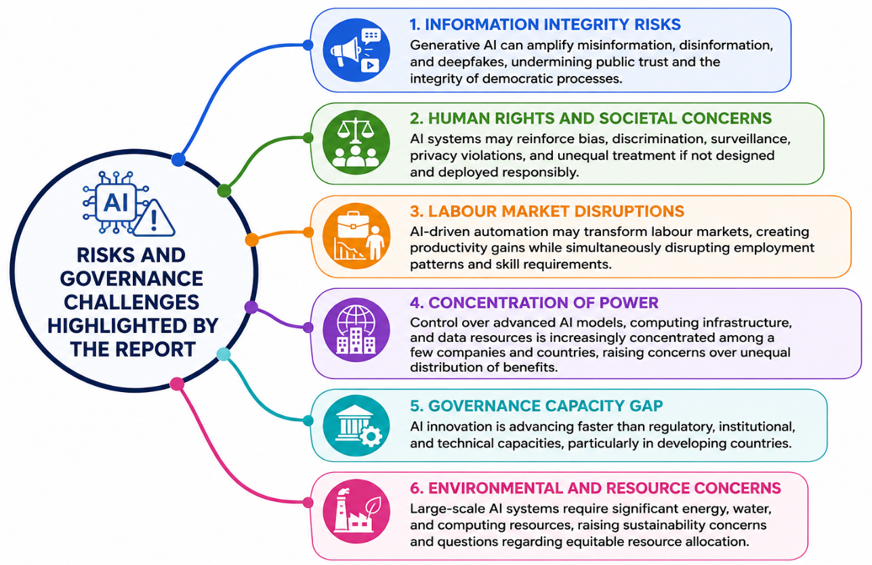
- AI Is Creating a New Development Divide: Countries lacking compute infrastructure, talent, data, and governance capacity risk being left behind in the AI economy.
- Emergence of Agentic AI Systems: AI systems are increasingly capable of autonomous planning and task execution, creating new governance challenges.
- AI Can Accelerate Sustainable Development: Responsible deployment of AI can support the achievement of SDGs in sectors such as health, education, food systems, and climate action.
Relevance of Report Findings for India
- Building AI Compute and Innovation Capacity: The report’s emphasis on compute infrastructure and research ecosystems underscores the importance of initiatives such as the IndiaAI Mission, indigenous AI models, and domestic GPU capacity.
- Bridging the AI Capacity Gap: India must strengthen access to high-performance computing, quality datasets, AI talent, and governance capabilities to ensure broad-based participation in the AI economy.
- Leveraging AI for Development: The report’s findings align with India’s efforts to deploy AI in healthcare, agriculture, education, language technologies, and Digital Public Infrastructure (DPI).
- Voice of the Global South: India’s experience with digital public goods and inclusive technology governance positions it to advocate for equitable, development-oriented, and inclusive global AI governance frameworks.
Way Forward
- Bridge the Global AI Capacity Gap: Expand access to compute infrastructure, datasets, technical expertise, and governance capacity, particularly in developing countries.
- Develop Better AI Evaluation Mechanisms: Build independent testing, auditing, benchmarking, and post-deployment monitoring systems for frontier AI models.
- Prepare for Agentic AI Systems: Strengthen oversight mechanisms for increasingly autonomous AI systems capable of independent planning and action.
- Promote Shared Global Evidence Standards: Develop common scientific frameworks and measurement standards to support informed AI governance.
- Deepen International Cooperation: Strengthen multilateral collaboration through UN-led processes to ensure that AI benefits are distributed more equitably across countries.