SYLLABUS
GS-3: Indian Economy and issues relating to planning, mobilization of resources, growth, development and employment.
Context: The Ministry of Tourism, in collaboration with NITI Aayog, launched the report ‘Unlocking Growth in Tourism and Hospitality Sector’ at a National Workshop in New Delhi.
More on the News
- The report presents a comprehensive roadmap for simplifying regulations, improving the ease of doing business, attracting investments, and promoting sustainable growth in India’s tourism and hospitality sector in line with the vision of Viksit Bharat 2047.
- The report is based on a detailed assessment of regulations governing accommodation providers, hospitality establishments, homestays, food and beverage services, tour operators, and tourism infrastructure projects.
Key Statistics Related to the Tourism and Hospitality Sector
- Global Tourism Scenario
- In 2024, Travel & tourism contributed ~10% of global GDP, supporting 1 in every 10 jobs worldwide.
- International visitor spending: USD 1.87 trillion (~12% YoY growth); domestic visitor spending: USD 5.3 trillion (record high).
- By 2035, the sector is projected to contribute USD 16.5 trillion, growing at 3.5% annually, faster than the 2.5% projected growth of the global economy.
- India’s Tourism Sector
- In FY 2023–24, tourism contributed ₹15.73 lakh crore (~USD 170 billion) to GDP (5.22% of GDP) and supported 84.6 million jobs (~20% increase over the last five years).
- Domestic tourism remains the key growth driver, with 2.9 billion domestic tourist visits (2024), exceeding the 2019 pre-pandemic peak of 2.3 billion.
- India has 44 UNESCO World Heritage Sites, 106 National Parks, 18 Biosphere Reserves, along with strong pilgrimage and wellness tourism.
- International tourism: 20.6 million international tourist arrivals (including NRIs) and ~USD 35 billion in tourism receipts in 2024, registering ~9% growth over 2023.
- Gap Between Potential & Performance
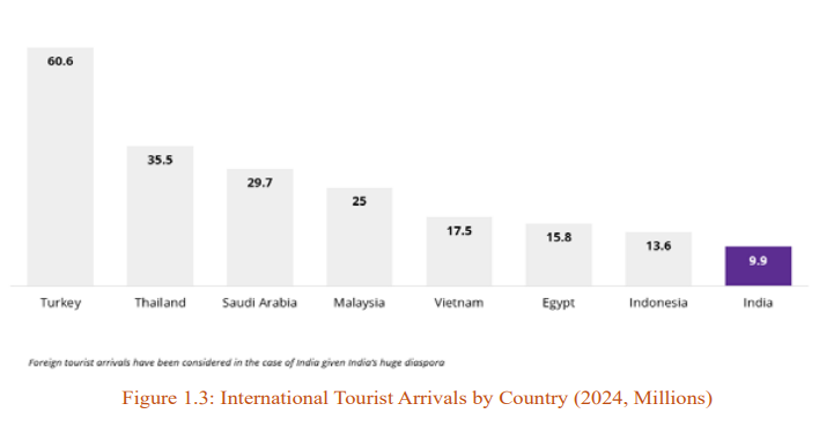
- India accounts for <1.5% of global international tourist arrivals; Foreign Tourist Arrivals (FTAs) stood at 9.95 million (2024), still below pre-pandemic levels and behind Thailand, Malaysia, and Vietnam.
- Despite earning ~USD 35 billion in international tourism receipts (2024), India trails Turkey (USD 56.3 billion), Thailand (USD 42.7 billion), and Saudi Arabia (USD 42 billion) despite its vast tourism assets.
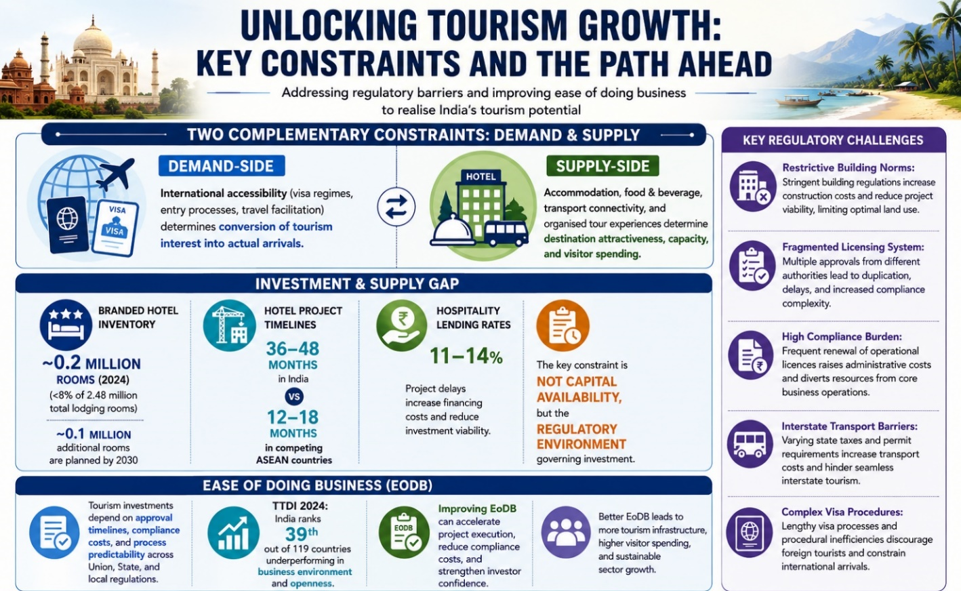
Key Challenges and Regulatory Bottlenecks
- Restrictive Building Norms: Stringent building regulations increase construction costs and reduce project viability, limiting optimal land use.
- Fragmented Licensing System: Multiple approvals from different authorities lead to duplication, delays, and increased compliance complexity.
- High Compliance Burden: Frequent renewal of operational licences raises administrative costs and diverts resources from business operations.
- Interstate Transport Barriers: Varying state taxes and permit requirements increase transport costs and hinder seamless interstate tourism.
- Complex Visa Procedures: Lengthy visa processes and procedural inefficiencies discourage foreign tourists and constrain international arrivals.
- Outbound tourism has grown rapidly, with outbound spending by Indian travellers ~15% above pre-pandemic levels, indicating leakage of domestic demand.
- In the Travel & Tourism Development Index (TTDI) 2024, India ranks 6th in Natural Resources and 9th in Cultural Resources, but lags in business environment, tourist services infrastructure, and international openness.
Key Recommendations of the Report
- Streamline Licensing: Adopt a single-window approval system by consolidating hotel licenses and eliminating duplicate permits.
- Liberalize Building Regulations: Relax Floor Area Ratio (FAR) and ground coverage norms to reduce costs and accelerate tourism projects.
- Promote Homestays: Increase the room limit and remove unnecessary NOCs to encourage rural tourism.
- Reform Tourist Transport: Extend All India Tourist Permit (AITP) validity and rationalize state taxes to improve seamless interstate travel.
- Strengthen Visa Regime: Expand Visa-on-Arrival (VoA) and simplify the e-Visa process to boost international tourist arrivals.
- Promoting sustainable, inclusive, and globally competitive tourism destinations across the country.
- Encouraging greater private investment in the tourism and hospitality sector.