
SYLLABUS
GS-3: Infrastructure: Ports.
Context: The Government has proposed a ₹10,000 crore Container Manufacturing Assistance Scheme (CMAS) to strengthen domestic production of shipping containers, reduce import dependence and enhance the resilience of India’s trade and logistics network.
About the Container Manufacturing Assistance Scheme (CMAS)
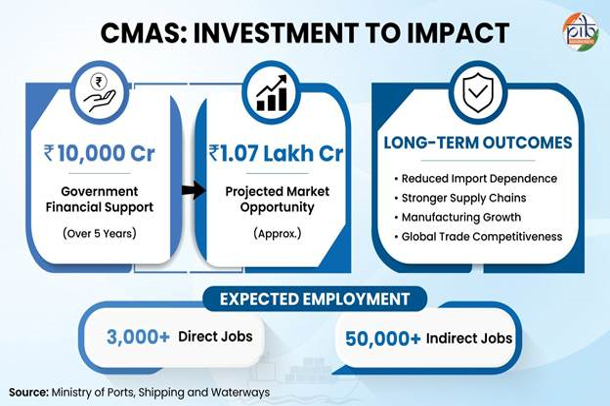
- The Container Manufacturing Assistance Scheme (CMAS) was announced in the Union Budget 2026–27 with an outlay of ₹10,000 crore over five years.
- Objective: The scheme aims to establish a globally competitive domestic container manufacturing ecosystem through financial and institutional support for setting up new manufacturing facilities and expanding existing units.
- It seeks to expand India’s annual domestic container manufacturing capacity to around 7.5 lakh Twenty-foot Equivalent Units (TEUs).
- Key Features of the Scheme
- Greenfield Support: The scheme will provide capital assistance for establishing new Greenfield manufacturing facilities.
- Brownfield Expansion: It will support the expansion of existing Brownfield manufacturing units.
- Operational Assistance: It will provide operational support to improve the competitiveness of domestic container manufacturers.
- Testing, Skilling and Capacity Building: The scheme will support testing infrastructure, skilling initiatives and capacity building.
- Employment Generation: The scheme is expected to generate around 3,000 direct jobs and more than 50,000 indirect jobs.
- Ancillary Industries: It is expected to support industries involved in corner castings, wooden frames and Corten steel.
Regulatory & Digital Maritime Reforms
- The Merchant Shipping Act, 2025, Coastal Shipping Act, 2025 and Indian Ports Act, 2025 aim to update the regulatory framework for shipping, coastal trade and port governance.
- One Nation One Port Process, Maritime Single Window and e-Samudra aim to simplify procedures, reduce documentation and improve operational efficiency.
- CMAS complements PM Gati Shakti, National Logistics Policy, Sagarmala Programme and Maritime Amrit Kaal Vision 2047.
- The Government has also announced a ₹70,000 crore Shipbuilding Financial Assistance Package to strengthen domestic shipbuilding and attract investment in maritime manufacturing.
Significance and Need of the Scheme
- Strategic Importance: Around 80% of global merchandise trade by volume is transported by sea, while containerised cargo accounts for nearly two-thirds of international trade value, highlighting the importance of container logistics.
- Import Dependence & Production Gap: India imports nearly 2 million empty containers annually, while domestic production was only around 24,000 TEUs in FY2024, compared with China’s several-million-TEU output, highlighting the need to expand domestic capacity.
- Growing Trade & Supply-Chain Resilience: India’s expanding manufacturing and EXIM trade is increasing container demand, while disruptions such as COVID-19, Suez Canal blockage, Ukraine war, Houthi attacks in the Red Sea and Strait of Hormuz tensions have exposed vulnerabilities in global shipping.
- Freight & Maritime Resilience: Domestic container availability can reduce vulnerabilities from container shortages and freight-rate volatility, while CMAS and the proposed Bharat Container Shipping Line can strengthen India’s control over critical components of its EXIM logistics chain.
- Manufacturing & Employment: The scheme can support allied industries such as Corten steel, corner castings and wooden frames and generate around 3,000 direct and more than 50,000 indirect jobs.
- Global Competitiveness: Manufacturing containers according to ISO standards and CSC requirements can help India become a reliable producer for global shipping networks and strengthen domestic maritime manufacturing.