
SYLLABUS
GS-1: Population and associated issues, poverty and developmental issues, urbanization, their problems and their remedies.
GS-2: Government Policies and Interventions for Development in various sectors and Issues arising out of their Design and Implementation.
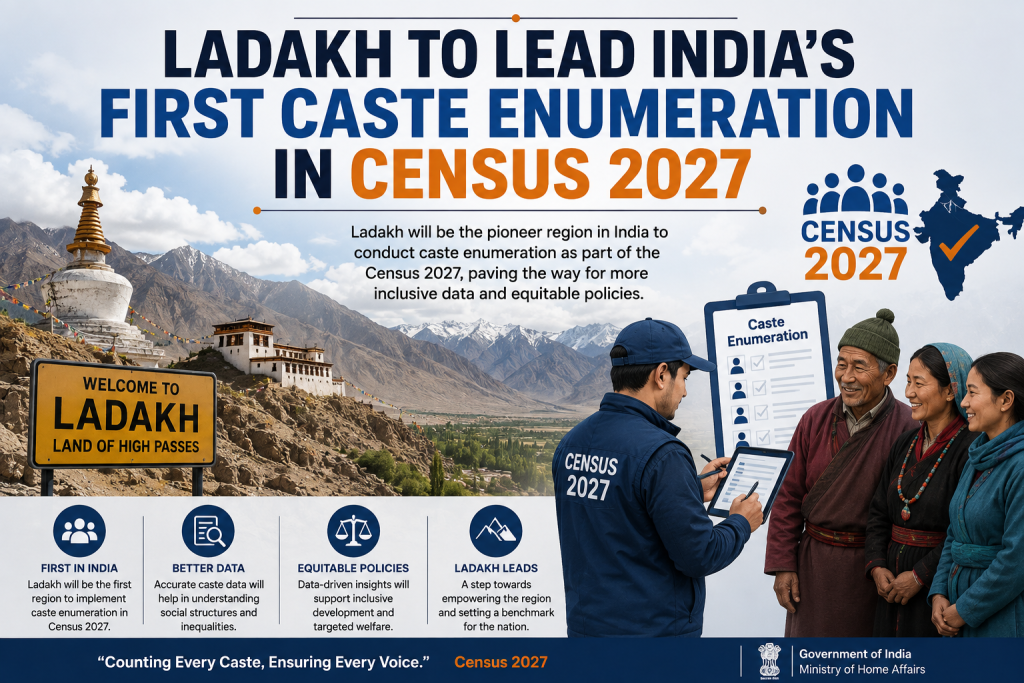
Context: Ladakh, one of India’s two youngest Union Territories, will become the first place in independent India to enumerate caste as part of a regular Census when the Population Enumeration phase of Census 2027 begins there in August 2026.
More on the News
• Ladakh will begin Population Enumeration ahead of the rest of India because it is a snow-bound region where enumeration during the usual February 2027 window would be difficult due to winter and inaccessible terrain.
• The self-enumeration window will open from August 17–31, 2026, followed by house-to-house Population Enumeration from September 1–30, 2026, with a revisional round from October 1–5, 2026.
• The exercise will also cover snow-bound areas of Jammu and Kashmir, Himachal Pradesh and Uttarakhand, while the rest of the country will conduct Population Enumeration in February 2027.
• Ladakh will also use paper schedules in addition to digital enumeration because defence establishments along the borders with China and Pakistan cannot be geo-tagged due to security concerns.
• Ladakh was not among the 16 States and Union Territories where the Population Enumeration questionnaire was pre-tested from July 1–20, 2026.
About the Census of India 2027
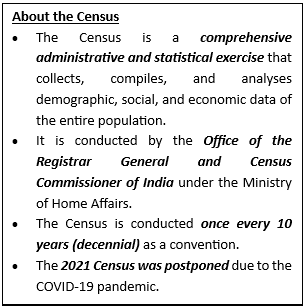
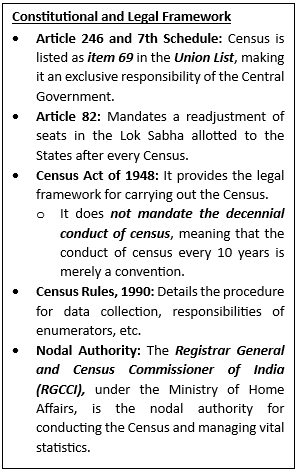
• Census 2027 will be the 16th Census of India and the 8th after Independence, conducted under the Census Act, 1948 and Census Rules, 1990.
• Census 2027 will be conducted in two phases:
- Houselisting and Housing Census (April–September 2026): Involves listing all buildings and structures with geo-tagging and unique IDs, while collecting detailed data through a 33-question schedule on housing conditions, amenities, assets and household characteristics.
- Population Enumeration (February 2027): Collects data on demographic, socio-cultural and economic parameters, including migration and fertility.
• March 1, 2027 is the reference date for most of the country, while October 1, 2026 is the reference date for snow-bound regions.
• Census 2027 is India’s first digital Census, using mobile applications for real-time data collection, a Census Management & Monitoring System (CMMS), the Houselisting Block Creator Web Map Application, self-enumeration and data-security features.
• Census-as-a-Service (CaaS) will facilitate clean, machine-readable and actionable data delivery to Ministries, along with dashboards and visualisation tools down to the village and ward level.
• The likely methodology is an open-ended caste column, under which respondents will state their caste and enumerators will record it as declared.
Historical Overview of Census in India
Pre-Independence:
• The first census exercises were conducted in Allahabad in 1824 and Banaras in 1827–28 by James Prinsep, while the first complete census of an Indian city was conducted in Dacca in 1830 by Henry Walter.
• The first nationwide census was undertaken in 1872 under Lord Mayo.
• The first modern synchronous census covering British India, except Kashmir, was conducted in 1881 under W.C. Plowden, establishing the decennial Census tradition.
• The 1931 Census was the last published comprehensive caste census before Independence and recorded 4,147 castes.
• The 1941 Census also collected caste details, but its processing and publication were disrupted by the Second World War.
Post-Independence:
• The 1951 Census was the first Census conducted under the Census Act, 1948. After Independence, caste enumeration for the general population was discontinued, while Scheduled Castes and Scheduled Tribes continued to be enumerated.
• The National Population Register (NPR) was launched in 2010 and updated in 2015.
• The SECC 2011 was conducted separately from the regular Census and was outside the purview of the Census Act, 1948. It collected caste information through an open-ended response, generating over 46 lakh caste names.
• In 2015, the government constituted an expert group headed by Arvind Panagariya, then Vice-Chairman of NITI Aayog, to examine and classify the caste data; however, the caste component was never released.
• Census 2027 marks a major departure by incorporating caste enumeration into the regular statutory Census.