
SYLLABUS
GS-3: Science and Technology- developments and their applications and effects in everyday life.
Context: The 2026 Nobel Prize in Physiology or Medicine has been jointly awarded to Karl Deisseroth, Peter Hegemann and Georg Nagel for their discoveries concerning light-gated ion channels and optogenetics.
Key Discoveries of the Nobel Laureates 2026
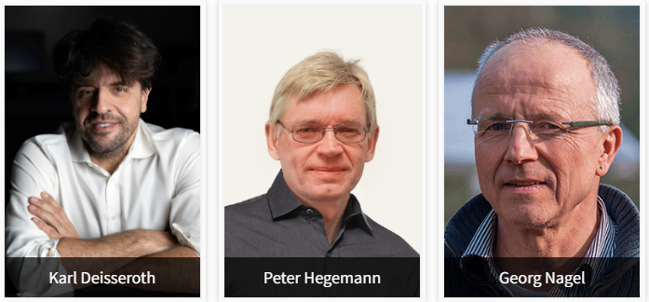
- Peter Hegemann and Georg Nagel — Discovery of light-gated ion channels: Peter Hegemann studied how the single-celled green alga Chlamydomonas senses light and moves towards it.
- Hegemann and Georg Nagel identified channelrhodopsins, light-sensitive proteins located in the cell membrane.
- They identified channelrhodopsin-1 and channelrhodopsin-2.
- When exposed to blue light, channelrhodopsin opens and allows positively charged ions to enter the cell, generating an electrical signal.
- They demonstrated that introducing the gene encoding channelrhodopsin into other cells could make those cells light-sensitive.
- Channelrhodopsin-2 was particularly important because it responds to light extremely rapidly, making it suitable for controlling electrical activity in cells.
- Karl Deisseroth — Development of optogenetics: Deisseroth recognised that channelrhodopsin could be used as a precise switch for nerve cells.
- He introduced the gene encoding channelrhodopsin into rat neurons.
- When blue light was applied, the neurons generated nerve signals.
- This breakthrough was published in 2005.
- In 2007, his team demonstrated that the light-controlled system could be used in the brains of living mice, with light delivered through a thin optical fibre.
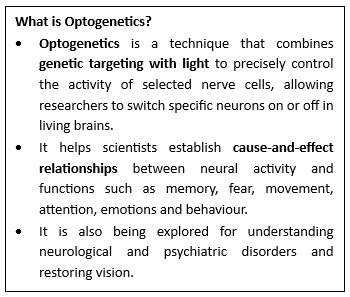
- This established the foundation of optogenetics — a technique that combines genetic targeting with light to control selected nerve cells.
About the Nobel Prize
- The Nobel Prizes were established through the will of Alfred Nobel, the Swedish inventor, scientist and entrepreneur.
- In his 1895 will, Nobel directed that his fortune should be used to reward those who had conferred the “greatest benefit to humankind.”
- The first Nobel Prizes were awarded in 1901.
- Nobel originally specified five prize categories: Physics, Chemistry, Physiology or Medicine, Literature and Peace.
- The Sveriges Riksbank Prize in Economic Sciences in Memory of Alfred Nobel was established in 1968 and is administered within the Nobel Prize system, although it was not one of the prizes specified in Nobel’s original will.
- The Nobel Prize in Physiology or Medicine is selected by the Nobel Assembly at Karolinska Institutet, Sweden.
- The Assembly has 50 members, while the Nobel Committee evaluates nominations and prepares recommendations before the Assembly makes the final decision.
- In 2026, the prize was shared equally by Karl Deisseroth, Peter Hegemann and Georg Nagel, with a total prize amount of 12 million Swedish kronor.