

SYLLABUS
GS-3: Conservation, environmental pollution and degradation; Infrastructure: Energy, Ports.
Context: India is building its first green methanol production plant at Kandla port, converting the invasive weed Prosopis juliflora into clean marine fuel, marking a significant step in the country’s energy transition and maritime decarbonisation journey.
About the Green Methanol Plant
• The plant is located at Deendayal Port Authority and is being built by Thermax Limited using gasification technology from Ankur Scientific Energy Technologies, owned by the port authority.
• It will produce five tonnes of methanol per day as a demonstration project.
• Production Process:
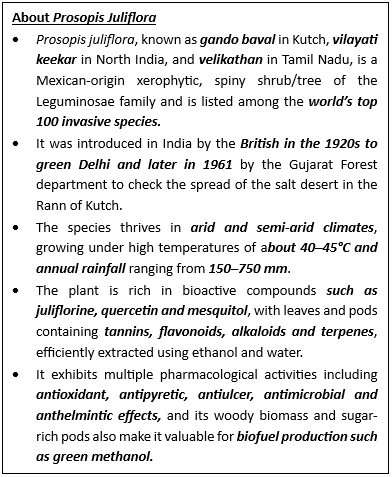
- Step 1 — Gasification (Ankur Scientific): Prosopis juliflora is heated in the absence of oxygen and broken down into syngas — a mixture of hydrogen, carbon monoxide, and CO₂, and once started, the reaction sustains its own heat, requiring only about 10–15 litres of oil for a 30-minute startup.
- Step 2 — Methanol Synthesis (Thermax Energy): The syngas is converted into methanol, ready for use as marine fuel.
The plant is also certified to run on other agricultural residues such as bagasse and cotton stalk.
• Methanol is used in shipping as a cleaner alternative to heavy “bunker oil.” While conventional methanol is derived from fossil fuels such as gas or coal, green methanol uses biomass.
- e-methanol, the next step, is produced using green hydrogen and captured CO₂, powered entirely by renewable electricity.
Significance of the Plant
• Environmental Benefits: According to Methanol Institute, green methanol can cut a vessel’s CO₂ emissions by up to 95%, reduce NOx by up to 80%, and eliminate sulphur oxides and particulate matter. This makes it a highly effective alternative to conventional marine bunker fuel.
• National Energy Security: Ankur Scientific estimates that agricultural residues like bagasse and cotton stalk, at their maximum potential, could displace up to one-third of India’s oil imports.
- This is critical given India’s dependence on imported crude oil, which stands at 85–90% of its total requirement.
• Policy Alignment: The plant aligns with several national frameworks:
- India’s Harit Sagar – Green Port Guidelines.
- The National Green Hydrogen Mission.
- India’s commitment to net-zero carbon emissions by 2070.
- The IMO’s 2023 Greenhouse Gas Strategy targets net-zero shipping emissions by 2050.
- Nearly 90% of India’s trade by volume moves through ports, making decarbonisation of shipping a central economic and climate priority, not a peripheral one
• Ecological Restoration The plant provides the first compelling economic reason to clear Prosopis juliflora, which has devastated Kutch’s Banni grasslands for decades — turning an ecological liability into a national energy asset.
Challenges
• Cost Gap: Green methanol (~$700–800/tonne) and e-methanol (~$2,000/tonne) remain significantly more expensive than conventional methanol (₹30/kg pre-Ukraine war and ₹70–80/kg post-war), making adoption largely penalty-driven under EU regulations rather than price-driven.
• Scale Limitation: The current 5 TPD demonstration plant is far below the 100–500 TPD scale required for commercial viability, although the APL 150 TPD plant begins to address this gap.
• Energy Source Issue: The plant currently relies on conventional grid electricity for operations, and meeting global carbon-intensity norms will require a transition to fully renewable power.
• Water–Energy–Food Nexus: India’s fragmented policy system, including subsidised electricity leading to excessive groundwater extraction (over 1 metre annual decline in some regions) and ₹1.5 lakh crore annual subsidies, creates structural barriers to a sustainable energy transition.
Way Forward
• Adopt Renewable Energy: Grid electricity must be replaced with renewable sources such as solar and wind to meet international carbon-intensity standards.
• Diversify Feedstock: Agricultural residues like bagasse and cotton stalk should be treated as national energy assets to scale production and reduce oil import dependence.
• Strengthen Policy Support: Existing measures such as the flat 30% subsidy for green-fuel vessels (August 2023), green port guidelines, and the hydrogen mission must be deepened and consistently implemented.
• Integrated Policy Reform: Water, energy, and agriculture policies must be governed through a unified nexus-based framework with pricing reforms and smart metering to ensure long-term resilience.