
SYLLABUS
GS-2: Government Policies and Interventions for Development in various sectors and Issues arising out of their Design and Implementation.
GS-3: Science and Technology- Developments and their Applications and Effects in Everyday Life.
Context: Recently, the Telecom Regulatory Authority of India (TRAI) released a consultation paper on developing the regulatory framework for Vehicle-to-Everything (V2X) communication.
More on the News
• The consultation paper seeks stakeholder inputs on key issues such as spectrum allocation, licensing models, interoperability standards, and security frameworks required for V2X deployment.
• It identifies the 5.9 GHz spectrum band—globally earmarked for V2X—as a potential candidate for India’s implementation strategy.
• It reflects the growing importance of 5G-enabled communication systems in enhancing road safety and enabling future autonomous mobility.
Key Features of the Proposed Regulatory Framework
• Spectrum Management and Technology Choice: The framework examines optimal utilisation of the 5.9 GHz band and evaluates technology options such as Cellular V2X (C-V2X) technology for reliable and low-latency communication.
• Infrastructure and Ecosystem Development: It emphasises the deployment of on-board units (OBUs) in vehicles and roadside units (RSUs) to facilitate seamless communication and real-time alerts.
• Interoperability and Standardisation: The need for common standards and interoperability across devices, networks, and regions is highlighted to ensure the seamless functioning of V2X systems.
• Security, Privacy, and Liability: The framework addresses concerns related to cybersecurity, data privacy, and legal liability, which are critical for safe and trustworthy deployment.
About V2X Communication
• Vehicle-to-Everything (V2X) communication refers to the exchange of real-time information between vehicles and their surrounding environment, enabling intelligent decision-making.
• It enables vehicles to detect hazards “beyond line of sight” through wireless alerts and data exchange (e.g., speed, location, traffic signals, and collision warnings), thereby significantly improving road safety.
• It includes multiple communication modes such as:
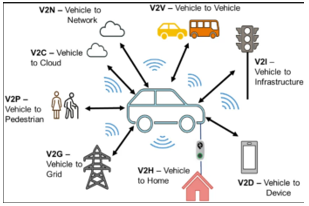
- Vehicle-to-Vehicle (V2V)
- Vehicle-to-Infrastructure (V2I)
- Vehicle-to-Pedestrian (V2P)
- Vehicle-to-Network (V2N)
• While early V2X systems relied on Dedicated Short-Range Communications (DSRC), there is a growing shift toward Cellular V2X (C-V2X) due to its ability to leverage 4G/5G networks, offer wider coverage, and integrate more seamlessly with existing telecom infrastructure.
Significance of V2X Communication
• Enhancing Road Safety: V2X enables real-time alerts regarding collisions, road hazards, and traffic conditions, significantly reducing accidents.
• Improving Traffic Efficiency: It facilitates smart traffic management, congestion reduction, and route optimisation, improving urban mobility.
• Enabling Autonomous Vehicles: Reliable communication is essential for autonomous driving systems, making V2X a foundational technology for future mobility.
• Strengthening Digital Ecosystem: It boosts demand for 5G infrastructure and digital connectivity, contributing to India’s broader digital transformation.
Challenges of V2X Communication
• Spectrum Allocation and Policy Trade-offs: India must balance the allocation of the 5.9 GHz band for safety-critical V2X services with competing telecom demands, ensuring efficient spectrum use without compromising road safety objectives.
• Infrastructure Readiness and Ecosystem Gaps: V2X deployment requires simultaneous upgrades in vehicles, roadside infrastructure, and telecom networks, and the current lack of coordinated ecosystem readiness remains a major constraint.
• Cost, Standardisation, and Interoperability Issues: High deployment costs, absence of uniform standards, and coexistence challenges between DSRC and C-V2X technologies pose significant hurdles to large-scale implementation.
• Cybersecurity and Data Privacy Risks: V2X systems are exposed to cyber threats and risks of data misuse, necessitating robust security frameworks to ensure trust and safety.
• Regulatory and Liability Uncertainty: Unclear frameworks regarding liability in accidents, data ownership, and accountability continue to pose challenges for effective regulation.
Way Forward
• Comprehensive Regulatory and Spectrum Framework: India should establish clear policies on 5.9 GHz spectrum allocation, licensing, and deployment models, ensuring alignment with global best practices while prioritising safety-critical V2X use.
• Develop Standards and Ensure Interoperability: India must evolve India-specific standards for OBUs and RSUs, and enable seamless C-V2X/DSRC coexistence, in coordination with international frameworks such as 3GPP and ITS-WAVE.
• Infrastructure and Ecosystem Readiness: Accelerate rollout of 5G networks, roadside infrastructure, and connected vehicle systems through public–private partnerships to enable large-scale adoption.
• Cybersecurity and Data Governance Frameworks: Create a dedicated framework addressing cybersecurity, data ownership, user consent, and liability in accident scenarios to ensure trust and safe deployment.
SOURCES:
PIB
Economictimes