
SYLLABUS
GS-3:Conservation, environmental pollution and degradation.
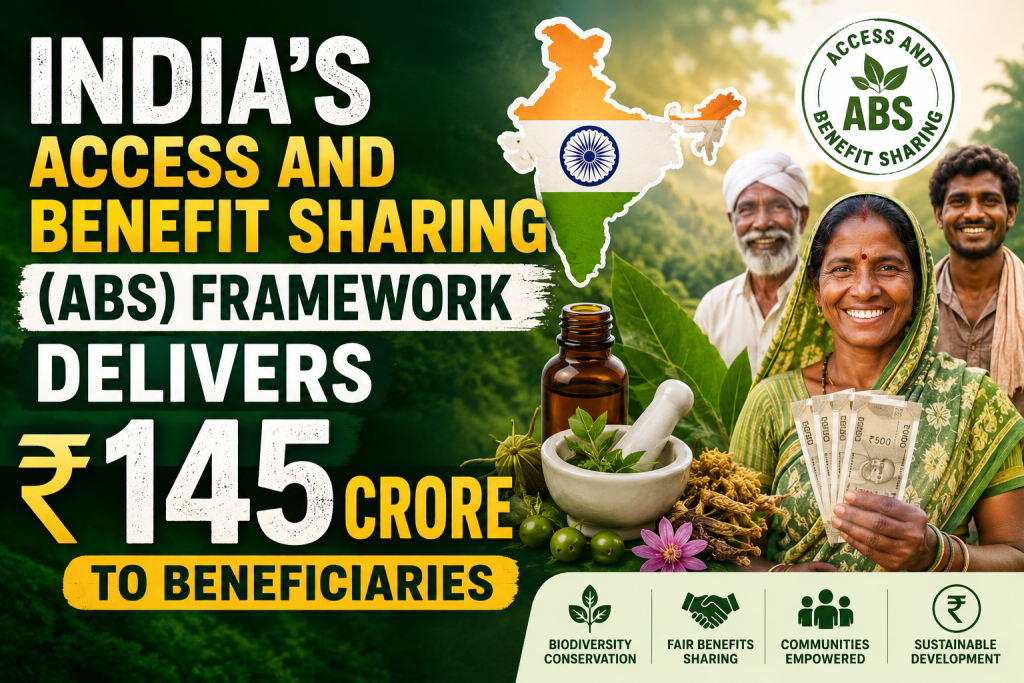
Context: India’s Access and Benefit Sharing (ABS) framework under the Biological Diversity Act, 2002, has mobilized over ₹266 crore and disbursed around ₹145 crore to local communities and biodiversity custodians, reinforcing equitable benefit sharing from the utilization of biological resources.
More on the News
- The National Biodiversity Authority (NBA) has realized more than ₹266 crore through the ABS mechanism since 2008, including ₹21.26 crore during FY 2025-26.
- Around ₹145 crore has been disbursed to beneficiaries, of which ₹78 crore was distributed during FY 2025-26.
- Benefits have reached over 10,500 Biodiversity Management Committees (BMCs) across 23 States and 4 Union Territories, more than 230 farmers, six State Forest Departments and various institutions.
- ABS funds have also supported six Red Sanders research projects.
- Sector-wise contribution to ABS realization:
- Red Sanders (Pterocarpus santalinus) – ₹120 crore (45%)
- Seed Sector – ₹84.61 crore (32.3%)
- Pharmaceuticals & AYUSH – ₹36.61 crore (13.8%)
- Together, these sectors account for nearly 91% of total ABS collections.
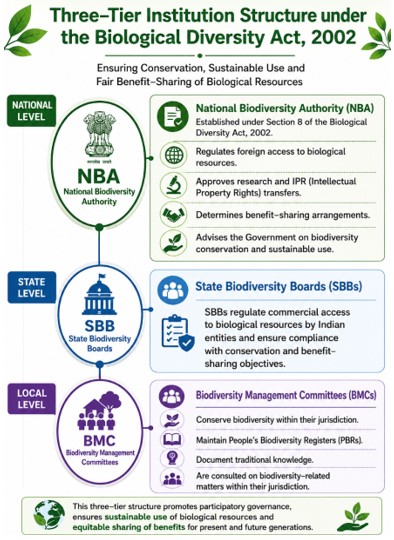
- Under the Biological Diversity Rules, 2024, 85–90% of the ABS amount is transferred by the NBA to State Biodiversity Boards for distribution to beneficiaries.
About Access and Benefit Sharing (ABS)
- Access and Benefit Sharing (ABS) is a mechanism that ensures fair and equitable sharing of benefits arising from the utilization of biological resources and associated traditional knowledge.
- It links biodiversity conservation with socio-economic benefits for local communities, farmers, traditional knowledge holders and biodiversity custodians.
- Benefits may be monetary (royalties, fees, compensation) or non-monetary (technology transfer, capacity building, joint research and intellectual property rights sharing).
- ABS promotes:
- Conservation of biodiversity
- Sustainable use of biological resources
- Livelihood enhancement of local communities
- Recognition of traditional knowledge systems
- The framework is based on Prior Informed Consent (PIC) and Mutually Agreed Terms (MAT) for accessing biological resources.
About the Biological Diversity Act, 2002
- The Biological Diversity Act, 2002, was enacted to implement India’s obligations under the Convention on Biological Diversity (1992).
- It regulates:
- Access to biological resources.
- Associated traditional knowledge.
- Transfer of research results.
- Intellectual Property Rights (IPRs) based on biological resources.
- Equitable sharing of benefits arising from their utilization.
- The Act seeks to achieve three key objectives:
- Conservation of biological diversity.
- Sustainable use of its components.
- Fair and equitable sharing of benefits arising from biological resources.
- It provides for the creation of the National Biodiversity Fund, State Biodiversity Funds and Local Biodiversity Funds.
Global and National Frameworks Supported by India’s ABS Mechanism
- Convention on Biological Diversity (1992).
- The Nagoya Protocol on Access and Benefit Sharing was adopted in 2010 and entered into force in 2014.
- National Biodiversity Strategy and Action Plan (NBSAP) 2024–2030.
- Kunming-Montreal Global Biodiversity Framework, particularly Target 13 on fair and equitable benefit sharing.
- Sustainable Development Goals (SDGs), especially:
- SDG 1 (No Poverty)
- SDG 8 (Decent Work and Economic Growth)
- SDG 12 (Responsible Consumption and Production)
- SDG 13 (Climate Action)
- SDG 15 (Life on Land)