
SYLLABUS
GS-3: Infrastructure: Energy.
Context: The Union Cabinet has approved the Pradhan Mantri Surya Sarovar Yojana (PM-SSY) with a total outlay of ₹5,070 crore to develop 5,000 MW of Floating Solar Photovoltaic (FSPV) Projects with co-located Energy Storage Systems (ESS).
About the Floating Solar Photovoltaic (FSPV) Plant
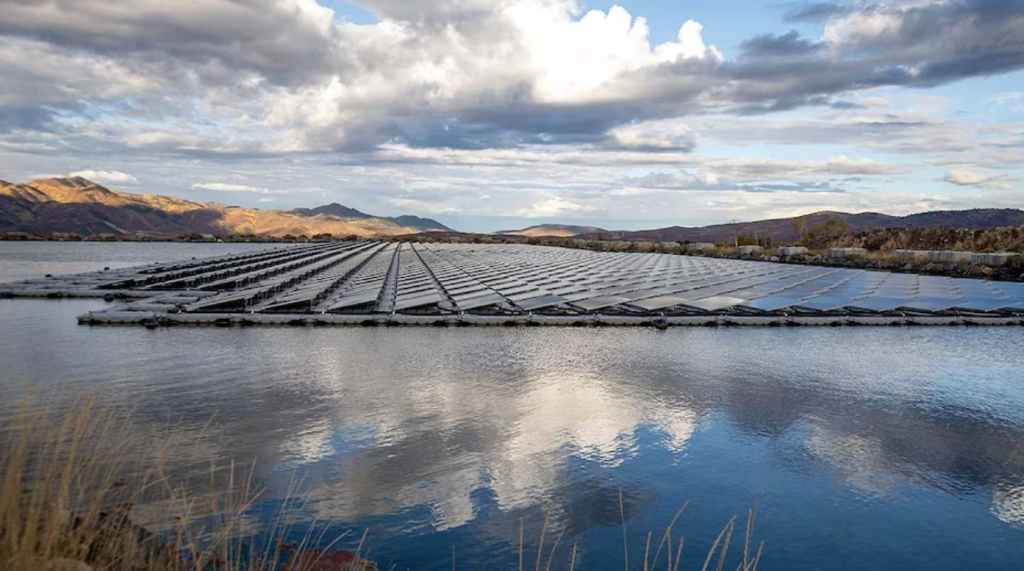
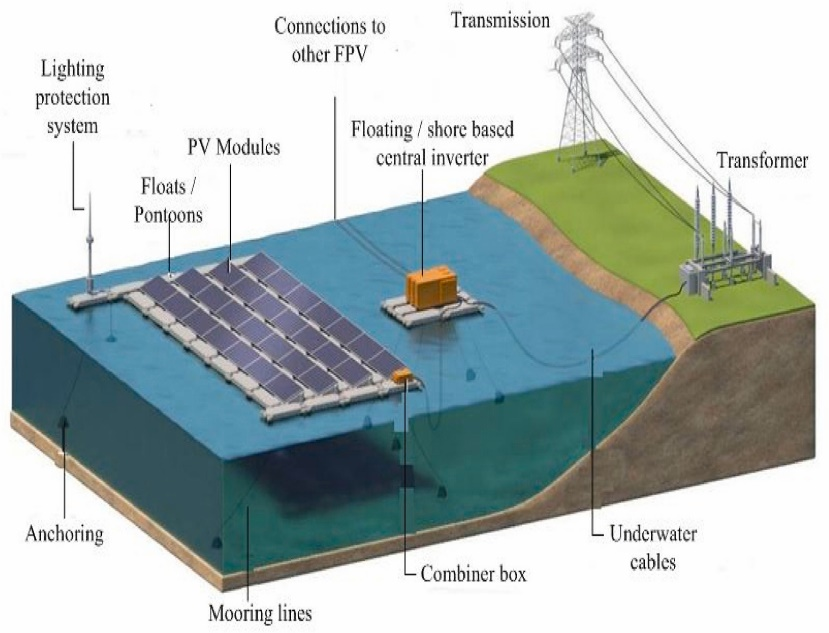
• A FSPV Plant is a solar power system installed on reservoirs, lakes, irrigation tanks, industrial ponds and other inland water bodies instead of land.
• Solar panels are mounted on floating platforms anchored with mooring systems to withstand changing water levels and weather conditions.
• Electricity generated is transmitted to the grid through underwater or floating cables connected to substations.
• Floating solar reduces land requirement, lowers water evaporation, and improves panel efficiency due to the cooling effect of water.
About the Pradhan Mantri Surya Sarovar Yojana (PM-SSY)
• Nodal Ministry: Ministry of New and Renewable Energy (MNRE).
• Total Outlay: ₹5,070 crore
• Objective: To promote large-scale deployment of Floating Solar Photovoltaic (FSPV) Projects integrated with Energy Storage Systems (ESS) across reservoirs and other inland water bodies.
• Target: Development of 5,000 MW of Floating Solar Photovoltaic Projects with a minimum 2-hour Energy Storage System (10,000 MWh).
• Implementing Period: FY 2026–27 to FY 2030–31, with financial assistance disbursement up to FY 2032–33.
• Central Financial Assistance (CFA): ₹1 crore per MW for eligible Floating Solar PV projects after successful commissioning. Up to ₹50 lakh per project for feasibility studies, including:
- Bathymetry studies
- Hydrography assessments
- Environmental studies
- Other preparatory activities for project de-risking.
• Nationwide Coverage: Applicable to all States and Union Territories.
• Efficient Land Utilisation: Promotes renewable energy generation without requiring additional land acquisition.
- Reduces competition for scarce land resources by using existing water bodies.
Need and Significance of the Scheme
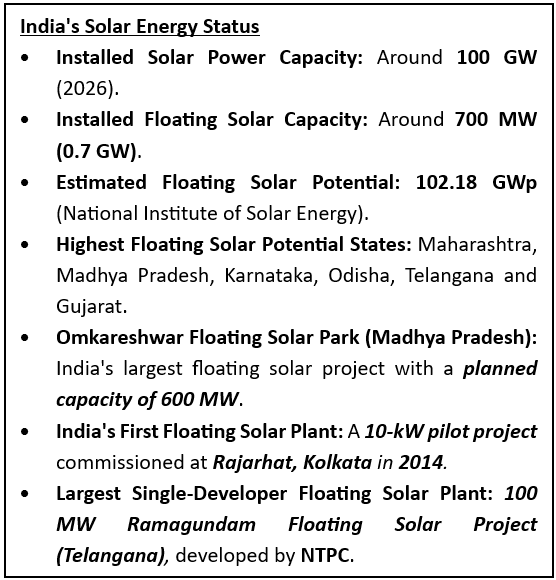
• Harnesses India’s Vast Floating Solar Potential: The National Institute of Solar Energy (NISE) has estimated a floating solar potential of about 102.18 GWp across reservoirs and other inland water bodies, while the current installed floating solar capacity is only around 700 MW.
• Addresses Land Constraints: Utilises existing reservoirs, dams, canals and industrial ponds for solar power generation, eliminating the need for additional land acquisition and reducing competition for scarce land resources.
• Strengthens Grid Reliability: The mandatory Energy Storage System (ESS) with a minimum two-hour storage capacity (10,000 MWh) enables renewable energy generated during the day to be supplied during peak demand and helps reduce renewable energy curtailment.
• Boosts Renewable Energy and Climate Goals: The scheme will add 5,000 MW of floating solar capacity, contribute to India’s renewable energy capacity addition, support the 500 GW non-fossil fuel capacity target by 2030, Net Zero by 2070, and reduce around 10 million tonnes of CO₂ emissions annually.
• Promotes Employment and Atmanirbhar Bharat: Expected to generate approximately 16,000–17,000 full-time equivalent employment opportunities while promoting domestic manufacturing of floatation systems, photovoltaic cells, modules and Energy Storage Systems.
• Promotes Sustainable Utilisation of Water Resources: Facilitates productive use of reservoirs and other inland water bodies for clean energy generation, supporting sustainable resource management and the vision of Viksit Bharat.