

SYLLABUS
GS-2: Government Policies and Interventions for Development in various sectors.
GS-3: Infrastructure; Disaster Management.
Context: India is undertaking one of the world’s largest dam rehabilitation and safety modernisation programmes through structural rehabilitation, technological modernization, and legal reforms to strengthen ageing water infrastructure and improve resilience against climate and disaster risks.
Status of Dams in India
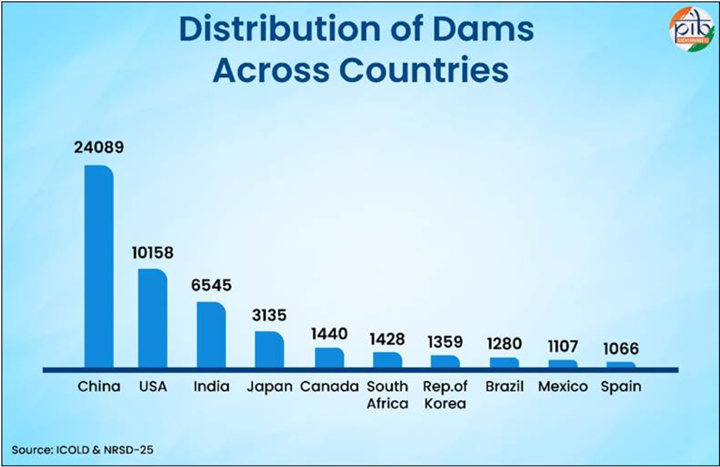
- India has the world’s third-largest network of large dams after the United States and China, with 6,628 specified dams, including 6,545 operational dams and 83 under construction.
- Their combined gross storage capacity is around 330 billion cubic metres, making them critical for irrigation, hydropower, drinking water supply, flood moderation, and national water security.
- Around 98.5% (6,448 dams) of India’s dams are owned by State Governments, while Central PSUs own 49 dams (0.7%), private entities own 36 dams (0.6%), and the Central Government owns 12 dams (0.2%).
- Maharashtra has the highest number of specified dams, followed by Madhya Pradesh, Gujarat, Chhattisgarh, Rajasthan, Karnataka, and Odisha.
- India’s oldest dam, the Kallanai (Grand Anicut) in Tamil Nadu, has remained functional for nearly 2,000 years, reflecting the long historical legacy of water infrastructure in India.
Challenges Facing Dam Infrastructure in India
- Ageing Infrastructure:
- Around 26% (1,681) of India’s dams are over 50 years old, including nearly 291 dams that are more than 100 years old, while about 42% fall in the 25–50 years age bracket.
- The ageing profile of dams has increased concerns regarding structural safety, operational efficiency, and maintenance requirements.
- Sedimentation and Declining Storage Capacity:
- Analysis of 439 reservoirs by the CWC shows an average 19% loss in gross storage capacity due to sedimentation, with average reservoir age around 42 years.
- The average annual storage loss is estimated at around 0.74%, equivalent to nearly 1.81 MCM per reservoir annually, affecting irrigation, hydropower, and flood moderation functions.
- Climate and Hydrological Risks:
- Changing hydrological patterns, increasing climate variability, extreme rainfall events, glacial lake outburst floods (GLOFs), and seismic vulnerabilities are creating new operational and safety risks for dam infrastructure.
- Such climate-induced risks necessitate systematic rehabilitation, improved reservoir management, and advanced flood forecasting systems.
- Disaster Vulnerability: Incidents such as the 2023 Sikkim flash floods that severely damaged the Chungthang Dam and the 2001 Bhuj earthquake impacting dam foundations in Gujarat, highlight the growing disaster vulnerability of dam infrastructure and downstream habitations.
Key Initiatives to Strengthen Dam Safety
- Dam Rehabilitation and Improvement Project (DRIP)
- The Dam Rehabilitation and Improvement Project (DRIP), launched in 2012 with World Bank support, is India’s flagship programme for improving dam safety and operational performance through structural repairs, spillway modernisation, gate strengthening, and advanced monitoring systems.
- DRIP is being implemented in three phases:
- DRIP Phase I (2012–2021) covered 223 dams across seven states.
- DRIP Phases II & III, operational since 2021, cover 736 dams across 19 states and three central agencies.
- Dam Safety Act, 2021
- The Dam Safety Act, 2021, provides a comprehensive legal framework for surveillance, inspection, operation, and maintenance of specified dams to prevent dam failure-related disasters.
- The Act establishes a four-tier institutional structure comprising:
- National Committee on Dam Safety (NCDS),
- National Dam Safety Authority (NDSA),
- State Committees on Dam Safety (SCDS),
- State Dam Safety Organisations (SDSOs).
- It mandates regular inspections, risk assessments, emergency action plans, instrumentation systems, inflow forecasting systems, and Early Warning Systems (EWS) for dams.
Technological Modernisation and Digital Monitoring
- India has adopted technology-driven dam safety management through the DHARMA (Dam Health and Rehabilitation Monitoring Application) platform for digital inspection records, safety assessments, and maintenance tracking.
- All 6,628 specified dams have been registered on the DHARMA platform, while around 13,000 dam inspections are conducted annually with digitally maintained records.
- India has also established the National Centre for Earthquake Safety of Dams at MNIT Jaipur to strengthen seismic safety assessment and research related to dam infrastructure.