
SYLLABUS
GS-3: Infrastructure: Energy; Conservation, environmental pollution and degradation.
Context: India has crossed the landmark 300 GW of installed non-fossil fuel-based electricity generation capacity, reaching 300.50 GW as of 31 July 2026, marking significant progress towards its target of 500 GW of non-fossil fuel capacity by 2030.
India’s Non-Fossil Fuel Energy Overview
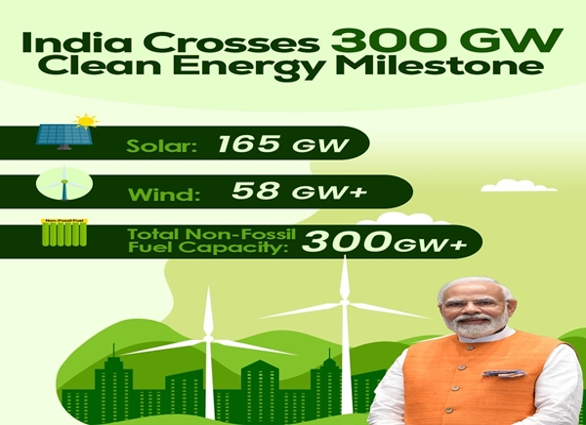
- India’s non-fossil fuel-based installed electricity generation capacity has reached 300.50 GW as of 31 July 2026, accounting for more than 60% of the 500 GW target set for 2030.
- Sector-wise Capacity
- Solar Power: 164.59 GW
- Wind Power: 58.14 GW
- Hydro Power (Large and Small): 57.24 GW
- Bio-power: 11.75 GW
- Nuclear Power: 8.78 GW
- Total Non-Fossil Fuel Capacity: 300.50 GW
- Non-fossil fuel sources now account for over 54% of India’s total installed electricity generation capacity, which stands at around 552 GW.
Significance of this Milestone
- Progress towards 500 GW Target: Crossing 300.50 GW means India has achieved more than 60% of its 500 GW non-fossil fuel capacity target for 2030, demonstrating substantial progress towards its clean energy commitments.
- Growing Role of Clean Energy: With non-fossil fuel sources accounting for over 54% of total installed electricity generation capacity, clean energy has become a major component of India’s power sector.
- Accelerated Renewable Energy Transition: The rapid expansion of solar and wind capacity, along with the record addition of 55.29 GW of non-fossil capacity during 2025–26, reflects the accelerating growth of India’s clean energy sector.
- Support for Climate and Net-Zero Goals: India’s renewable energy expansion supports its enhanced Nationally Determined Contributions (NDCs) under the Paris Agreement, including reducing emissions intensity of GDP by 45% by 2030, achieving about 50% of cumulative electric power installed capacity from non-fossil fuel-based energy sources by 2030, promoting LiFE (Lifestyle for Environment), and supporting its long-term goal of net-zero emissions by 2070.
Government Initiatives for Advancing Renewable Energy in India
- Transmission Infrastructure and Market Support: ISTS charge waivers have been provided for eligible renewable energy projects, alongside the Green Energy Corridor Scheme and transmission planning up to 2032.
- Standard bidding guidelines have been issued for solar, wind, wind-solar hybrid and Firm and Dispatchable Renewable Energy projects, along with 100% FDI under the automatic route.
- Renewable Energy Procurement and Storage: Renewable Energy Implementing Agencies have been given a trajectory to issue 50 GW of renewable energy bids annually from FY 2023–24 to FY 2027–28.
- Solar Parks and Domestic Manufacturing: The Solar Parks and Ultra Mega Solar Power Projects Scheme provides land and transmission infrastructure, while the PLI Scheme for High-Efficiency Solar PV Modules promotes domestic manufacturing.
- National Green Hydrogen Mission and Renewable Energy Integration: The National Green Hydrogen Mission promotes production, use and export of green hydrogen, alongside the RPO/RCO trajectory up to 2029–30 and the Offshore Wind Energy Strategy.
- Pumped Storage Projects are also being promoted, with 10 projects totalling 11,870 MW under construction.
- Hydropower and Nuclear Energy Expansion: 12,723.5 MW of hydropower projects are under construction and 4,274 MW are at planning stages for completion by 2031–32. Nuclear power capacity is targeted to reach 100 GW by 2047.
- Major Renewable Energy Schemes:
- Pradhan Mantri Kisan Urja Suraksha evam Utthaan Mahabhiyan (PM-KUSUM)
- PM Surya Ghar Muft Bijli Yojana
- National Programme on High Efficiency Solar PV Modules
- New Solar Power Scheme for Tribal and Particularly Vulnerable Tribal Group (PVTG) Habitations/Villages under PM JANMAN
- Dharti Aabha Janjatiya Gram Utkarsh Abhiyan (DA JGUA)
- National Green Hydrogen Mission
- Viability Gap Funding (VGF) Scheme for Offshore Wind Energy Projects