
SYLLABUS
GS-3: Infrastructure: Energy, Ports, Roads, Airports, Railways etc.
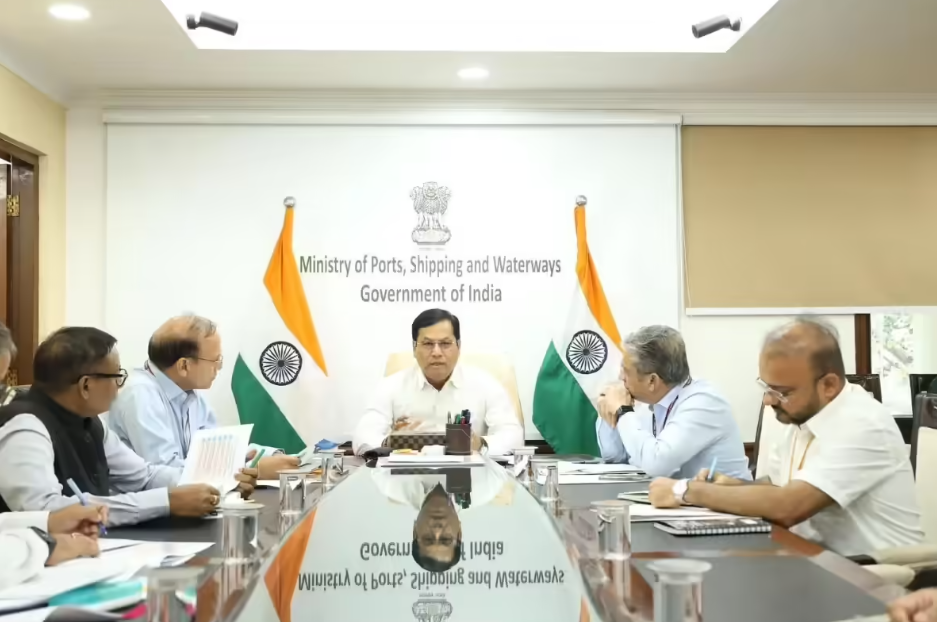
Context: The Ministry of Ports, Shipping & Waterways (MoPSW) has advanced plans to roll out Water Metro services across 18 cities and circulated the Draft National Water Metro Policy, 2026 for inter-ministerial and State consultations to establish a national framework for water-based urban mobility.
More on the News
• Phase I cities include Guwahati, Srinagar, Patna, Varanasi, Ayodhya, and Prayagraj, while Tezpur and Dibrugarh in Assam are proposed under Phase II.
• The initiative builds upon the operational success of the Kochi Water Metro and aims to transform inland waterways into efficient, eco-friendly, and integrated urban transport corridors.
About Water Metro / Water Buses / Water Taxi
• A Water Metro is a mechanically propelled mass passenger transport system operating on inland, coastal, and other water bodies for the systematic movement of passengers and, where applicable, vehicles.
• It may operate across intra-city, inter-city, coastal, and inter-island corridors on rivers, canals, lakes, backwaters, estuaries, creeks, and coastal waters.
• Water Metro systems use modern vessels, floating jetties, automated fare systems, and passenger information systems to provide organised water-based urban transport services.
• Unlike conventional ferry services, Water Metro systems are designed as high-frequency urban mobility networks supporting daily commuting, tourism, recreation, and regional connectivity.
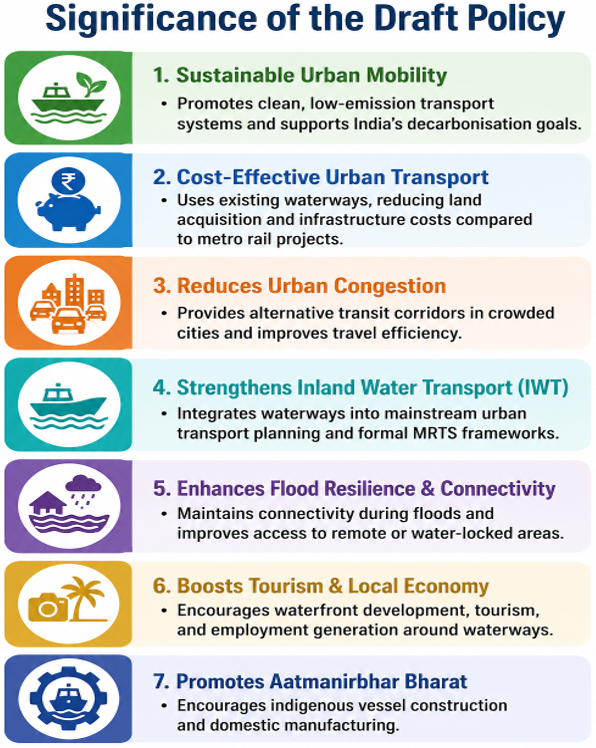
• The system provides a low-cost, low-emission, and congestion-free mobility alternative by leveraging existing waterways with minimal land acquisition requirements.
Key Features of Water Metro
• Green & Low-Emission Mobility: Promotes electric, battery-operated, solar-assisted, and hybrid ferries to reduce carbon emissions and fuel consumption, with hybrid vessels used for longer routes and difficult operational conditions.
• Mass Public Transport System: Functions as a scheduled public transport system for daily urban mobility while also supporting tourism and recreational activities.
• Standardisation & Safety: Ensures standardised vessel designs, charging systems, terminals, and navigational infrastructure in compliance with national maritime and inland vessel safety regulations.
• Multimodal Integration: Integrates Water Metro services with metro rail, buses, roads, feeder systems, pedestrian pathways, and last-mile connectivity infrastructure.
• Ecosystem-Based Development: Develops a comprehensive ecosystem including vessels, pontoons, jetties, charging and bunkering facilities, passenger terminals, navigational aids, digital systems, and emergency rescue support.
• Indigenous Manufacturing: Encourages vessel construction by Indian shipyards under the Aatmanirbhar Bharat initiative through standardisation and bulk procurement to reduce costs and improve scalability.
• Flexible Funding Models: Supports implementation through joint Centre-State funding, State-funded projects, PPP models, and fully Central-funded projects for strategic National Waterway corridors.
• Urban & Climate Resilience: Improves connectivity to remote and water-locked regions, reduces urban congestion, and provides transport resilience during floods and infrastructure disruptions.
About the Draft National Water Metro Policy, 2026
• The Draft National Water Metro Policy, 2026, prepared by the Ministry of Ports, Shipping & Waterways (MoPSW), seeks to establish a coordinated national framework for integrating inland waterways into India’s urban transport ecosystem.
• It aims to position Water Metro systems alongside other Mass Rapid Transit Systems (MRTS) such as metro rail, BRTS, and tramways to promote sustainable, multimodal, and low-emission urban mobility.
• Key Objectives: The policy promotes green propulsion technologies (electric and hybrid ferries), standardisation in vessel and terminal design, passenger safety, technical efficiency, affordable public transport, multimodal integration, and indigenous manufacturing.
• Planning Criteria: Water Metro projects will be prioritised in cities with continuous or semi-continuous navigable waterways, urban agglomerations with populations above one million, tourism-intensive corridors, and flood-prone or water-locked regions requiring improved connectivity.
• Operational & Infrastructure Components: The framework provides for modern terminals and floating jetties, passenger amenities, automated fare collection systems, passenger information systems, charging and bunkering infrastructure, GPS/AIS-based navigational aids, energy management systems, and backup power infrastructure.
• Ecosystem-Based Development Approach: The policy adopts an integrated ecosystem model covering vessels, pontoons, terminals, charging infrastructure, navigational systems, and seamless multimodal integration with existing transport networks.
• Fare & Revenue Framework: The policy emphasises affordable and inclusive public transport rather than profit maximisation, while encouraging non-fare revenue through advertising, retail spaces, waterfront commercial development, and tourism activities.
• Funding Models: Multiple implementation models are proposed, including joint Centre–State funding, fully State-funded projects, Public-Private Partnerships (PPP), and fully Centre-funded initiatives.
• Performance Monitoring: Performance assessment will be based on indicators such as safety standards, punctuality, ridership levels, operational efficiency, fuel savings, and environmental outcomes.
Legal & Constitutional Framework
• Inland Waterways Authority of India (IWAI) Act, 1985: Empowers the IWAI to develop and regulate National Waterways while also providing advisory support for waterways outside National Waterways.
• Inland Vessels Act, 2021: Regulates mechanically propelled inland vessels in India by prescribing standards for vessel construction, operation, pollution control, and passenger safety.
• Constitutional Provisions: Shipping and navigation on National Waterways fall under the Union List, while inland waterways other than National Waterways are placed under the Concurrent List of the Constitution.
Sources:
PIB
Economic Times
Policyedge