SYLLABUS
GS-2: Bilateral, regional and global groupings and agreements involving India and/or affecting India’s interests.
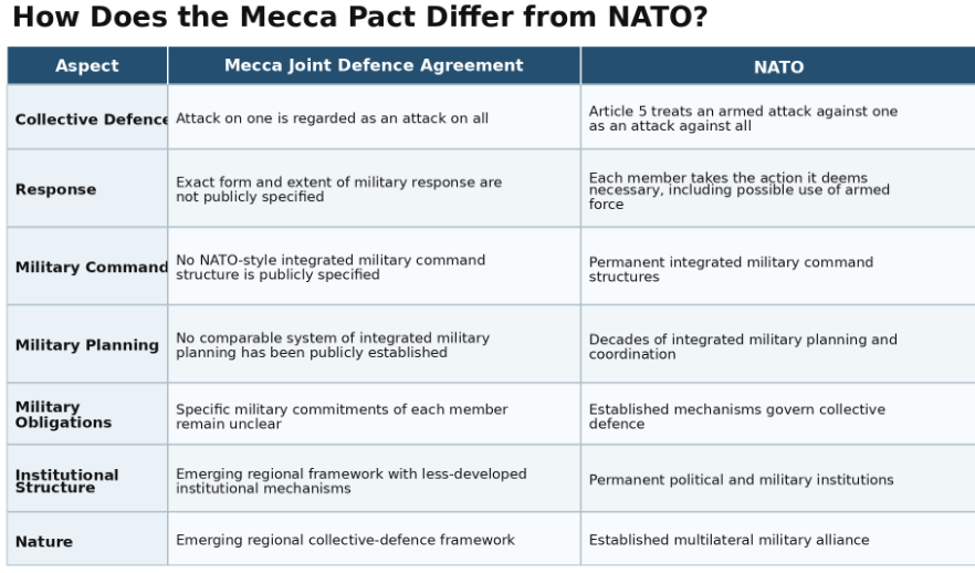
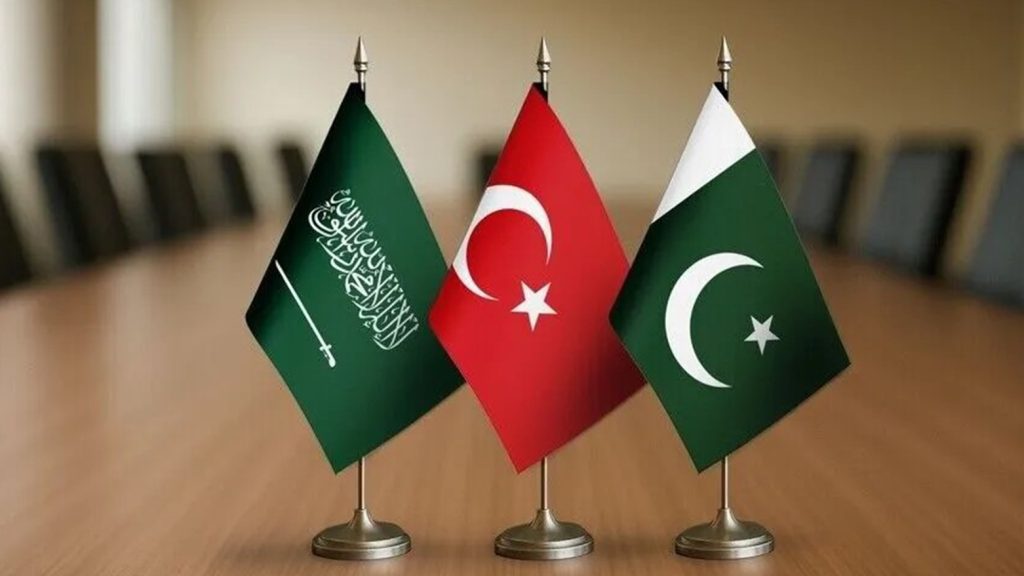
Context: Saudi Arabia, Pakistan and Türkiye signed the Mecca Joint Defence Agreement, containing an “attack on one, attack on all” provision under which an armed attack against any one of the three countries would be regarded as an attack against all three, drawing comparisons with NATO’s collective-defence principle.
More on the News
- The pact comes amid heightened security tensions in West Asia, including attacks involving Iran, Israel and Iran-backed groups, and growing concerns over the security of Gulf states and regional energy routes.
- The agreement has been described as “NATO-style” because of its collective-defence clause.
- Turkey has indicated that the framework could be expanded to include other countries, with Egypt, Qatar and Kuwait among the countries whose possible participation has been discussed.
About the Mecca Joint Defence Agreement
- The agreement provides for the enhancement of all aspects of defence cooperation, including military coordination, joint defence-industry projects, technology partnerships, procurement and greater military interoperability.
- Saudi and Turkish officials have described the pact as purely defensive, stressing that it is not intended to establish a military axis or sectarian bloc or target any particular country.
- The agreement builds on longstanding military cooperation among the three countries, including Saudi–Pakistan defence ties and growing Türkiye–Pakistan and Saudi–Türkiye defence-industry cooperation.
- Nature and Scope:
- No Automatic Military Intervention: The pact does not publicly specify automatic troop deployment, force commitments or the exact military response in case of an attack, leaving the form and extent of assistance to consultations among the members.
- No Joint Command Structure: Unlike NATO, it does not publicly establish permanent integrated military command structures or detailed collective-defence procedures.
- Potential Regional Expansion: Türkiye has expressed an intention to expand the framework beyond the three signatories, potentially creating a broader regional security arrangement.
Implications for India
- Impact on India–Saudi Arabia Relations: Greater Saudi security dependence on Pakistan could give Islamabad additional leverage in Riyadh and complicate India’s strategic, economic and energy ties with Saudi Arabia.
- Pakistan’s Strategic and Military Leverage: The pact could strengthen Pakistan by combining Saudi economic strength with Türkiye’s military and defence-industrial capabilities, affecting India’s security calculations.
- Changing Regional Defence Balance: Closer Saudi–Türkiye–Pakistan defence cooperation could expand joint production, technology partnerships and military cooperation, potentially strengthening Pakistan’s conventional capabilities.
- China Factor: The pact could strengthen a broader non-Western defence ecosystem around Pakistan, given its established defence relationship with China and growing cooperation with Türkiye and Saudi Arabia.
- Maritime and Energy Security: A stronger security framework across the Persian Gulf, Red Sea and Arabian Sea could affect India’s energy supplies, maritime trade and Western Indian Ocean interests.
- Strategic Uncertainty and Future Expansion: Expansion to other Gulf states and deeper military commitments could increase the pact’s regional impact, requiring India to preserve strategic autonomy and deepen ties with Gulf partners.