
SYLLABUS
GS-3: e-technology in the aid of farmers.
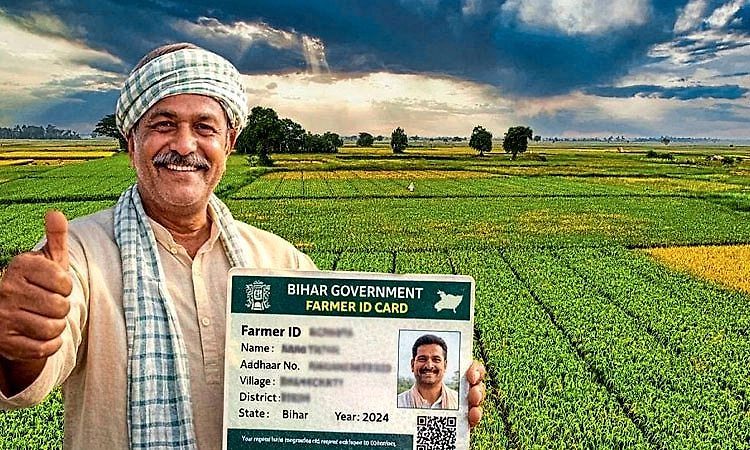
Context: The Ministry of Agriculture and Farmers Welfare achieved the target of creating 11 crore Farmer IDs nearly five months ahead of the deadline of 31 March 2027 under the Digital Agriculture Mission.
Farmer IDs: Key Details
- Nature of the ID: The Farmer ID, also known as Kisan Pehchaan Patra, is a unique digital identity based on Aadhaar and linked dynamically to State land records. Changes in land-record details can be reflected in the ID record.
- Registration profile: Women account for approximately 26% of registered farmers, while around 81% belong to small and marginal operational-holding categories.
- About 15% of registered farmers are aged 70 or above, while 7.5% are below 30.
- Inclusion of actual cultivators: Registration is also being extended to cultivators who may not appear as landowners in official records.
- 28,680 tenants and sharecroppers across five States and 314,298 Forest Rights holders across six States have been registered.
Understanding the Digital Agriculture Mission and AgriStack
- Digital Agriculture Mission: Approved by the Union Cabinet on 2 September 2024, the Mission has a total outlay of ₹2,817 crore, including a central share of ₹1,940 crore. It is an umbrella scheme to develop digital public infrastructure (DPI), improve agricultural estimates and support technology-based initiatives in agriculture.
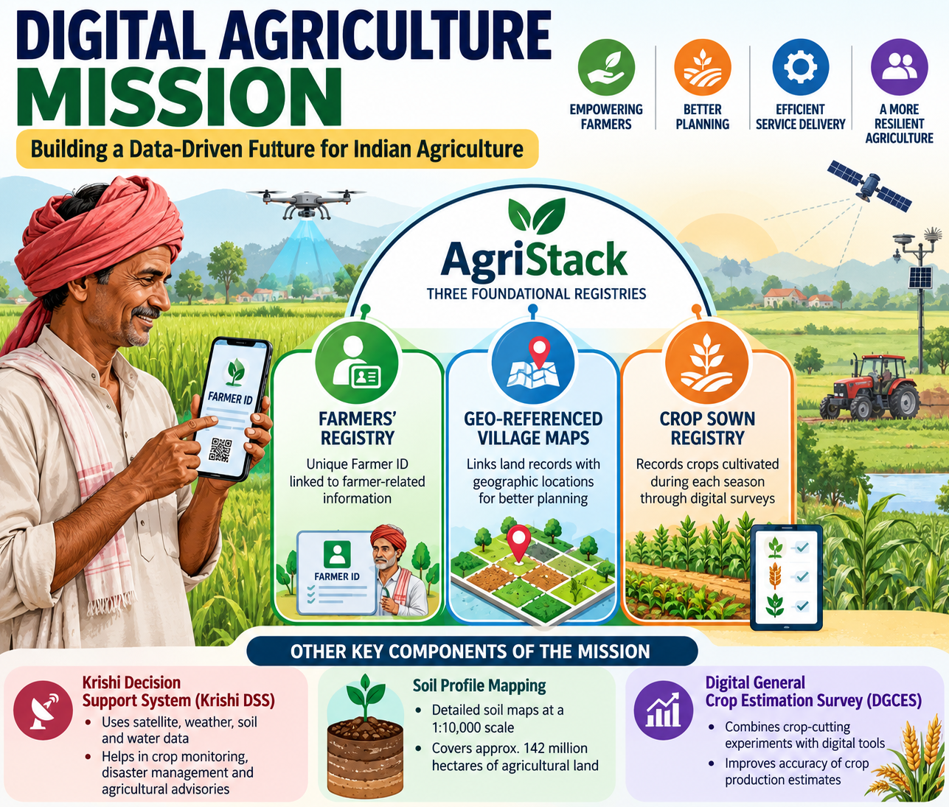
- AgriStack: It is the farmer-centric digital public infrastructure comprising three foundational registries, created and maintained by State Governments and Union Territories:
- Farmers’ Registry: Provides farmers with unique digital identities and links relevant farmer-related information.
- Crop Sown Registry: Records crops cultivated during each season, supported by Digital Crop Surveys.
- Geo-referenced Village Maps: Connect land-related information with geographic locations to support planning and decision-making.
- Other components of the Mission:
- The Krishi Decision Support System (Krishi DSS) integrates remote-sensing information on crops, soil, weather and water resources into a geospatial system.
- Soil Profile Mapping envisages detailed soil maps at a 1:10,000 scale for approximately 142 million hectares of agricultural land.
- The Digital General Crop Estimation Survey (DGCES) uses crop-cutting experiments to improve the accuracy of crop-yield estimates.
Significance and Potential Applications
- Simplified service delivery: A common digital identity can reduce repeated submission of documents and verification requirements, making access to farmer-centric government schemes and services simpler and more transparent.
- Agricultural credit, insurance and procurement: The registry is intended to facilitate bank loans, including Kisan Credit Card services, crop-insurance claims, disaster relief and procurement under the Minimum Support Price (MSP) system. Actual benefits remain subject to the eligibility conditions and procedures of the respective schemes.
- Improved agricultural planning: Integrating crop, soil, weather and water-resource data can support crop monitoring, agricultural advisories, disaster response and more informed decisions on irrigation, pest management and crop planning.
- Greater transparency and administrative efficiency: A verified farmer database can help reduce duplicate records, improve coordination among departments and strengthen the monitoring of agricultural schemes.
- According to the Ministry, more than 6 crore farmers had already received direct benefits under various schemes through Farmer ID-based service delivery.
Concerns and the Way Ahead
- Inclusive registration: Registration systems should accommodate actual cultivators, including eligible tenants and sharecroppers, so that dependence on land ownership records does not leave them outside the digital framework.
- Data accuracy and interoperability: States and Union Territories need to maintain updated records and ensure that relevant databases can work together across departments and schemes. The next phase should focus on the effective use of the 11 crore IDs, not merely increasing registrations.
- Privacy and accountability: Clear safeguards for personal data, transparent rules for data access and effective grievance-redressal mechanisms are essential to build farmers’ trust in digital agricultural infrastructure.