
SYLLABUS
GS-3: Science and Technology- Developments and their Applications and Effects in Everyday Life; Achievements of Indians in Science & Technology.
Context: Recently, scientists from the Indian Institute of Astrophysics (IIA) used nearly a century of observations from the Kodaikanal Solar Observatory (KSO) to uncover new insights into how the Sun’s surface magnetic features track its 11-year activity cycle and influence future solar activity.
More on the News
- The study analysed digitised solar observations spanning multiple solar cycles, making use of one of the world’s longest continuous records of solar data.
- Researchers examined Calcium-K (Ca-K) spectroheliogram images, which reveal magnetic activity in the Sun’s chromosphere.
- The findings provide fresh evidence on the relationship between solar surface features, polar magnetic fields and the Sun’s periodic activity cycle.
- The study enhances understanding of the mechanisms governing solar magnetism and long-term solar variability.
Understanding the Solar Activity Cycle
- The Sun undergoes a periodic cycle of activity approximately every 11 years, marked by fluctuations in sunspots, solar flares, coronal mass ejections and magnetic activity.
- The cycle alternates between Solar Minimum (low activity) and Solar Maximum (peak activity).
- The cycle is driven by the Sun’s internal magnetic dynamo, generated through interactions between plasma flows and magnetic fields within the solar interior.
- Although solar activity follows an 11-year cycle, the Sun’s magnetic field reverses polarity every cycle and returns to its original orientation after about 22 years (Hale Cycle).
- Variations in the Sun’s magnetic field influence space weather and can affect satellites, communication systems, navigation networks and power infrastructure on Earth.
Key Findings of the Study
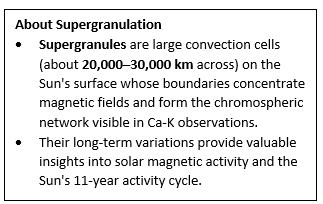
- Supergranulation Tracks Solar Activity: Analysis of century-long Kodaikanal observations showed that variations in supergranulation patterns closely follow the Sun’s 11-year activity cycle.
- Polar Network Index (PNI) as a Magnetic Proxy: Researchers used supergranulation-derived network structures to develop the Polar Network Index (PNI), enabling reconstruction of long-term variations in the Sun’s polar magnetic fields.
- Polar Fields Predict Future Solar Cycles: The study found a strong correlation between the PNI and the strength of subsequent solar cycles, confirming that polar magnetic fields serve as reliable precursors of future solar activity.
- Evidence for Solar Dynamo Theory: The findings provide observational support for the Babcock–Leighton Solar Dynamo Model, which explains the generation and evolution of the Sun’s magnetic cycle.
Significance of the Study
- Improving Solar Cycle Prediction: A better understanding of polar magnetic fields can enhance forecasting of future solar cycles and solar activity levels.
- Advancing Space Weather Forecasting: Improved predictions of solar storms can help protect satellites, navigation systems, communication networks and power grids.
- Strengthening Solar Dynamo Research: The findings provide important observational evidence for theories explaining the generation and evolution of solar magnetic fields.
- Supporting Space Exploration: Reliable forecasts of solar activity are critical for the safety of astronauts and future space missions.
- Showcasing India’s Scientific Contribution: The study highlights the global importance of India’s long-term solar observations and research infrastructure in advancing solar physics.
About Kodaikanal Solar Observatory (KSO)
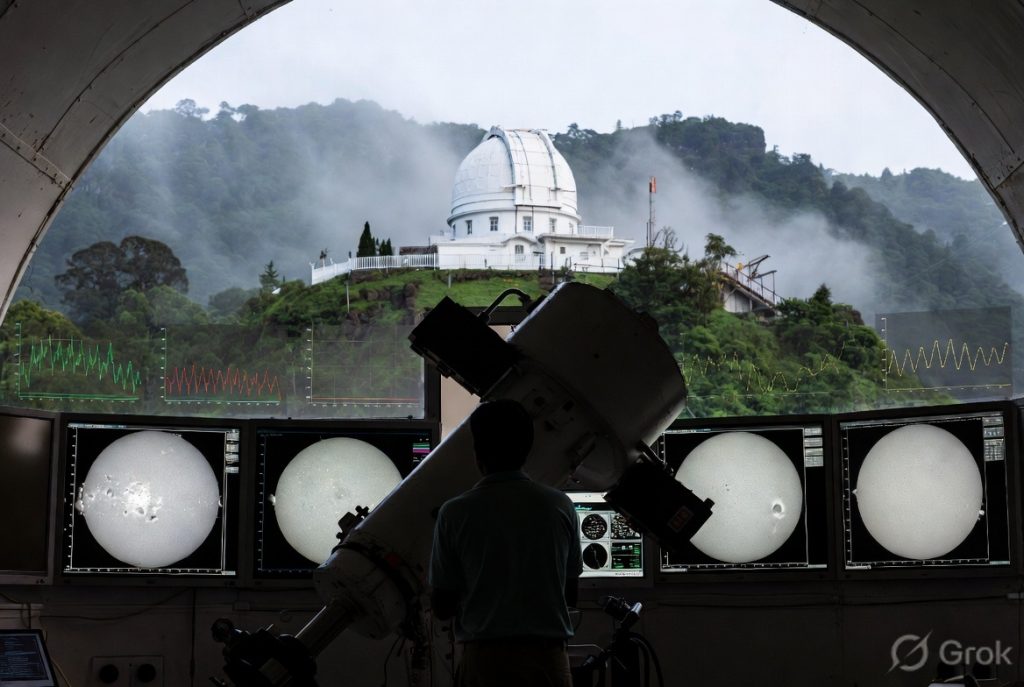
- Established in 1899 at Kodaikanal, Tamil Nadu, the observatory is one of India’s premier solar research facilities and is currently operated by the Indian Institute of Astrophysics (IIA), Bengaluru.
- KSO is renowned for maintaining one of the world’s longest continuous records of solar observations, with systematic observations of the Sun being carried out since 1904.
- The observatory houses several historic and modern solar instruments and has made significant contributions to solar physics, including studies related to sunspots, solar magnetic activity and solar variability.