
SYLLABUS
GS-3: Science and Technology- Developments and their Applications and Effects in Everyday Life; Indigenization of Technology and Developing New Technology.
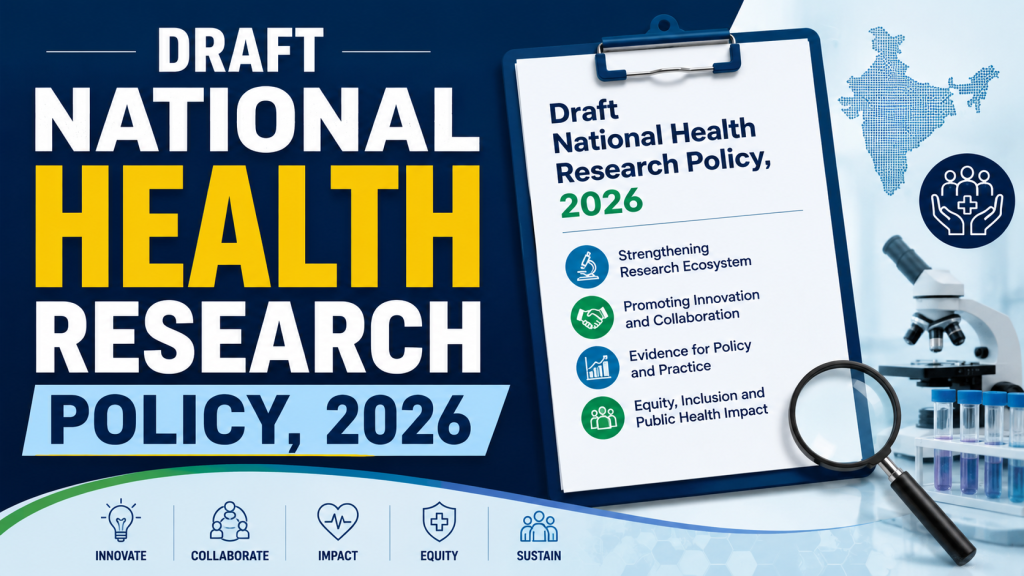
Context: The Department of Health Research (DHR), Ministry of Health and Family Welfare, has released the Draft National Health Research Policy (NHRP), 2026 for public consultation, proposing a comprehensive and impact-oriented overhaul of India’s health research ecosystem.
More on the News
- The draft policy seeks to replace the National Health Research Policy, 2011 and establish a modern, impact-oriented framework aligned with India’s evolving health priorities.
- It aims to create a capable, inclusive, self-reliant, and responsive health research ecosystem, while strengthening the link between research, policymaking, healthcare delivery, and innovation.
- The policy seeks to establish India’s first comprehensive framework covering biomedical, clinical, public health, health systems, epidemiological, behavioural, and digital health research.
Need for the Policy
- Changing Health Challenges: India’s health burden is increasingly shaped by non-communicable diseases (NCDs), antimicrobial resistance (AMR), mental health disorders, ageing-related conditions, and emerging infectious diseases, requiring a reoriented research framework.
- Fragmented Research Ecosystem: Health research remains dispersed across institutions and sectors, leading to duplication of efforts, weak coordination, and limited translation of research into policy and practice.
- Low Public Investment in Health Research: Government expenditure on health research is estimated at only 0.024% of GDP, limiting India’s research capacity and innovation potential.
- Uneven Research Capacity: Research infrastructure, funding opportunities, and skilled manpower remain concentrated in a limited number of premier institutions, creating regional and institutional disparities.
Key Proposals / Features of the Draft Policy
- National Health Research Agenda (NHRA)
- Establish a dynamic national framework for identifying priority research areas based on disease burden, public health needs, and emerging challenges.
- Priority areas include TB, AMR, vector-borne diseases, cancer, NCDs, mental health, anaemia, child malnutrition, women’s health, maternal and neonatal mortality, primary healthcare, and emergency care.
- Increased Investment in Health Research: Proposes a phased increase in public spending on health research from 0.024% of GDP currently to 0.072% by 2037 and 0.15% by 2047.
- Shift to Impact-Oriented Research: Move beyond publication- and citation-based assessment towards evaluation based on public health outcomes, policy relevance, societal impact, and translational value.
- Three-Tier Governance Structure: It proposes a governance framework comprising:
- National Health Research Stewardship Committee for strategic oversight;
- Department of Health Research (DHR) as the nodal implementation agency; and
- ICMR as the scientific and technical lead.
- National Research Integrity Office (NRIO) and Research Governance Reforms
- Proposes establishing a National Research Integrity Office (NRIO) to strengthen scientific integrity, ethical oversight, and responsible research practices.
- Also seeks to simplify approvals for multicentre studies and improve research governance mechanisms.
- Greater Role for States and Private Sector: Encourages state-level research agendas and greater participation of private hospitals, industry, startups, philanthropy, and community organisations in health research.
Significance of the Policy
- Aligning Research with Public Health Priorities: Ensures that research funding and efforts are directed towards India’s most pressing health challenges and disease burdens.
- Strengthening Health Security: Enhances preparedness for pandemics, AMR, emerging diseases, and other public health emergencies through targeted and coordinated research.
- Promoting Evidence-Based Policymaking: Strengthens the integration of scientific evidence into health policies, programmes, and healthcare delivery systems.
- Democratising Health Research: Expands research opportunities beyond a few elite institutions and promotes wider participation by states, medical colleges, young researchers, and underserved regions.
- Improving Research Translation: Seeks to bridge the gap between research generation and its application in healthcare delivery, public policy, and health outcomes.