
SYLLABUS
GS-3: Achievements of Indians in science & technology; indigenization of technology and developing new technology.
Context: The Indian Council of Agricultural Research (ICAR) has developed India’s first indigenous MA-104 Cell Line-Based Live Attenuated African Swine Fever (ASF) Vaccine for pigs, marking a major breakthrough in veterinary biotechnology and animal health.
About the Vaccine
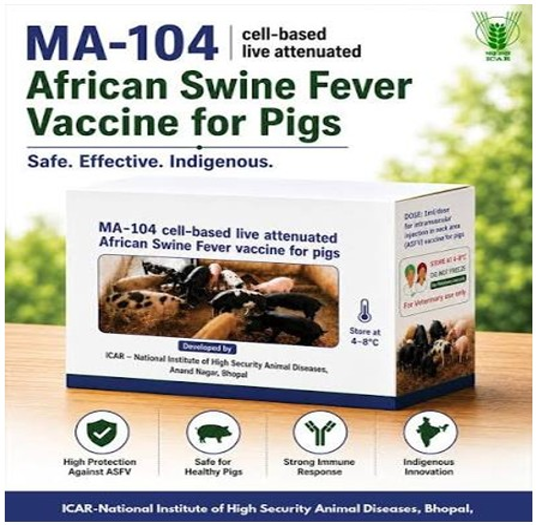
- Developed by ICAR–National Institute of High Security Animal Diseases (ICAR-NIHSAD), Bhopal.
- India’s first indigenous MA-104 Cell Line-Based Live Attenuated African Swine Fever (ASF) Vaccine.
- Developed using a novel attenuated ASFV Genotype II virus with unique gene deletions in the MA-104 cell line.
- Uses the widely available MA-104 cell line, making it suitable for large-scale and cost-effective production.
- Eliminates dependence on proprietary manufacturing platforms used in commercially licensed ASF vaccines.
- Recommended for healthy pigs above 8 weeks with a 1 mL intramuscular dose followed by a booster after 14 days.
About African Swine Fever (ASF)
- African Swine Fever (ASF) is a highly contagious trans-boundary viral disease caused by the African Swine Fever Virus (ASFV).
- It affects domestic and wild pigs.
- It is characterised by high fever, haemorrhages and mortality rates that may approach 100%.
- It is among the world’s most devastating livestock diseases, causing severe socio-economic losses to the pig farming sector.
- No effective treatment exists, and before this development India had no commercially approved ASF vaccine; disease control depended on rapid diagnosis, culling and strict biosecurity measures.
- Impact of ASF in India:
- ASF was first detected in India in 2020 and has since spread to several States and Union Territories.
- The outbreaks caused massive pig mortality, disrupted pig production, restricted animal movement and trade, and severely affected smallholder pig farmers, especially in the North-Eastern region.
- During the 2020–21 Assam outbreaks, pig mortality and culling caused estimated losses of ₹276 crore.
- In Mizoram, ASF affected over 11,382 households up to 2025, resulting in estimated losses of ₹982 crore.
| Parameter | African Swine Fever (ASF) | Classical Swine Fever (CSF) |
| Virus | African Swine Fever Virus (ASFV) | Classical Swine Fever Virus (CSFV) |
| Genome | Large, enveloped, double-stranded DNA virus | Small, enveloped, positive single-stranded RNA virus |
| Family | Asfarviridae (Genus: Asfivirus) | Flaviviridae (Genus: Pestivirus) |
| Vector | Soft ticks (Ornithodoros) in endemic areas | No known biological vector |
| Mortality | High; up to 90–100% (highly virulent strains) | Variable; higher in piglets, lower in older animals |
Significance of the Vaccine
- Disease Control: The vaccine is expected to significantly reduce pig mortality by providing an effective preventive tool against ASF, one of the world’s most destructive livestock diseases.
- Farmer Livelihoods: It will minimise economic losses and strengthen the livelihoods of pig farmers, particularly in North-Eastern India, where ASF outbreaks have been most severe.
- Animal Health Security: The vaccine will strengthen India’s animal health security, improve disease preparedness, and enhance livestock biosecurity against future ASF outbreaks.
- Affordable Production: The use of the widely available MA-104 cell line enables large-scale, cost-effective vaccine production by eliminating dependence on proprietary manufacturing platforms.
- Scientific Breakthrough: The development demonstrates India’s growing capability to produce world-class indigenous veterinary vaccines and advanced animal health technologies.
- Food & Biosecurity: By protecting the pig population, the vaccine contributes to food security, biosecurity, and the sustainable growth of India’s livestock sector.
- Atmanirbhar Bharat: The indigenous vaccine advances the vision of Atmanirbhar Bharat by reducing reliance on imported veterinary technologies.
- Global Potential: India joins the few countries with indigenous ASF vaccine capability, creating opportunities to become a global supplier of affordable veterinary vaccines.