
SYLLABUS
GS-3: Indian Economy and issues relating to planning, mobilization of resources, growth, development and employment.
GS-2: Government policies and interventions for development in various sectors and issues arising out of their design and implementation.
Context: The 11th anniversary of the Skill India Mission (SIM) is being observed in 2026, marking eleven years since its launch by Prime Minister Narendra Modi in 2015 to equip youth with industry-relevant skills for employment, entrepreneurship and sustainable livelihoods.
More on the News
- The 11th anniversary of the Skill India Mission was celebrated along with World Youth Skills Day 2026, organised by the Ministry of Skill Development and Entrepreneurship (MSDE).
- The theme for World Youth Skills Day 2026 was “Skilling for a Shared Future“, highlighting India’s commitment to preparing its workforce for both domestic and global labour markets.
About the Skill India Mission (SIM)
- Launched: 15 July 2015.
- Launched by: Prime Minister Narendra Modi.
- Nodal Ministry: Ministry of Skill Development and Entrepreneurship (MSDE).
- Vision: To create a skilled, employable and globally competitive workforce while promoting entrepreneurship and lifelong learning.
- Objective:
- Equip youth with industry-relevant skills.
- Improve employability and productivity.
- Promote entrepreneurship and self-reliance.
- Bridge the gap between industry demand and workforce skills.
- Aligned with the vision of Viksit Bharat 2047.
- Major Components:
- Pradhan Mantri Kaushal Vikas Yojana (PMKVY)
- Jan Shikshan Sansthan (JSS)
- National Apprenticeship Promotion Scheme (NAPS)
- Craftsmen Training Scheme (CTS) through ITIs
- Skill India Digital Hub
- PM-SETU
- IndiaSkills and WorldSkills Competitions
- Centres of Excellence
- Entrepreneurship and international mobility initiatives
- Institutional Framework
- Ministry of Skill Development and Entrepreneurship (MSDE)
- National Skill Development Corporation (NSDC)
- National Council for Vocational Education and Training (NCVET)
- Sector Skill Councils (SSCs)
Key Achievements of the Skill India Mission
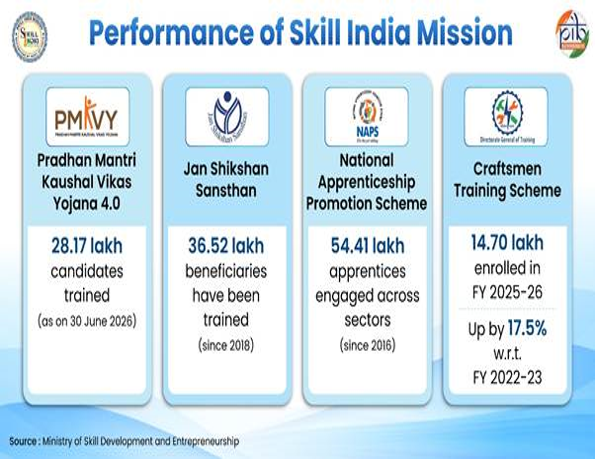
- More than 6 crore youth have been empowered through various schemes of the Ministry of Skill Development and Entrepreneurship (MSDE), with over 1 crore youth trained every year under the SIM.
- More than 54.41 lakh apprentices have been engaged under the NAPS since 2016, promoting the ‘Earn While You Learn’ model through Direct Benefit Transfer (DBT).
- India has strengthened its global competitiveness in vocational skills through IndiaSkills and WorldSkills competitions, securing 3 Gold, 3 Silver, 1 Bronze Medal and 3 Merit Awards at the Global Skills Challenge Australia 2026 and Taipei Capital Cup 2026.
Significance of the Skill India Mission
- Harnesses Demographic Dividend: Enables India to leverage its large working-age population through skill development.
- Bridges Skill Gap: Aligns training with industry demand, reducing the mismatch between available jobs and workforce capabilities.
- Strengthens Global Workforce Mobility: Prepares skilled professionals for international labour markets and positions India as a global talent hub.
- Promotes Future-Ready Skills: Expands training in AI, digital technologies, automation, green jobs and Industry 4.0.
- Advances Women-led Development: Expands women’s participation in skill development, entrepreneurship and non-traditional occupations.
- Supports Inclusive Development: Extends skilling opportunities to rural communities, artisans, tribal populations, school dropouts and other vulnerable groups.
- Contributes to Viksit Bharat 2047: Develops a skilled, innovative and globally competitive workforce essential for achieving the vision of a developed India by 2047.