

SYLLABUS
GS-3: Indian Economy and issues relating to planning, mobilization of resources, growth, development and employment; Inclusive growth and issues arising from it.
Context: Recently, NITI Aayog launched the DPI@2047 roadmap to guide India’s next phase of Digital Public Infrastructure (DPI) for inclusive, non-linear, and productivity-led growth.
More on the News
- The report titled ‘DPI@2047: The Roadmap to Prosperity’ was released by the NITI Frontier Tech Hub under NITI Aayog.
- It presents a three-stage evolution of DPI (1.0, 2.0, 3.0), moving from foundational digital inclusion to productivity-driven and innovation-led growth.
- The document builds on the successes of Aadhaar and Unified Payments Interface to expand access to economic opportunities.
- It targets $18,000 per capita income by focusing on mass livelihood empowerment, human capability development, and systemic digital transformation.
- The roadmap was developed in partnership with EkStep Foundation and Deloitte, reflecting a collaborative ecosystem-driven approach.
About Digital Public Infrastructure (DPI) 2.0
- DPI 2.0 (2025–2035) is designed to move India from foundational inclusion to livelihood-led, productivity-driven growth, forming the base for DPI 3.0 (2035–2047), which aims at broad-based prosperity and high-value economic expansion.
- It represents a shift from earlier focus areas like identity and payments to mass livelihood empowerment, innovation diffusion, and economic participation at scale.
- The roadmap envisions India becoming a $30 trillion economy with a per capita income of $18,000 by 2047, supported by DPI-led transformation.
- DPI 2.0 integrates AI, trusted data systems, and interoperable digital infrastructure to democratise access to knowledge, markets, and opportunities across society.
Implementation Roadmap (DPI 2.0 & 3.0)
- The DPI@2047 roadmap proposes a two-phase strategy:
- DPI 2.0 (2025–2035): Focus on livelihood-led, productivity-driven growth.
- DPI 3.0 (2035–2047): Achieve broad-based prosperity and a high-income society.
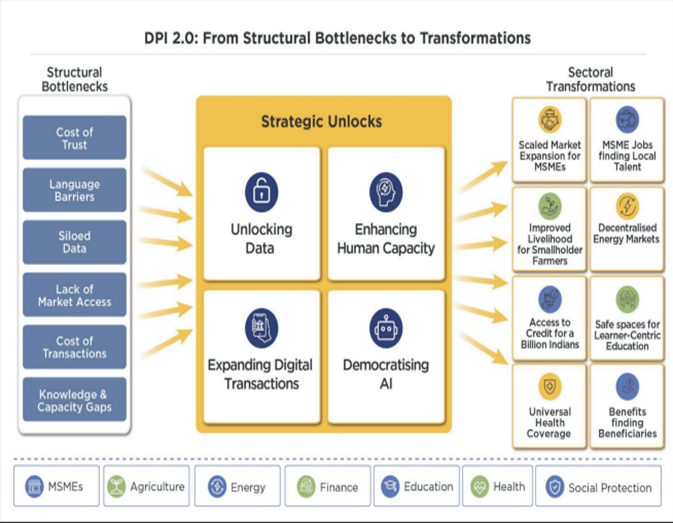
- For DPI 2.0, the roadmap identifies eight sectoral transformations and outlines four execution imperatives:
- District-led Demand Aggregation: Linking DPI initiatives with district-level development goals to ensure hyper-local adoption and create demand for digital solutions.
- Scaling Technology Entrepreneurship: Expanding India’s base of innovators through incubators, accelerators, mission-driven R&D, and enabling policy frameworks to build a distributed innovation ecosystem.
- Leveraging AI Momentum: Using AI as a key productivity engine to solve structural challenges and ensure its accessibility for both citizens and enterprises.
- Cross-Sectoral Strategic Unlocks: Include unlocking data for insights and trust-based systems, democratising AI to remove digital and language barriers, enhancing human capacity and knowledge access, and expanding digital transactions through open networks.
Key Sectoral Transformations under DPI 2.0
- Mass Inclusion at Scale (Livelihood Expansion):
- MSME Market Expansion: Enabling access to market intelligence, improving market linkages, and simplifying compliance processes to unlock growth for small enterprises.
- Local Job Matching: Making MSMEs digitally visible to connect them with local talent, turning job fulfilment into a low-cost, high-trust transaction.
- Smallholder Farmer Empowerment: Providing farmers with advisory services, credit access, and stronger market linkages to improve income and resilience.
- Foundations of Human Capability:
- Learner-Centric Education Ecosystem: Creating safe, inclusive, and digital learning spaces aligned with NEP, ensuring equitable access to content in local languages and continuous learning pathways.
- Universal Health Coverage: Building systems where a single health crisis does not push families into poverty, ensuring healthcare access irrespective of financial status.
- Systemic Enablers:
- Access to Credit for a Billion Indians: Leveraging monetizable assets and digital systems to expand microcredit access at scale.
- Decentralised Energy Markets: Enabling efficient utilisation of renewable energy to meet growing and unmet demand.
- Benefits Delivery Systems: Ensuring that welfare benefits reach all eligible citizens in a timely, transparent, and inclusive manner.
Key Achievements of DPI 1.0
- India’s DPI 1.0 laid the foundation for mass inclusion and digital governance at scale, enabling rapid expansion of services and economic activity.
- Aadhaar: Over 1.3 billion people covered, enabling 80–90 million daily authentications.
- UPI: Handles hundreds of millions of daily transactions, becoming the world’s largest real-time payment platform.
- It demonstrated the power of open, interoperable digital rails, contributing nearly 1% of GDP today and projected up to 4% by 2030.
- Significance:
- Established digital identity, payments, and financial inclusion at population scale.
- Created the foundation for DPI 2.0 expansion into productive sectors.
Way Forward / Call to Action
- State-led, decentralised execution models to ensure contextual and scalable solutions.
- Iterative 2-year transformation cycles, allowing experimentation, learning, and scaling of successful models.
- Initial focus (2026–27) on MSMEs and agriculture, with lighthouse pilots in select states followed by wider rollout.
- Building a strong entrepreneurial ecosystem aligned with DPI demand.
- Establishing a global DPI collaboration platform to position India as a leader in DPI and AI for public good.