
SYLLABUS
GS-1: Indian Culture – Salient aspects of Art Forms, Literature and Architecture from ancient to modern times.
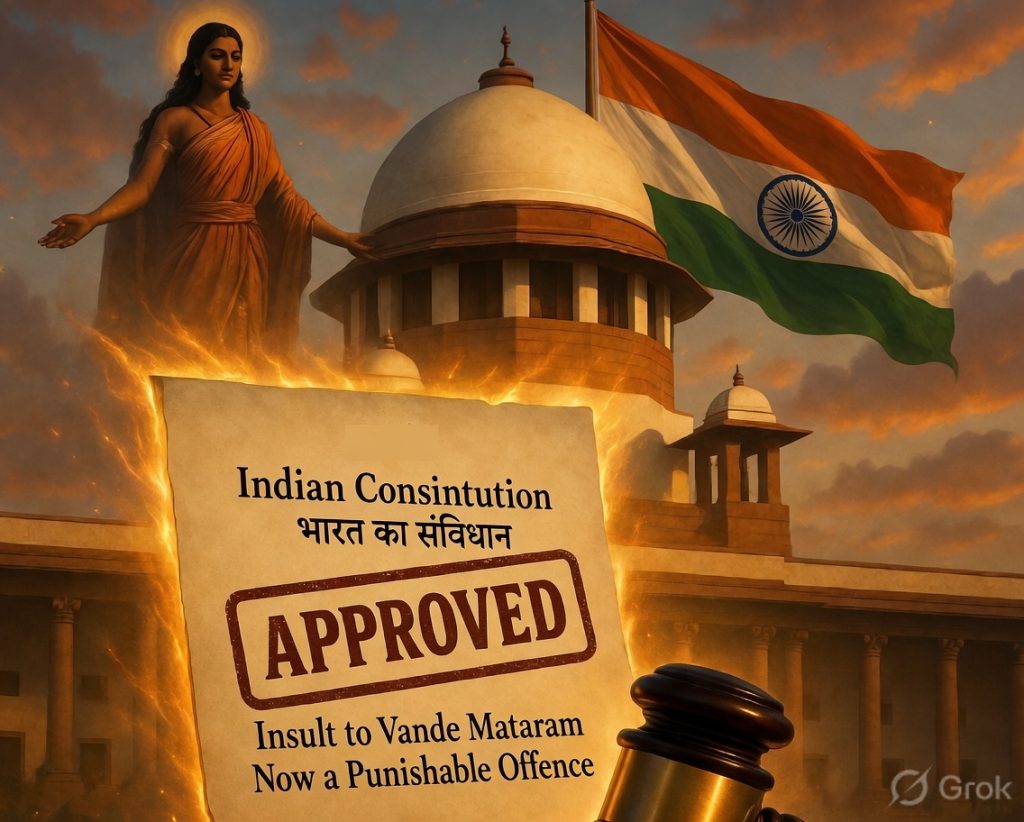
Context: The Union Cabinet recently approved a proposal to amend the Prevention of Insults to National Honour Act, 1971, to make insulting or obstructing the singing of Vande Mataram a punishable offence.
More on the News
- The Cabinet approved amendments to Section 3 of the Prevention of Insults to National Honour Act, 1971, which currently penalises intentional prevention or disturbance of the National Anthem.
- The proposed amendment seeks to place Vande Mataram, India’s National Song, on a legal footing similar to that of the National Anthem, Jana Gana Mana.
- Once enacted by Parliament, intentional disruption, disturbance, or acts of disrespect during the singing of Vande Mataram may attract punishment of up to three years’ imprisonment, fine, or both.
- The move follows recent directives issued by the Union Ministry of Home Affairs to States and other government bodies encouraging the rendition of all six stanzas of Vande Mataram during official and ceremonial occasions, particularly in the context of the song’s 150th anniversary commemorations.
- The advisory also stated that when both are played at an event, Vande Mataram should be rendered before the National Anthem.
About Vande Mataram
- Vande Mataram was composed by Bankim Chandra Chattopadhyay in the 1870s and was later included in his novel Anandamath (1882).
- The song is primarily written in highly Sanskritised Bengali and invokes the motherland as a divine mother figure.
- The song was first sung at the 1896 session of the Indian National Congress (INC) in Kolkata by Rabindranath Tagore, marking its early association with the Indian freedom movement.
- During the Swadeshi Movement (1905) against the Partition of Bengal, Vande Mataram emerged as a powerful slogan of anti-colonial nationalism and became closely associated with India’s freedom struggle.
- In 1937, leaders of INC decided to use only the first two stanzas of Vande Mataram at its gatherings, as later stanzas contain explicit devotional references to Hindu deities, which some communities found objectionable and exclusionary during the inclusive‑mass‑phase of the freedom movement.
- In 1950, the Constituent Assembly accorded Vande Mataram the status of the National Song, while Jana Gana Mana was adopted as the National Anthem.
About the Prevention of Insults to National Honour Act, 1971
- The Act was enacted to prevent disrespect toward India’s key national symbols, including:
- The National Flag
- The Constitution of India
- The National Anthem.
- Section 3 of the Act currently prescribes punishment for intentionally preventing the singing of the National Anthem or causing disturbance to an assembly engaged in such singing.
- Punishment under the Act may extend to – Three years’ imprisonment, or Fine, or Both.
- The proposed amendment seeks to extend similar statutory protection to Vande Mataram.