

SYLLABUS
GS-2: Government Policies and Interventions for Development in various sectors and Issues arising out of their Design and Implementation; Important Aspects of Governance.
Context: The University Grants Commission (UGC) has directed Higher Educational Institutions (HEIs) to upload students’ academic credit data to the National Academic Depository–Academic Bank of Credits (NAD-ABC) portal by June 30, 2026, bringing renewed attention to the ABC and APAAR as key pillars of India’s digital education ecosystem.
More on the News
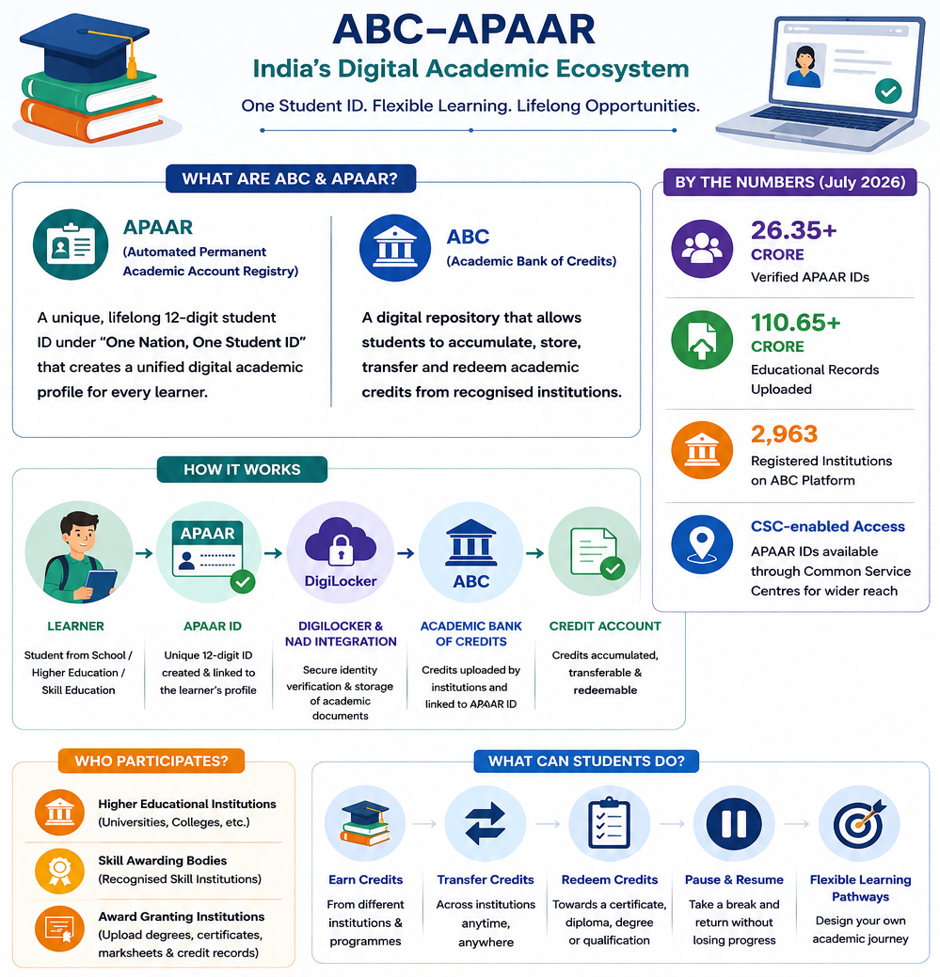
- As of July 2026, over 26.35 crore verified APAAR IDs have been generated, making it one of the world’s largest student digital identity initiatives.
- As per official data, 2,963 institutions have registered on the platform, while more than 110.65 crore educational records have been uploaded
- APAAR and ABC are increasingly integrating records across school education, higher education, and skill development, while APAAR IDs can also be generated through Common Service Centres (CSCs) to enhance accessibility in remote areas.
Understanding the Digital Architecture: ABC and APAAR
- APAAR (Automated Permanent Academic Account Registry) is a unique lifelong student identifier developed under the “One Nation, One Student ID” initiative. It creates a unified digital academic identity for learners and enables the integration of records across school education, higher education, skill development, and lifelong learning pathways.
- Academic Bank of Credits (ABC), introduced under the National Education Policy (NEP) 2020, is a digital repository that enables students to accumulate, store, transfer, and redeem academic credits earned from recognized institutions. It functions as a virtual academic credit bank, allowing learners to retain and utilize credits across different programmes and institutions.
- The ecosystem operates through the NAD-ABC platform, which links learners, Higher Educational Institutions (HEIs), Skill Awarding Bodies, and regulatory authorities. Academic credits, marksheets, certificates, and degrees are uploaded by authorized institutions and mapped to a learner’s APAAR-linked profile.
- By integrating with platforms such as DigiLocker and leveraging interoperable digital infrastructure, APAAR and ABC create a secure, portable, and verifiable academic record system. This supports the Multiple Entry and Exit (MEE) framework and the National Credit Framework (NCrF), enabling learners to pursue flexible educational pathways without losing previously earned credits.
Significance for India’s Education System
- Enhanced Academic Mobility: Students can transfer credits across institutions and programmes, reducing barriers to mobility and promoting a more flexible higher education ecosystem.
- Operationalising Multiple Entry and Exit: The system enables learners to pause and resume their educational journey while preserving earned credits, a key reform envisaged under NEP 2020.
- Integrated Lifelong Learning Ecosystem: By linking records from school education, higher education, and skill development, the platform supports continuous learning, reskilling, and upskilling throughout an individual’s life.
- Greater Transparency and Credibility: Digitally verified academic records reduce document fraud, simplify credential verification, and enhance trust in educational qualifications.
- Improved Digital Governance: A unified digital academic architecture streamlines record management, reduces administrative burdens, and promotes efficient service delivery across educational institutions.
Future Implications / Challenges
- Data Privacy and Security: Protecting sensitive student information and ensuring robust consent-based data sharing mechanisms will be critical for sustaining public trust.
- Institutional Readiness and Standardisation: Effective implementation requires timely uploading of records, interoperable systems, and standardised credit frameworks across institutions.
- Awareness and Adoption: Wider awareness among students and proactive participation by educational institutions are necessary to fully realise the benefits of the ecosystem.
- Bridging the Digital Divide: Ensuring equitable access to digital infrastructure and services, particularly in remote and underserved regions, remains essential for inclusive implementation.