
SYLLABUS
GS-2: Functions and responsibilities of the Union and the States, issues and challenges pertaining to the federal structure. Parliament and State legislatures—structure, functioning, conduct of business, powers & privileges and issues arising out of these.
Context: The Parliament has passed the Kerala (Alteration of Name) Bill, 2026, proposing to change the name of the State from Kerala to Keralam, reflecting its Malayalam name and pronunciation.
More on the News
- The Bill seeks to amend the First Schedule of the Constitution, where the State is officially listed as “Kerala”.
- The Kerala Legislative Assembly had unanimously passed a resolution on 24 June 2024 requesting the Centre to change the State’s name to “Keralam”; the Union Cabinet approved the proposal in February 2026.
- Following the Cabinet approval, the proposal was referred to the Kerala Legislative Assembly under the proviso to Article 3, and the Assembly unanimously approved it in July 2026, after which the Bill was introduced in Parliament.
Evolution of the Name “Keralam”
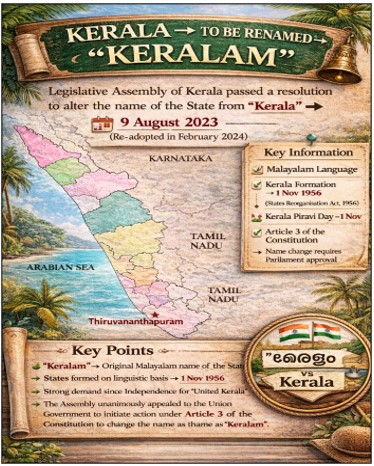
- Ancient reference: The earliest historical trace of the name dates back to the 3rd century BCE, when the region was referred to as “Keralaputra” in Rock Edict II of Ashoka.
- Aikya Kerala Movement: In the 1920s and 1940s, the Aikya Kerala Movement emerged as a strong socio-political campaign demanding the unification of Malayalam-speaking regions into one State.
- Travancore–Cochin: On 1 July 1949, the princely States of Travancore and Cochin were merged to create Travancore–Cochin.
- Formation of Kerala: On 1 November 1956, under the States Reorganisation Act, the modern State was formed on linguistic lines.
- Although popularly known in Malayalam as “Keralam”, it was officially entered as “Kerala” in the First Schedule of the Constitution.
- 2023 Resolution: On 9 August 2023, the Kerala Legislative Assembly unanimously passed a resolution requesting the Central Government to amend the Constitution and officially adopt “Keralam” in all languages listed in the Eighth Schedule.
- 2024 Resolution: Following technical observations by the Ministry of Home Affairs, the Assembly refined its proposal and, on 24 June 2024, passed a second unanimous resolution limiting the amendment to the First Schedule of the Constitution.
The Procedure to Rename a State in India
- Constitutional Basis: Parliament holds the authority to change the name of a State under Article 3 of the Constitution of India.
- Introduction of the Bill: A Bill for renaming a State can be introduced in either House of Parliament only on the recommendation of the President.
- Reference to State Legislature: The President refers the Bill to the concerned State Legislature for expressing its views within a specified period.
- Views Not Binding: The views or suggestions of the State Legislature are not binding on Parliament.
- Parliamentary Passage: The Bill is passed by a simple majority of members present and voting.
- Article 4: A law made under Article 3 may include consequential amendments to the First Schedule and Fourth Schedule and is not treated as a constitutional amendment under Article 368.
- Presidential Assent: After being passed by both Houses of Parliament, the Bill is presented to the President for assent; upon receiving assent and coming into force, the State’s name stands officially altered.
Some Recent Instances of Similar Demands
- West Bengal to Bangla/Paschim Bongo: Proposals have included “Paschim Bongo” (2011) and “Bangla” in 2018; however, the proposal has not yet received final approval from the Union Government.
- Delhi to Indraprastha: An MP proposed renaming the national capital to “Indraprastha” in February 2026 to restore its ancient civilizational identity.
- Odisha: The State was renamed from Orissa to Odisha in 2011, with the language changed from Oriya to Odia.
- Uttarakhand: The region was initially renamed Uttaranchal; in 2007, it was officially renamed Uttarakhand following popular demand.
- Puducherry: Pondicherry was renamed Puducherry in 2006 to reflect Tamil linguistic identity.