
SYLLABUS
GS-3: Indian Economy and issues relating to planning, mobilization of resources, growth, development and employment.
Context: NITI Aayog has released the report titled Key Sectors to Position India as a Global Manufacturing Hub – Volume 1, identifying 12 priority manufacturing sectors with strong potential for global competitiveness, local value addition, job creation and deeper integration into global supply chains.
About the Report
- The report, prepared by NITI Aayog in collaboration with CRISIL Intelligence, assesses India’s manufacturing landscape in relation to global trends, sectoral growth opportunities and global benchmarks.
- The 12 priority sectors are automobiles, electronics, steel, capital goods, defence and drones, chemicals, solar photovoltaic, textiles, pharmaceuticals and medical devices, telecom equipment, leather and footwear, and food processing.
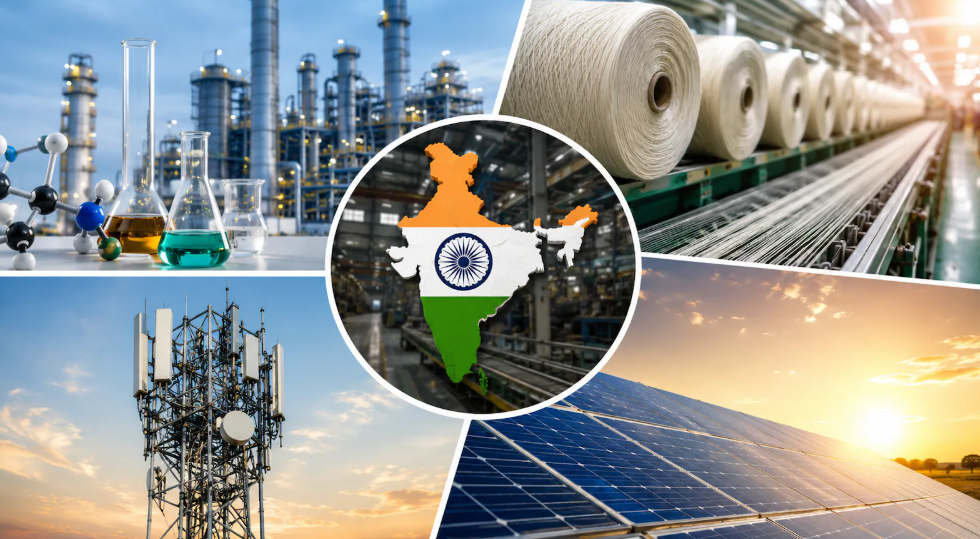
- The report will be released in three volumes, with Volume I covering four sectors—Chemicals, Textiles, Solar PV Manufacturing, and Telecom & Networking Products.
Key Findings of the Report
- Manufacturing position: Manufacturing accounts for 17.5% of India’s Gross Value Added (GVA), with its share broadly stagnant at 16–18% for nearly two decades.
- India’s share in global manufacturing value increased from around 1.5% in 1995 to 3.2% in 2023, compared with China’s rise from about 5% to nearly 32%.
- Four-phase assessment: The study involved shortlisting sectors based on relative attractiveness, comprehensive assessment of market potential and competitiveness, benchmarking international best practices, and developing actionable sector-specific recommendations.
- Global opportunity: Global companies are diversifying supply chains, providing India an opportunity to attract manufacturing, build productive capacity and expand its presence in global production networks.
- Chemicals: Domestic chemical consumption is projected to reach US$290–310 billion by FY2030. India needs faster production growth, stronger downstream production, better feedstock utilisation and reduced import dependence.
- Textiles: India is the sixth-largest textile and apparel exporter, accounting for 4.1% of global exports, while the sector provides livelihoods to more than 45 million people and contributes around 2% of GDP, 11% of manufacturing GVA and 9% of merchandise exports.
- Telecom and networking equipment: India is the world’s second-largest telecommunications market, with more than 1.2 billion subscribers.
- More than 80% of critical components are sourced from China.
- The National Telecom Policy 2025 targets doubling the sector’s GDP contribution and exports, creating one million jobs and increasing investment and research and development expenditure by 2030.
- Solar photovoltaic: India had 106 GW of installed solar capacity by March 2025 and needs around 174 GW more to achieve the 2030 target of 280 GW.
- Module manufacturing capacity reached 100 GW in August 2025, while cell capacity reached 25 GW.
- Common constraints: Key challenges include import dependence, fragmented supply chains, infrastructure and logistics gaps, limited domestic value addition, technology constraints and skill shortages.
Recommendations of the Report
- Strengthen Domestic Value Addition: Move beyond assembly-led manufacturing by expanding domestic value addition in chemicals, solar PV and telecom components.
- Promote Technology, R&D and Scale: Promote technology partnerships, R&D, technology transfer and economies of scale to improve productivity and competitiveness.
- Develop Manufacturing Ecosystems: Develop integrated industrial and clean-tech clusters with better infrastructure, logistics, testing, supply chains and industry-led skills.
- Expand Global Market Access: Leverage free trade agreements, trade partnerships and supply-chain diversification to strengthen exports and global market access.
- Adopt Differentiated Policy Responses: Address sector-specific constraints through targeted policy support and stronger government–industry collaboration.