
Context: In his Independence Day 2026 address, the Prime Minister presented the ‘Saptadhara’ (Seven Streams) Roadmap to transform India into a developed nation by 2047. The roadmap focuses on seven major areas of development.
What is Viksit Bharat @2047?
- The Vision for India in 2047, known as ‘Viksit Bharat’ (Developed India), aims to transform the country into a developed economy by the time it celebrates the 100th anniversary of its independence. It is an initiative launched by NITI Aayog, India’s premier think tank, to prepare a roadmap or blueprint for India’s development over the next 25 years.
- The objective of this initiative is to make India a global leader in innovation and technology, which will also serve as a model country in terms of human development and social welfare and will be a strong advocate of environmental sustainability. Achieving this ambitious goal requires comprehensive efforts across various sectors, with science and technology playing a crucial role.
- Seven Major Areas of the Saptadhara:
- Manufacturing Power: Developing the entire production chain in the country, from raw materials to finished products, and manufacturing high-quality Zero-Defect products.
- Agriculture and Food Production: Strengthening the system from farm to market and exports, promoting chemical-free agriculture, and giving Indian agricultural products a global identity.
- Technology and Innovation: Promoting modern technologies such as AI, quantum technology, space technology, robotics, data centres and 6G.
- Gati Shakti: Developing high-speed railways, roads, waterways, airports and ports to create a fast and efficient multimodal transportation system.
- Defence Power: Promoting self-reliance in the defence sector and developing new capabilities such as drones, anti-drone systems and hypersonic technology.
- Green and Blue Economy: Promoting green hydrogen, renewable energy, energy storage and green transportation, while making better use of marine resources.
- India’s Soft Power: Strengthening India’s global identity through Yoga, Ayurveda, culture, handicrafts, films, VFX, animation, gaming and digital content.
- Current Status of the Indian Economy:
- India revised its GDP series in 2026 with a new base year, with the current base year being 2022–23.
- For 2025–26, nominal GDP was revised downward from ₹357 lakh crore to ₹345 lakh crore, indicating an earlier overestimation.
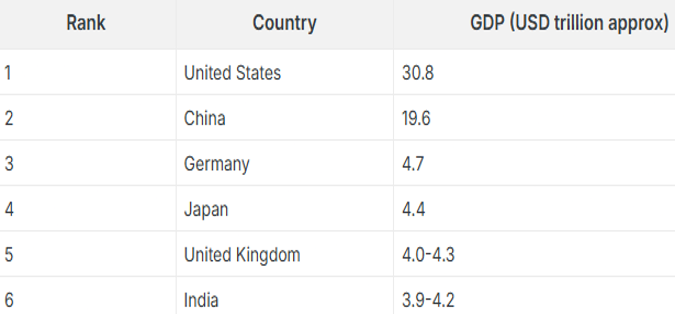
- This revision reduced India’s GDP in dollar terms from approximately $4.1 trillion to $3.9 trillion.
- According to the IMF World Economic Outlook (2026), India is currently the sixth-largest economy in the world.
- According to IMF projections, India is likely to overtake Japan by 2027 to become the fourth-largest economy in the world.
- By 2031, India is projected to overtake Germany and become the third-largest economy in the world.
- India is among the fastest-growing major economies in the world.
- Strong domestic demand, public investment, the digital economy and the services sector are the major drivers of India’s growth.
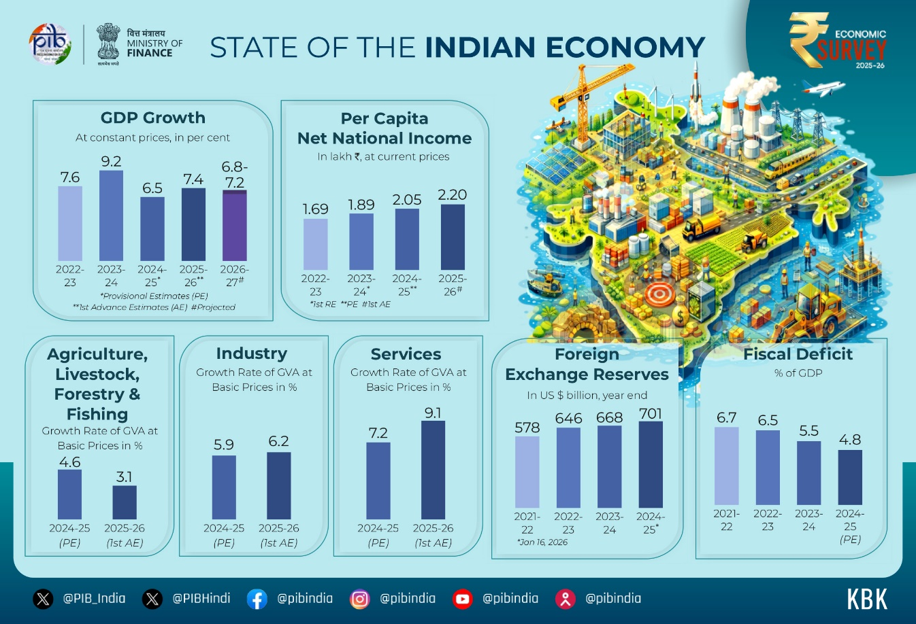
- The Ministry of Statistics and Programme Implementation (MoSPI) has released provisional estimates of national income, showing that India’s GDP growth rate increased to 7.7% in FY 2025–26, compared with 7.1% in FY 2024–25.
- India’s real GDP growth rate for the entire financial year 2025–26 was 7.7%, which is higher than the 7.6% estimate released in February 2026.
- According to the Economic Survey 2025–26, real GDP growth in FY 2025–26 was estimated at approximately 7.4%.
- Economic growth in FY 2026–27 is expected to remain in the range of 6.8%–7.2%.
- The Reserve Bank of India (RBI), considering potential risks arising from the geopolitical crisis in West Asia and the possibility of below-normal monsoon, revised its GDP growth projection for FY 2026–27 from 6.9% to 6.6%.
- Foreign Exchange Reserves:
- India’s foreign exchange reserves have remained strong at around US$700 billion.
- This strengthens the country’s ability to meet import payments, maintain exchange-rate stability and deal with external economic shocks.
- Inflation:
- India’s Consumer Price Index (CPI)-based inflation for May 2026 was approximately 3.93%. In contrast, due to a rise in fuel and electricity prices, Wholesale Price Inflation (WPI) reached a high level of 9.68%.
- The RBI’s inflation target is 4% ± 2%.
- Currently, CPI-based inflation remains within the RBI’s target range.
- India revised its GDP series in 2026 with a new base year, with the current base year being 2022–23.
- Agenda for Developed India by 2047:
- This is a comprehensive vision plan aimed at transforming India into a developed nation by 2047, which will mark the 100th anniversary of India’s independence.
- The four pillars of Viksit Bharat are:
- Youth, Poor, Women and Farmers.
- Achieving this vision requires comprehensive efforts in areas such as economic growth, social equality, global competitiveness, environmental sustainability, industrial modernization and good governance.
- Economic Growth:
- India has set a target of achieving an annual GDP growth rate of 7–8% to achieve sustained economic growth.
- According to NITI Aayog, India’s GDP could reach US$30 trillion by 2047, based on the assumption that India’s real GDP grows at an average annual rate of more than 9%.
- According to the PHD Chamber of Commerce and Industry (PHDCCI), India’s GDP is expected to exceed US$7 trillion by 2030 and reach US$34.7 trillion by 2047.
- Per capita income: It is estimated to reach US$4,667 by 2030 and US$21,000 by 2047.
- Sectoral Contribution to GDP by 2047:
- Agriculture: Expected to decline from 20% in FY 2023 to 12%.
- Industrial Sector: Expected to reach 34%.
- Manufacturing Sector: Targeted to reach 25%.
- Services Sector: Expected to remain around 54%.
- Initiatives such as Make in India and Aatmanirbhar Bharat (Self-Reliant India) promote domestic manufacturing and reduce import dependence.
- Production Linked Incentive (PLI) schemes provide financial incentives to major sectors such as electronics, pharmaceuticals and textiles.
- Social Equality:
- Efforts are underway for poverty eradication, universal healthcare and ensuring quality education.
- Programmes such as the Pradhan Mantri Garib Kalyan Anna Yojana (PMGKAY), which provides free food grains to the poor, and the National Education Policy (NEP) 2020, which reforms the education system, are key components of this strategy.
- Industrial Modernization:
- Under the Make in India initiative, promoting manufacturing to contribute 25% of GDP is a major objective.
- Maritime India Vision 2030 and Amrit Kaal Vision 2047 aim to develop the maritime sector, including ports, shipping and waterways.
- Efforts to modernize port operations, develop green hydrogen/ammonia hubs, and promote cruise tourism are part of this strategy.
- Global Competitiveness:
- The PM Gati Shakti Master Plan integrates infrastructure projects across sectors to accelerate development.
- The Digital India initiative expands internet access and promotes fintech adoption while supporting e-governance and digital services.
- Environmental Sustainability:
- India has set a target of achieving net-zero emissions by 2070 and increasing the adoption of renewable energy.
- Initiatives such as the Green India Mission focus on renewable energy and sustainable urban development.
- Major Strengths of the Indian Economy:
- India has a large domestic market and strong domestic demand.
- A rapidly expanding digital economy.
- Strong services sector.
- Growing public and infrastructure investment.
- Large and expanding working-age population.
- Increasing capabilities in manufacturing, technology and innovation.
- Strong potential in renewable energy and green technologies.
- Challenges:
- Economic inequalities, infrastructure gaps, policy uncertainty, environmental concerns, skill development, rural youth and global risks continue to remain major challenges.
- Other Challenges:
- Middle-income trap
- Ageing population
- Maintaining a high GDP growth rate
- Rupee–dollar exchange rate
- Geopolitics and regional integration
- Low labour force participation
- Solutions:
- To address the above challenges, there is a need for continued fiscal and monetary policies, skill development, promotion of exports, rural development and expansion of renewable energy capacity.
- Other Measures:
- Targeting large-scale and rapid disinvestment
- Strengthening and expanding the middle class
- Increasing labour force participation
- Accelerating the infrastructure pipeline
- Leveraging progress in the manufacturing sector
- Promoting private investment
- Implementing structural reforms
- Increasing capital accumulation
Conclusion: Viksit Bharat @2047 is not merely a commitment of the government but a shared dream of every Indian. This initiative provides a pathway for establishing India as a leading global power.