

SYLLABUS
GS-3: Issues related to Direct and Indirect Farm Subsidies; Issues of Buffer Stocks and Food Security.
Context: The Cabinet Committee on Economic Affairs (CCEA) has approved the National Investment Policy for Urea-2026 (NIPU-2026) to encourage investment in gas-based urea manufacturing units and strengthen India’s self-reliance in urea production under Atmanirbhar Bharat.
About the National Investment Policy for Urea-2026 (NIPU-2026)
• Nodal Department: Department of Fertilizers, Ministry of Chemicals and Fertilizers.
• Objective: Promote fresh investment in gas-based urea manufacturing units to increase indigenous urea production and reduce import dependence.
• Coverage: All new gas-based urea manufacturing projects under the policy.
• Applicability: Uniform incentives for public sector, private sector and cooperative sector projects.
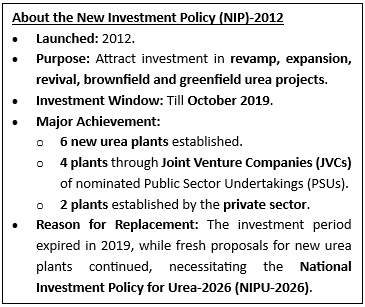
• Reason for the Policy: Introduced after the investment window under New Investment Policy (NIP)-2012 expired in October 2019, while new proposals for urea plants continued to be received.
• Key Features:
- Separate treatment of fixed and variable costs for greater transparency in pricing.
- Return on Equity (RoE) band introduced with Minimum (12%) and Maximum (16%).
- Foreign exchange risk mitigation by converting fixed costs into Indian Rupees after four years based on prevailing exchange rates.
- Expected to generate savings of over ₹250 crore per plant compared with projects established under NIP-2012.
• Targets under NIPU-2026:
- Encourage establishment of 8–9 new gas-based urea plants.
- Create an additional production capacity of about 10 million tonnes annually.
- Achieve self-sufficiency in urea production and substantially reduce or eliminate imports.
• Expected Outcomes:
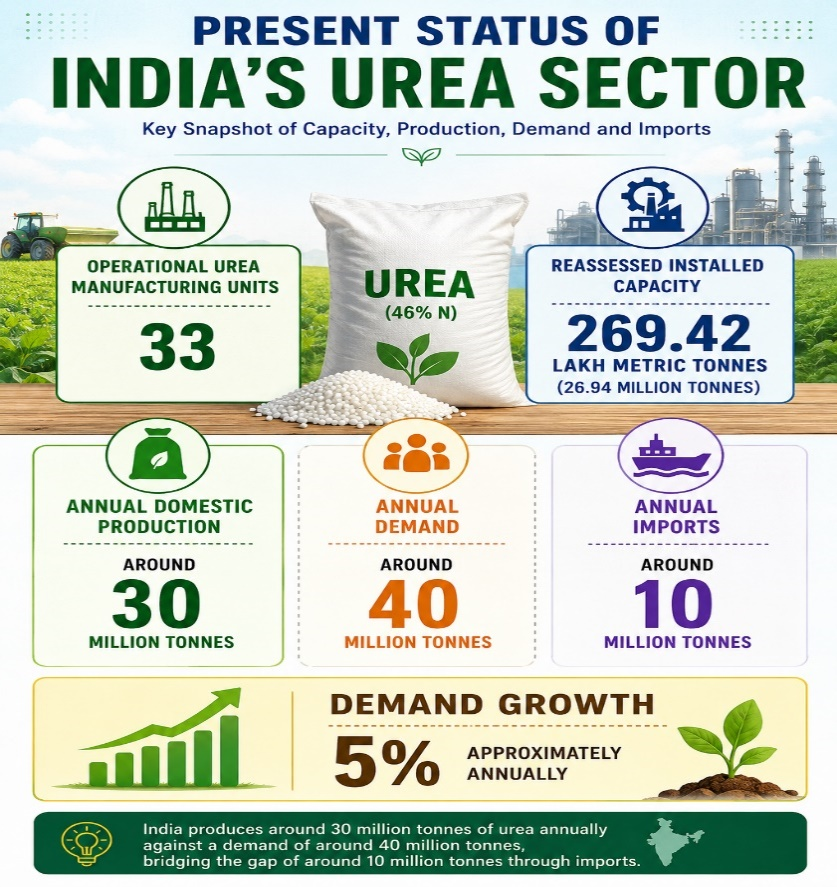
- Narrow the gap between domestic demand and indigenous production.
- Improve transparency and financial viability of new urea projects.
- Save foreign exchange by reducing fertilizer imports.
- Ensure a stable and reliable supply of urea for Indian agriculture.
- Strengthen India’s fertilizer security under Atmanirbhar Bharat.
Significance
• Strengthens Fertilizer Security: Expands domestic urea production, reducing dependence on imports and ensuring a more reliable supply of a critical agricultural input.
• Advances Atmanirbhar Bharat: Promotes indigenous manufacturing capacity, making India progressively self-reliant in urea production.
• Catalyses Private and Public Investment: Introduces a transparent and predictable incentive framework that encourages investment by public, private and cooperative sectors in gas-based urea plants.
• Improves Fiscal Efficiency: The revised pricing framework and policy design are expected to reduce project costs, generating savings of over ₹250 crore per plant compared with NIP-2012.
• Reduces Import Dependence and Saves Foreign Exchange: Higher indigenous production lowers urea imports, reducing exposure to global market uncertainties and conserving valuable foreign exchange.
• Promotes Industrial Growth and Employment: Establishment of new urea plants will stimulate industrial activity, strengthen the domestic fertilizer manufacturing ecosystem and generate direct and indirect employment.