
SYLLABUS
GS-2:e-governance- applications, models, successes, limitations, and potential.
GS-3:Infrastructure: Railways.
Context: Indian Railways has approved two Kavach projects worth ₹341 crore covering 1,409 route kilometres (RKM), reinforcing efforts to enhance railway safety and modernise signalling infrastructure across the network.
More on the News
- The projects include ₹201 crore for 811 RKM in Ambala Division and ₹140 crore for 598 RKM in Ahmedabad Division for the deployment of Kavach 4.0.
- The projects are being implemented under the umbrella programme for the provision of Kavach with an LTE-based communication backbone across the remaining routes of Indian Railways.
- Kavach rollout is being prioritised on High-Density Network (HDN) and Highly Utilised Network (HUN) routes, which together carry the overwhelming majority of railway traffic.
- As of March 2026, the progress achieved are:
- 3,103 RKM equipped with Kavach.
- 767 stations and 4,277 locomotives fitted with the system.
- 8,570 km of Optical Fibre Cable (OFC) laid and 1,100 telecom towers installed.
About Kavach System
- What is Kavach?
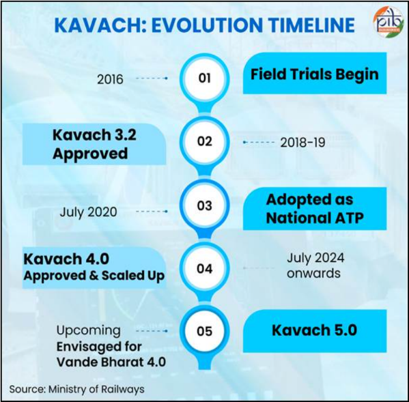
- Kavach is an indigenously developed Automatic Train Protection (ATP) system developed by the Research Designs and Standards Organisation (RDSO) in collaboration with the Indian industry.
- It was initially developed as the Train Collision Avoidance System (TCAS) and was adopted as the national ATP system of Indian Railways in 2020.
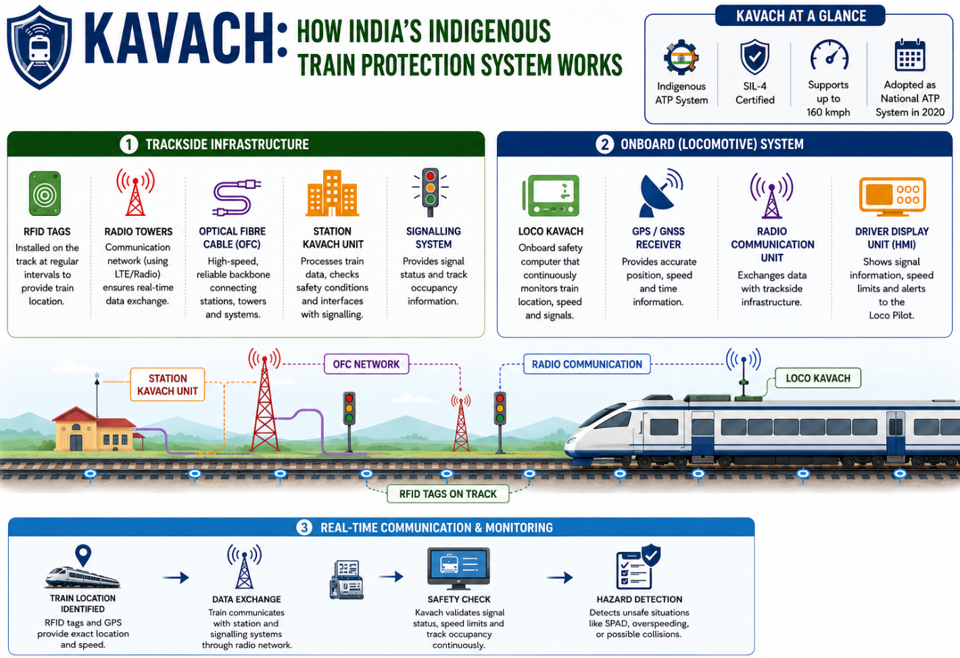
- Kavach 4.0 has been certified to Safety Integrity Level-4 (SIL-4), the highest level of railway safety assurance, and it supports train operations up to 160 kmph.
- Key Features and Components:
- Prevents Signal Passing at Danger (SPAD).
- Automatically applies brakes to prevent collisions and overspeeding.
- Enforces speed restrictions and assists train operations during fog or low-visibility conditions.
- Provides in-cab signal information to loco pilots.
- Uses an integrated network of:
- RFID tags along the track,
- onboard locomotive equipment,
- station-based Kavach systems,
- telecom towers and radio communication,
- Optical Fibre Cable (OFC) network.
Significance of Kavach Deployment
- Enhancing Railway Safety: Reduces the risk of collisions, overspeeding and signal violations by providing automatic intervention during unsafe situations.
- Minimising Human Error: Acts as a fail-safe system by supporting loco pilots and automatically applying brakes when required.
- Improving Network Capacity: Enables safer train operations at shorter intervals, thereby increasing line capacity and improving operational efficiency.
- Advancing Atmanirbhar Railway Technology: As an indigenously developed ATP system, Kavach strengthens India’s technological self-reliance while supporting the modernisation of the railway network.