
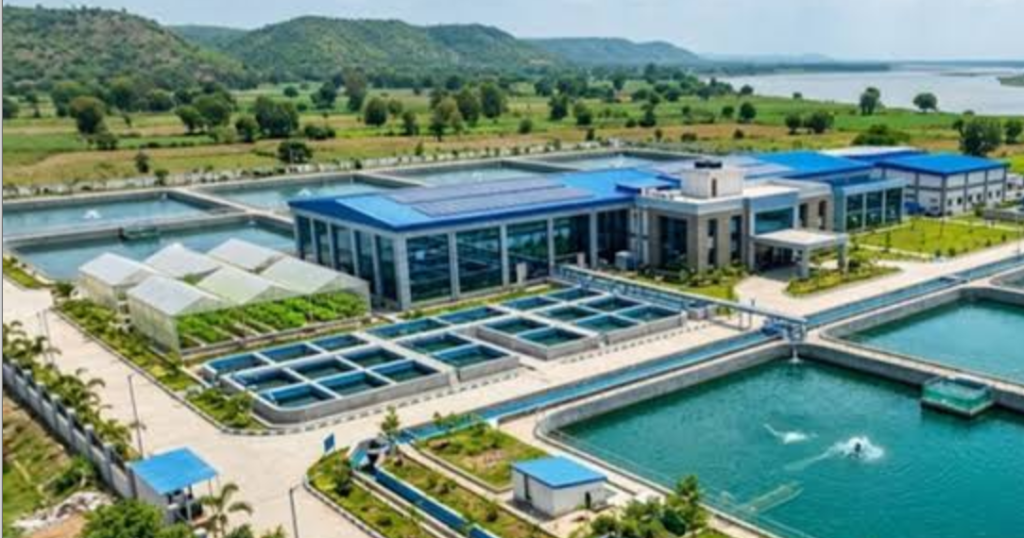
Context: On Thursday, Chief Minister Samrat Choudhary reviewed the Vision 2030–Bihar Fisheries Priority Project at ‘Sankalp’, Lok Sevak Awas, under which special fisheries clusters will be developed in several districts of Bihar.
Key Details
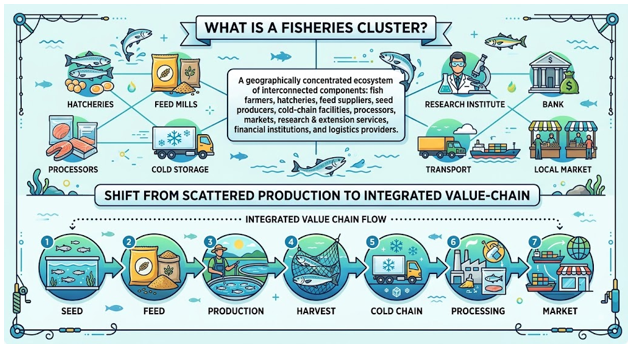
- The State will develop region-specific fisheries clusters based on local resource potential.
- The proposed focus areas include integrated fish-cluster development in Saran and Munger, large-scale freshwater fish farming in Saran, cage culture and fisheries development in Siwan, integrated fish farming in Madhubani, special fisheries clusters in Begusarai, Khagaria and Bhagalpur, and a large-scale integrated fisheries cluster in Purnea.
- Eight priority projects are proposed to develop 1,848.75 hectares of direct intervention area and 9,357 hectares of indirect impact area.
- The projects target creation of around 52,000 direct and indirect employment opportunities.
- The State has more than 93,000 hectares of water area under government and private water bodies combined, according to the Directorate of Fisheries’ district-wise data.
- Major rivers—including the Ganga, Kosi, Gandak, Son, Bagmati, Kamla and Mahananda—offer scope for inland fisheries, though flood and seasonal-water variability pose challenges.
- Bihar is implementing fisheries interventions under the Pradhan Mantri Matsya Sampada Yojana (PMMSY), which promotes production, productivity, post-harvest management, fishers’ welfare and sustainable fisheries.
Significance
- Higher productivity: Cluster-based input supply, training, technology and extension can improve fish yield and quality.
- Value addition: Cold storage, ice plants, processing, packaging and branding can reduce post-harvest losses and raise farmers’ returns.
- Blue economy: The initiative advances the inland-fisheries component of the blue economy and supports a sustainable resource-based rural economy.
Challenges
- Quality seed and feed: Limited access to disease-free seed, certified hatcheries and affordable quality feed can constrain productivity.
- Flood risk: Floods can damage ponds, cause fish escape and disrupt inputs and markets.
- Environmental concerns: Excessive use of feed, chemicals or antibiotics can affect water quality and ecosystem health.
Bihar to Use AI for Real-Time Hospital Bed Assessment
Context: Bihar is moving towards becoming the first state in the country to provide real-time information on the availability of ICU, ward and general beds in government hospitals through e-Hospital (e-Hospital) software.
Key Features
- The system will display the availability of ICU and general beds in government hospitals in real time.
- It will allow district-hospital doctors to identify where a critical patient can be referred and whether beds and doctors are available at a higher facility.
- The initiative will cover approximately 14,000 health facilities, including primary health centres, medical colleges and government hospitals.
- It is being integrated with the State’s electronic health-record system, enabling digital management of patient records and services.
Digital Health Components
- ABHA (Ayushman Bharat Health Account): A unique digital health ID for citizens.
- ABDM (Ayushman Bharat Digital Mission): Aims to build an interoperable and citizen-centric digital health ecosystem.
- The Ayushman Bharat Digital Mission (ABDM) functions under the Ministry of Health and Family Welfare (MoHFW), Government of India, and is implemented on the ground by the National Health Authority (NHA).
- HFR (Health Facility Registry): An official ABDM component providing a verified and comprehensive registry of health facilities across India.
- EHR (Electronic Health Record): A digital record of a patient’s health information.
- Telemedicine: Enables remote medical consultation through audio, video and digital platforms.
SraVaani: Multilingual Indian Speech Recognition Model
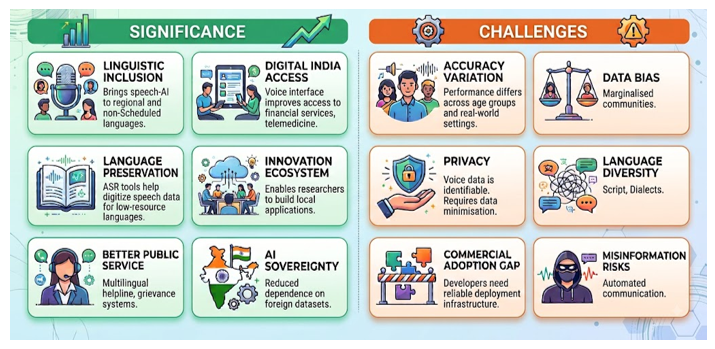
Context: Researchers at the Indian Institute of Science (IISc), working with ARTPARK and Google, have released SraVaani 1.0, an open-source automatic speech-recognition model trained on 65 Indian languages and dialects.
Key Points
- SraVaani is an Automatic Speech Recognition (ASR) model: it converts spoken words into written text.
- It has been developed by IISc’s SPIRE Lab and ARTPARK under the broader Project Vaani initiative.
- Project Vaani seeks to create a large open speech dataset representing natural speech across India’s districts, with an eventual target of more than 150,000 hours of audio from around one million people across 773 districts.
- The model supports 20 Scheduled languages and 45 regional languages and dialects.
- It supports languages and dialects including Angami, Angika, Awadhi, Bajjika, Beary Bashe, Bhili, Bhojpuri, Bundeli, Chakhesang, Chakma, Chhattisgarhi, Garo, Garhwali, Kokborok and Tulu.
BCI Withdraws Direction Against NALSAR Graduates
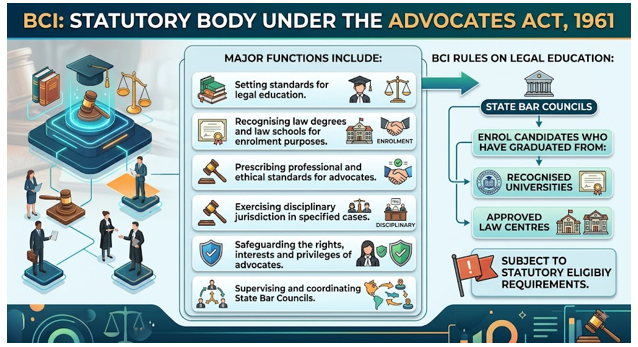
Context: The Bar Council of India (BCI) briefly directed State Bar Councils not to enrol 2026 graduates of the NALSAR University of Law, Hyderabad, as advocates. The order was withdrawn later the same day, and the BCI clarified that NALSAR graduates remain free to apply for enrolment with any State Bar Council.
Legal Framework
- Advocates Act, 1961
- The Act provides for the constitution of the Bar Council of India and State Bar Councils, and regulates enrolment and professional practice of advocates.
- Section 17: Every State Bar Council must prepare and maintain a roll of advocates.
- Section 24: Specifies eligibility for enrolment as an advocate, including citizenship requirements, a recognised law degree, fulfilment of State Bar Council rules and payment of applicable fees.
- Section 25: A candidate applies for enrolment to the State Bar Council within whose jurisdiction they propose to practise.
- An advocate cannot be enrolled with more than one State Bar Council.