
SYLLABUS
GS-2: India and its Neighborhood- Relations; Effect of Policies and Politics of Developed and Developing Countries on India’s interests, Indian Diaspora.
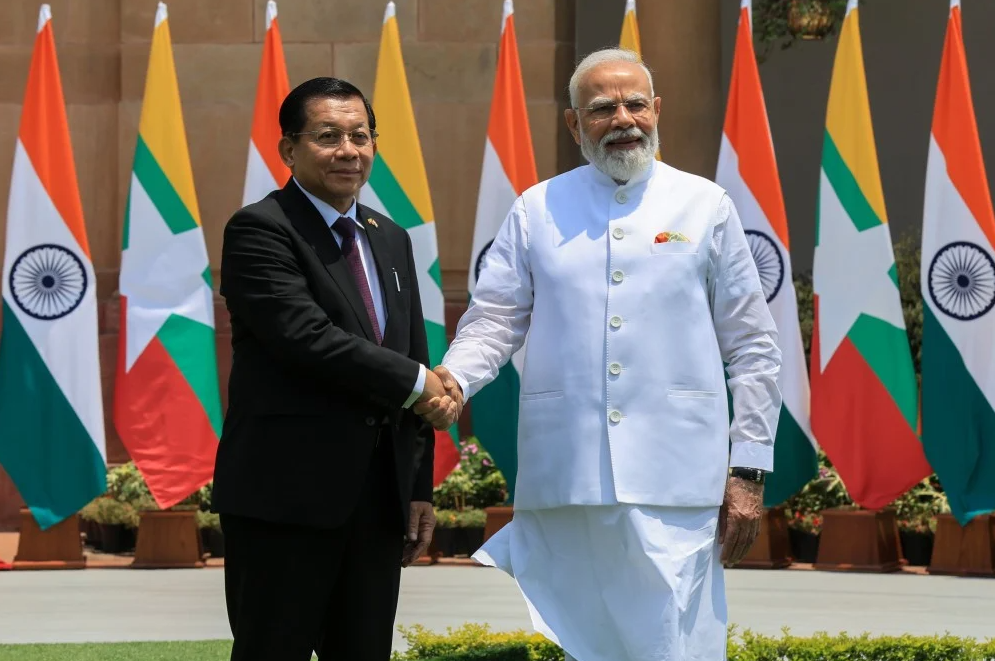
Context: Myanmar President U Min Aung Hlaing paid an official visit to India from 30 May to 3 June 2026, marking his first overseas visit since assuming office as President in April 2026.
More on the News
• The choice of India over China for President Min Aung Hlaing’s first official foreign visit highlighted the strategic significance of India–Myanmar ties and reflected the success of India’s pragmatic approach towards engaging Myanmar amidst evolving regional geopolitical dynamics.
• India reiterated its support for a stable, peaceful and prosperous Myanmar and emphasized the need for inclusive political reconciliation and development-led engagement.
• Both sides reviewed cooperation in regional and multilateral forums, including BIMSTEC, ASEAN-related mechanisms and the Mekong-Ganga Cooperation framework.
Key Outcomes of the Visit
• Connectivity Cooperation: Both sides reviewed progress on the Kaladan Multi-Modal Transit Transport Project and the India–Myanmar–Thailand Trilateral Highway and agreed to accelerate their implementation to enhance regional connectivity and economic integration.
• Trade and Economic Cooperation: The leaders agreed to deepen cooperation in trade, investment, infrastructure, agriculture, energy and border trade, with particular emphasis on promoting economic linkages between India’s Northeast and Myanmar.
• Security and Defence Cooperation: Myanmar assured India that its territory would not be used for activities inimical to India’s security interests and reaffirmed its commitment to cooperate in addressing insurgency, terrorism and other cross-border security challenges.
• Development Partnership and Capacity Building: India reiterated its support for Myanmar through development projects, border area development initiatives, Quick Impact Projects (QIPs), capacity-building programmes and training under the Indian Technical and Economic Cooperation (ITEC) framework.
• Humanitarian Assistance and Reconstruction: India reaffirmed its commitment to supporting Myanmar’s post-earthquake recovery, rehabilitation and reconstruction efforts, building upon assistance already extended under Operation Brahma.
• Cultural and Civilizational Cooperation: Both countries emphasized their shared Buddhist heritage and agreed to further strengthen cultural exchanges, religious tourism and people-to-people ties.
Significance of Myanmar for India
• Gateway to Southeast Asia: Myanmar serves as India’s land bridge to ASEAN and occupies a central position in the implementation of the Act East Policy, facilitating India’s engagement with Southeast Asia.
• Strategic Importance for Northeast India: Sharing a border of over 1,600 km with four Northeastern states, Myanmar is critical for enhancing regional connectivity and economic integration while addressing security challenges such as insurgency, cross-border terrorism, narcotics trafficking, and arms smuggling in India.
• Balancing China’s Influence: Myanmar occupies a pivotal position in the India–China strategic competition and remains critical for preventing excessive Chinese influence in India’s immediate neighbourhood and the Bay of Bengal region.
• Maritime and Indo-Pacific Significance: Myanmar’s strategic coastline along the Bay of Bengal enhances its importance for India’s SAGAR (Security and Growth for All in the Region) vision, maritime security architecture and broader Indo-Pacific strategy.
• Resource and Economic Security: Myanmar possesses significant reserves of natural gas, rare earth elements and other critical minerals, making it an important partner for India’s efforts to diversify energy and critical mineral supply chains.
India–Myanmar Bilateral Relations
• Political Relations
- India and Myanmar share deep historical, cultural and civilizational ties and maintain regular high-level political engagement.
- Myanmar is the only ASEAN country sharing a land boundary with India and occupies a central position in India’s Neighbourhood First Policy, Act East Policy and Indo-Pacific vision.
• Economic Relations
- India is among Myanmar’s largest trading partners, with bilateral trade conducted under the ASEAN–India Trade in Goods Agreement (AITIGA) and India’s Duty-Free Tariff Preference (DFTP) scheme.
- India has a growing investment presence in Myanmar, particularly in the oil & gas, power and infrastructure sectors, with energy cooperation emerging as an important pillar of the bilateral economic partnership.
• Connectivity Relations
- Myanmar is India’s only ASEAN neighbour connected through both land and maritime boundaries, making it a critical bridge between South Asia and Southeast Asia.
- The Kaladan Multi-Modal Transit Transport Project and India–Myanmar–Thailand Trilateral Highway form the backbone of India’s regional connectivity strategy.
• Defence and Security Cooperation
- India and Myanmar cooperate closely in addressing insurgency, cross-border terrorism, illegal migration, drug trafficking and arms smuggling.
- Myanmar has supported Indian efforts against insurgent groups operating along the border, such as NSCN-K and ULFA, which have historically maintained bases in Myanmar’s border regions.
• Cultural and People-to-People Relations
- Buddhism serves as a major civilizational bridge between the two countries, fostering strong cultural and spiritual linkages.
- Religious tourism, academic exchanges, scholarships and cultural cooperation continue to strengthen people-to-people contacts.