
SYLLABUS
GS-3: Achievements of Indians in science & technology; indigenization of technology and developing new technology; Awareness in the fields of Space.
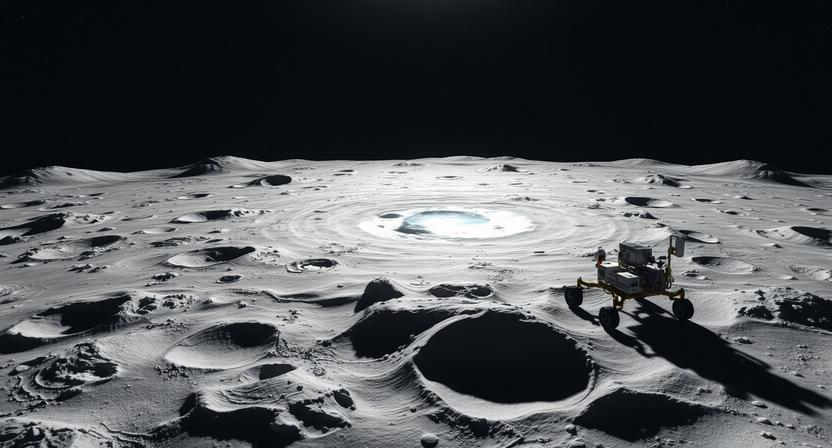
Context: Nearly six years after its launch, Chandrayaan-2 has provided fresh evidence suggesting the possible presence of subsurface water ice beneath permanently shadowed regions (PSRs) near the Moon’s south pole.
Key Findings of the Research
- Evidence of Subsurface Ice: Scientists from the Physical Research Laboratory (PRL), Ahmedabad, used Chandrayaan-2’s Dual Frequency Synthetic Aperture Radar (DFSAR) data to investigate lunar south polar regions.
- The study identified radar signatures consistent with the possible presence of subsurface water ice beneath the floors of four doubly shadowed craters.
- Study of Doubly Shadowed Craters: The research focused on doubly shadowed craters, located within Permanently Shadowed Regions (PSRs).
- These regions never receive direct sunlight and remain extremely cold (~25 K), making them ideal reservoirs for preserving water ice over billions of years.
- New Radar-Based Ice Detection Criterion: Scientists developed a refined method to identify subsurface ice using Circular Polarization Ratio (CPR) > 1 and Degree of Polarization (DOP) < 0.13.
- This combination indicates volumetric scattering; a radar signature potentially associated with buried ice.
- Distinguishing Ice from Rocky Terrain: The CPR-DOP criterion helps separate genuine ice signatures from radar reflections caused by rough rocky surfaces, improving the reliability of ice detection.
- Strongest Evidence from Faustini Crater: A 1.1 km diameter crater inside the Faustini crater showed the strongest indications of subsurface ice.
- The crater exhibits:
- High CPR values (>1)
- Low DOP values (<0.13)
- Distinctive lobate-rim morphology.
- Technological Achievement: DFSAR became the first fully polarimetric Synthetic Aperture Radar (SAR) sent to study the Moon.
- Operating in both L-band and S-band frequencies, it can probe below the lunar surface and detect buried ice deposits.
Significance of the Research
- Improves Understanding of Lunar Polar Volatiles: The findings provide new insights into the distribution and long-term preservation of water ice and other volatile materials in the Moon’s polar regions.
- Supports Future Lunar Exploration: The study helps identify potential ice-rich locations suitable for future robotic and human missions to the Moon.
- Enables In-Situ Resource Utilisation (ISRU): Lunar water ice could be utilized to produce drinking water, breathable oxygen, and hydrogen-oxygen rocket fuel for sustained lunar operations.
- Reduces Dependence on Earth-Supplied Resources: The availability of local water resources could significantly reduce the cost and logistical challenges of long-duration lunar missions.
- Strengthens India’s Contribution to Lunar Science: The discovery underscores the continued scientific success of Chandrayaan-2 and reinforces India’s growing role in global lunar exploration.
- Aids Future South Pole Missions: The findings provide valuable guidance for future missions targeting the Moon’s south polar region, including landing site selection and resource exploration.
About Chandrayaan-2
- Chandrayaan-2 was India’s second lunar exploration mission launched on 22 July 2019 by the GSLV Mk III-M1 rocket from Satish Dhawan Space Centre, Sriharikota.
- The mission consisted of:
- Orbiter
- Vikram Lander
- Pragyan Rover
- Major Objectives:
- Study lunar surface geology and mineralogy.
- Map lunar topography and morphology.
- Investigate the lunar exosphere.
- Search for and quantify water ice in polar regions.
- Examine the Moon’s surface and shallow subsurface properties.
- Mission Outcome: On 7 September 2019, communication with the Vikram lander was lost during the final descent phase.
- However, the Orbiter remained healthy and fully operational, continuing scientific observations around the Moon.
- Orbiter Orbit: The Chandrayaan-2 Orbiter currently operates in a 100 km × 100 km polar orbit around the Moon.
- Major Orbiter Payloads
- CLASS (Large Area Soft X-ray Spectrometer) – Elemental mapping of the lunar surface.
- CHACE-2 – Studies the lunar exosphere.
- DFSAR (Dual Frequency Synthetic Aperture Radar) – Detects water ice and studies subsurface features.
- IIRS (Imaging Infra-Red Spectrometer) – Maps minerals and water/hydroxyl signatures.
- DFRS (Dual Frequency Radio Science Experiment) – Studies the lunar ionosphere.
Sources :
Indian Express
The Hindu
ISRO
ISRO