
SYLLABUS
GS-2: Government policies and interventions for development in various sectors and issues arising out of their design and implementation.
GS-3: Indian Economy and issues relating to Growth, Development and Employment; Inclusive Growth and issues arising from it.
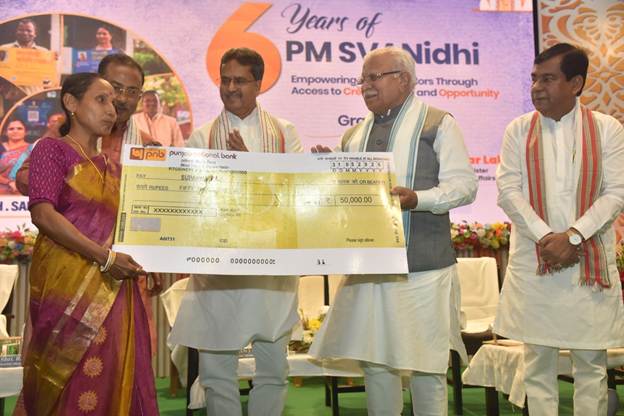
Context: PM Street Vendor’s AtmaNirbhar Nidhi (PM SVANidhi) has completed six years as a flagship micro-credit and financial inclusion scheme of the Ministry of Housing and Urban Affairs (MoHUA).
About PM SVANidhi
- PM Street Vendor’s AtmaNirbhar Nidhi (PM SVANidhi) is a Central Sector Scheme launched in June 2020 by the Government of India to support street vendors affected by the COVID-19 pandemic.
- It is implemented by the Ministry of Housing and Urban Affairs (MoHUA) in collaboration with the Department of Financial Services (DFS).
- The scheme has been extended till March 2030.
- Objective: The scheme aims to provide “Swarozgar, Svavlamban and Swabhimaan” (self-employment, self-reliance and dignity) to street vendors.
- Its objective is not merely to provide credit but also to promote financial security, social recognition, digital inclusion and sustainable livelihood opportunities.
- It seeks to reduce dependence on informal moneylenders who often charge exorbitant interest rates.
- Coverage: The scheme covers street vendors engaged in the sale of goods, food items and services in urban areas.
- It is the first dedicated micro-credit scheme for street vendors in India.
- Financial Assistance: Provides collateral-free working capital loans through three progressive tranches: ₹15,000 (First Tranche), ₹25,000 (Second Tranche) and ₹50,000 (Third Tranche).
- The scheme also provides credit guarantee support for the loans.
- Interest Subsidy and Credit Incentives: Beneficiaries receive an interest subsidy of 7% per annum on timely repayment.
- Timely repayment enables access to higher loan tranches and improves creditworthiness.
- UPI-linked RuPay Credit Card: Vendors successfully repaying eligible loan tranches can avail UPI-linked RuPay Credit Cards with credit limits of up to ₹30,000.
- Digital Inclusion: The scheme promotes digital transactions through cashback incentives of up to ₹1,600.
- It encourages the adoption of digital payment platforms and financial literacy among street vendors.
- SVANidhi Se Samriddhi (SSS): Under SVANidhi Se Samriddhi, beneficiary families are profiled and linked with eight selected Central Government welfare schemes.
- The initiative aims to provide a comprehensive social security net for street vendor households.
Impact of PM SVANidhi
- Economic Empowerment: Nearly 95% of PM SVANidhi beneficiaries accessed formal institutional credit for the first time, with around 30% later obtaining additional loans beyond the scheme, reflecting improved creditworthiness.
- Income Enhancement: Beneficiaries recorded an average annual income increase of nearly 20%, indicating improved economic resilience and livelihood security.
- Digital and Financial Inclusion: The scheme has integrated millions of street vendors into the formal banking and digital payment ecosystem, enhancing financial literacy, transparency, and access to financial services.
- Improvement in Household Welfare: Independent assessments conducted in 2023 and 2025 found significant improvements in housing stability, healthcare access, education, and nutrition among beneficiary households.
- Social Inclusion: Women account for nearly 46% of beneficiaries, while around 70% belong to marginalized communities, demonstrating the scheme’s broad and inclusive outreach.
- Strengthening Urban Livelihoods: PM SVANidhi has improved business sustainability, supported micro-enterprises, strengthened local supply chains, and enhanced the integration of street vendors with Urban Local Bodies (ULBs).