

SYLLABUS
GS-3: Indigenization of Technology and Developing New Technology.
Context: The Defence Research and Development Organisation (DRDO) recently completed the final development trials of the Unmanned Aerial Vehicle Launched Precision Guided Missile (ULPGM)-V3 in both air-to-ground and air-to-air modes at the National Open Area Range near Kurnool, Andhra Pradesh.
More on the News
- The missile has been developed indigenously by DRDO with participation from multiple laboratories led by Research Centre Imarat (RCI), Hyderabad, and has been integrated on UAV platforms developed by Newspace Research and Technologies, Bengaluru, for the current trials.
- DRDO has partnered with Bharat Dynamics Limited (BDL), Hyderabad and Adani Defence Systems & Technologies Limited, Hyderabad, as production agencies for the development and manufacturing of the missile system.
- The missile has been produced entirely through the Indian defence industrial ecosystem involving MSMEs and domestic industries, with the successful trials validating a mature indigenous supply chain capable of immediate serial mass production.
About ULPGM-V3
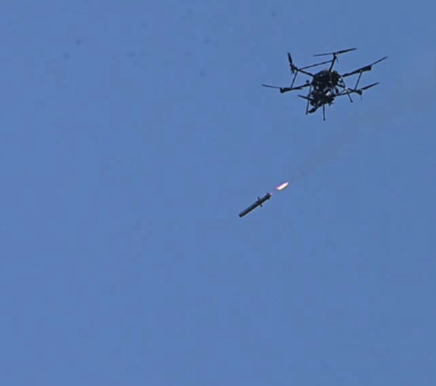
- The Unmanned Aerial Vehicle Launched Precision Guided Missile (ULPGM)-V3 is an indigenously developed lightweight “fire-and-forget” missile designed for launch from drones and unmanned aerial systems.
- It has been designed to provide precision strike capability against both ground-based and aerial targets in modern battlefield environments.
- Key Features of ULPGM-V3:
- The missile supports dual operational capability:
- Air-to-Ground mode for anti-tank and precision strike operations.
- Air-to-Air mode for engaging drones, helicopters, and airborne threats.
- It incorporates an advanced seeker system and precision-guidance technology for accurate target engagement.
- The missile is lightweight, modular, and optimised for deployment through UAV platforms, improving tactical flexibility in network-centric warfare.
- The anti-armour variant reportedly includes a tandem-charge warhead capable of defeating explosive reactive armour (ERA)-protected tanks in top-attack mode.
- The missile supports dual operational capability:
Significance of ULPGM-V3 for India
- Boost to Aatmanirbhar Bharat: The successful indigenous development of ULPGM-V3 strengthens India’s self-reliance in precision-guided munitions and reduces dependence on imported drone-launched missile systems.
- Enhancing Drone Warfare Capability: The missile significantly improves India’s UAV-based offensive capability for precision strikes, anti-armour warfare, and counter-drone operations in modern battlefields.
- Lessons from Recent Conflicts: The development assumes added importance in the backdrop of the extensive use of drones by the adversary during Operation Sindoor, where unmanned systems emerged as a critical component of surveillance, targeting and tactical strike operations.
- Force Multiplication for Armed Forces: ULPGM-V3 provides cost-effective stand-off strike capability while reducing risks to personnel and conventional aircraft during combat operations.
- Strengthening Counter-Drone Operations: Its air-to-air capability against drones, helicopters, and low-flying aerial targets strengthens India’s emerging counter-UAV warfare architecture.