
SYLLABUS
GS-2: Statutory, Regulatory and various Quasi-judicial Bodies; Functions and Responsibilities of the Union and the States, Issues and Challenges Pertaining to the Federal Structure.
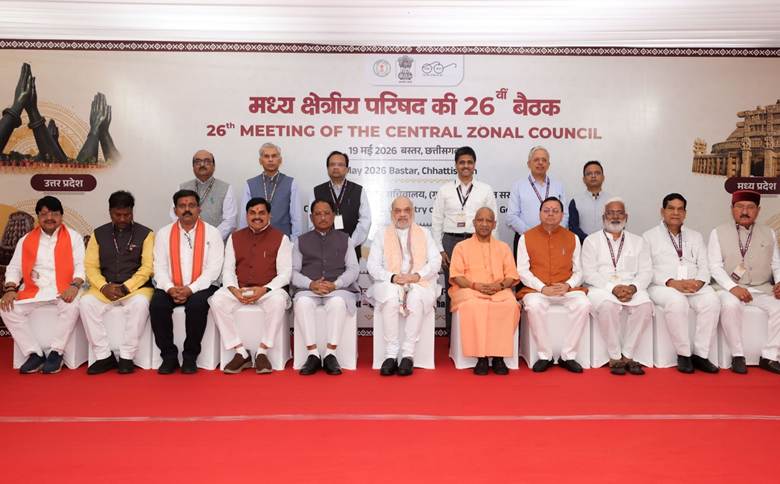
Context: The Union Home Minister recently chaired the 26th meeting of the Central Zonal Council (CZC) in Bastar, Chhattisgarh.
More on the News
- The meeting was attended by the Chief Ministers of 4 Central Zonal Council states – Chhattisgarh, Madhya Pradesh, Uttar Pradesh, and Uttarakhand.
- The meeting was organised by the Inter-State Council Secretariat, functioning under the Ministry of Home Affairs, with the Chhattisgarh Government as the host.
Key Highlights of the Meeting
- The Union Home Minister stated that India has made major progress in eliminating Left Wing Extremism (LWE) and said that while the country has become “Naxal-free”, the focus must now shift towards accelerating development in regions that have remained affected by extremism for decades.
- The meeting emphasised stronger inter-state coordination on issues relating to internal security, cybercrime, narcotics control, border disputes, and law and order.
- The Council reiterated the importance of cooperative federalism, consensus-based governance, and coordinated efforts between the Centre and States towards the vision of “Viksit Bharat”.
About Zonal Councils
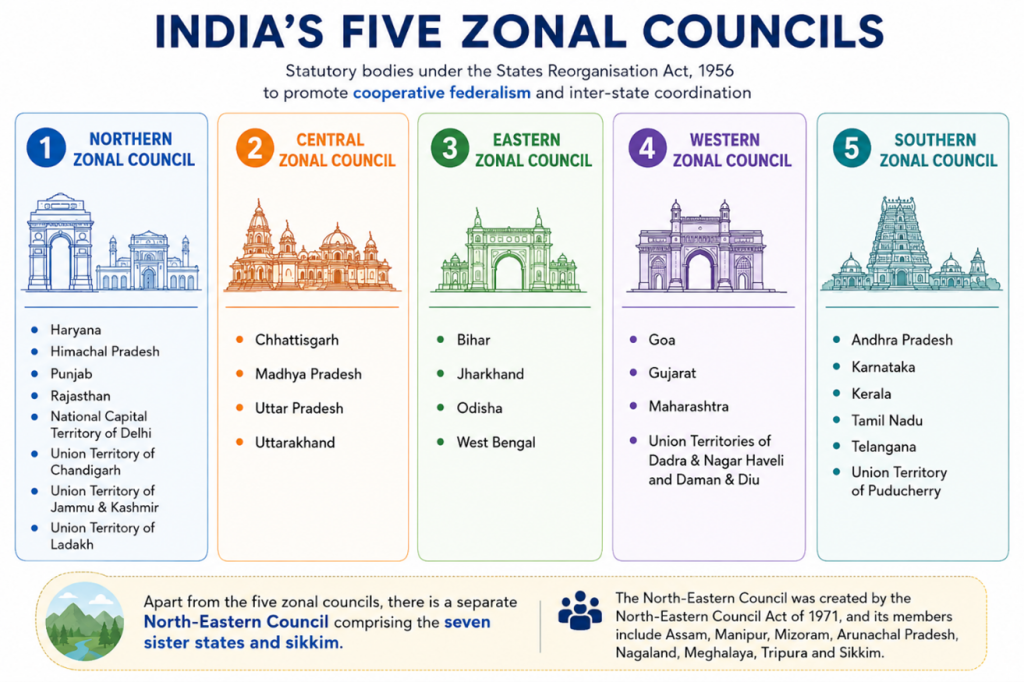
- The idea of Zonal Councils was mooted by Prime Minister Jawaharlal Nehru in 1956, during the debate on the States Reorganisation Commission’s report (Fazl Ali Commission), to promote cooperative working among States. Subsequently, five Zonal Councils were established under Part III of the States Reorganisation Act, 1956.
- They were created to promote:
- cooperative federalism,
- national integration,
- inter-state coordination,
- and resolution of regional disputes through dialogue and consensus.
- India has five Zonal Councils — Northern, Central, Eastern, Western, and Southern — while the North Eastern Council functions separately under a different statutory framework.
- The North-Eastern Council was created by the North-Eastern Council Act of 1971, and its members include Assam, Manipur, Mizoram, Arunachal Pradesh, Nagaland, Meghalaya, Tripura and Sikkim.
- The Union Home Minister serves as the Chairman of all Zonal Councils, while Chief Ministers and two Ministers from the member States are the members in each Zonal Council.
- In case of UTs, there are two members from each UT.
- Each chief minister acts as a vice-chairman of the council by rotation, holding office for a period of one year at a time.
- Each Zonal Council has a Standing Committee comprising the Chief Secretaries of member states, which undertakes preliminary discussions and helps resolve issues before the Zonal Council meetings.
- The Inter-State Council Secretariat under the Ministry of Home Affairs acts as the nodal body for organising and coordinating Zonal Council meetings.
Significance of Zonal Councils in Indian Federalism
- Strengthening Cooperative Federalism: Zonal Councils provide an institutional platform for regular dialogue and coordination between the Centre and States.
- Peaceful Resolution of Inter-State Issues: They help address disputes relating to boundaries, water sharing, transport, and security through consultation and consensus-building.
- Improving Policy Coordination: The Councils facilitate coordinated implementation of national schemes and the sharing of best governance practices among states.
- Enhancing National Integration: Regular political and administrative interaction among states helps reduce regionalism and strengthen national unity.
- Addressing Regional and Security Challenges: Zonal Councils play an important role in coordinated responses to challenges such as Left Wing Extremism, cybercrime, disaster management, and regional development gaps.