

SYLLABUS
GS-2: Important International institutions, agencies and fora- their structure, mandate.
GS-3: Indian Economy and issues relating to planning, mobilization of resources, growth, development and employment.
Context: At the International Monetary Fund–World Bank Spring Meetings 2026, developing countries launched the first-ever Borrowers’ Platform, marking a significant step toward rebalancing a global financial system historically shaped by creditor interests.
About the Borrowers’ Platform
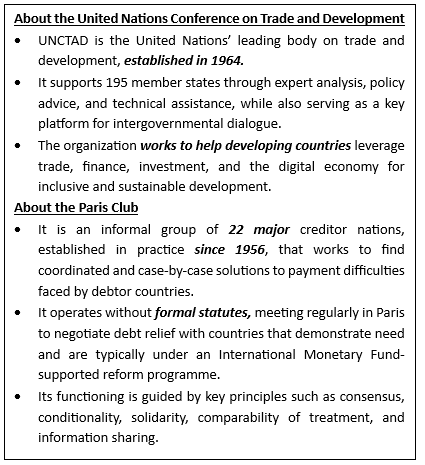
- The Borrowers’ Platform is a dedicated forum for developing countries that brings together finance ministers and central bank governors to exchange knowledge and experiences on sovereign debt, strengthen coordination among borrowing nations, enhance debt management capacity, and articulate a collective voice in global debt discussions.
- Secretariat: The initiative is supported by the United Nations Conference on Trade and Development as its secretariat.
- Objective: It aims to address long-standing asymmetries in the global financial system, historically dominated by creditor-led frameworks such as the Paris Club.
- Nature and Scope: It functions as a technical and cooperative mechanism and is not a negotiation or debt restructuring forum.
- Focus Areas: The platform promotes peer learning and technical cooperation, strengthens capacity-building and debt transparency, and facilitates the sharing of best practices in debt management.
- Institutional Backing: The initiative was proposed by the UN Secretary-General’s Expert Group on Debt in June 2025 and later endorsed in the Sevilla Commitment 2025 and the UNCTAD16 Geneva Consensus 2025.
- Governance Structure: The platform is guided by a working group led by Egypt as Chair and Pakistan as Vice-Chair, with members including Colombia, Honduras, Nepal, Zambia, and the Maldives.
Significance
- Addressing Structural Imbalance: The initiative seeks to correct the creditor-dominated global debt system (e.g., Paris Club) by providing borrowing countries, which previously lacked a formal coordination platform, with a collective voice to rebalance power asymmetry.
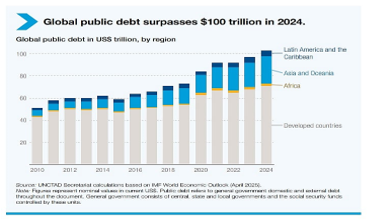
- Rising Debt Crisis in Developing Countries: Developing countries face a rapidly worsening debt situation, with external debt reaching $11.7 trillion in 2024, contributing to $31 trillion out of the $102 trillion global public debt, and growing at twice the rate of developed economies since 2010.
- Fiscal Stress and Development Constraints: High debt servicing burdens—around 10% of revenues (and ~25% for least developed countries)—along with $920 billion in annual servicing costs have led 54 countries (home to 3.4 billion people) to spend more on debt than on health or education.
- Unequal Financing Conditions: Developing countries face structurally unequal financial conditions, including borrowing costs 2–4 times higher than the United States, with nearly half spending at least 6.5% of export revenues on debt servicing and experiencing a negative net resource transfer of $25 billion in 2023.
- Strengthening Capacity and Transparency: Through initiatives like UNCTAD’s Debt Management and Financial Analysis System (DMFAS) programme, which has supported over 75 countries for more than 40 years, the platform enhances debt transparency, governance, and sustainability.
- Political Momentum: The platform has strong political backing, with participation from 30 countries, including major economies like India and South Africa, as well as vulnerable states such as the Maldives, reflecting the widespread nature of debt challenges.
Challenges
- Limited Mandate: The platform is not a negotiation or restructuring body and therefore cannot directly influence creditor decisions.
- Fragmented Global Debt Architecture: Multiple overlapping mechanisms, such as the Paris Club, G20 Common Framework, and Global Sovereign Debt Roundtable, create coordination inefficiencies.
- Persistent Creditor Dominance: Global financial decision-making remains largely controlled by creditors, limiting the effectiveness of borrowers’ collective voice.
- Information Asymmetry: Lack of transparency in debt contracts and treatment comparability weakens the bargaining power of developing countries.
- Rising Debt Burdens: Rapidly increasing interest payments, reaching $921 billion in 2024, are crowding out essential spending on health, education, and climate action.
Way Forward
- Strengthening Institutional Capacity: Capacity should be enhanced by expanding technical assistance through the United Nations Conference on Trade and Development and scaling up DMFAS systems.
- Enhancing Borrower Coordination: Developing countries should build shared frameworks on debt transparency and negotiation strategies to strengthen collective action.
- Integrating with Global Mechanisms: The platform should align with the International Monetary Fund–World Bank and G20 processes for better policy coherence.
- Improving Data Transparency: Standardized reporting on debt contracts and obligations is needed to reduce information asymmetry.
- Pushing Structural Reforms: Efforts should focus on fairer debt restructuring mechanisms and more balanced representation in global financial governance.
Source:
Unctad
Downtoearth
Reuters