
SYLLABUS
GS 2: Indian Constitution—Historical Underpinnings, Evolution, Features, Amendments, Significant Provisions and Basic Structure.
Context: The Constitution (One Hundred and Thirty-First Amendment) Bill, 2026, was introduced in the Lok Sabha on April 16, 2026, and aims to amend the Constitution with regard to delimitation.
More on the News
- Along with the Constitution (131st Amendment) Bill, 2026, the Delimitation Bill, 2026, and the Union Territories Laws (Amendment) Bill, 2026 were also introduced in the Lok Sabha.
- These Bills increase the size of Lok Sabha, seek to enable delimitation based on the 2011 census, and enable reservation for women to be based on this delimitation.
- The Union Territories (UTs) Laws Bill gives effect to similar provisions in cases of Puducherry, Delhi, and Jammu & Kashmir.
About the Constitution (131st Amendment) Bill, 2026
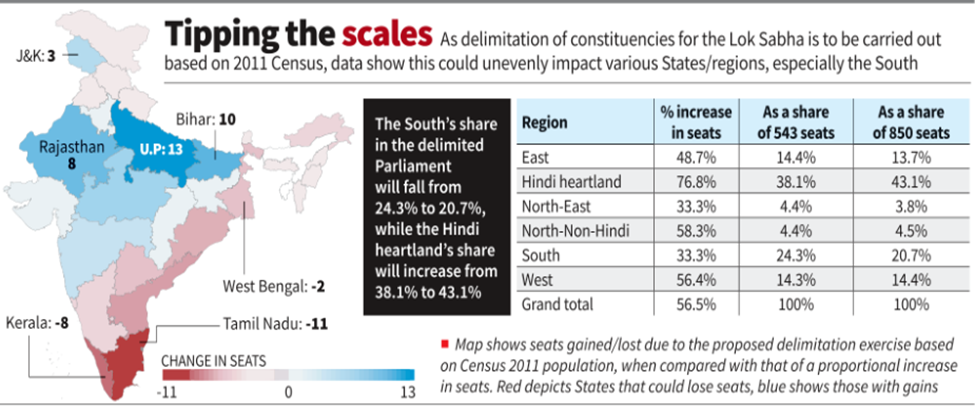
- A Much Larger Lok Sabha: The present strength of the Lok Sabha, as laid out in Article 81, is capped at 550 (530 seats from states and 20 from Union Territories).
- The Bill raises that ceiling sharply: 815 from states and 35 from UTs, an increase of 300 seats.
- Redefining “Population”: Article 81 defines “population” as per the latest published Census, but until the first Census after 2026, it uses the 1971 Census for seat allocation and the 2001 Census for constituency delimitation.
- The Bill amends Articles 55, 81, 82, 170, 330, and 332 to introduce flexibility, allowing Parliament to decide which published Census to use.
- Population will be defined as that “ascertained at such census, as Parliament may by law determine.”
- Delinking Delimitation from the Census: One of the more significant changes is to Article 82, which currently requires that parliamentary constituencies be readjusted after each census. The Bill makes three changes.
- First, it drops the requirement that a completed census must trigger delimitation; the exercise can now be initiated at any time, on the basis of whichever published census Parliament designates.
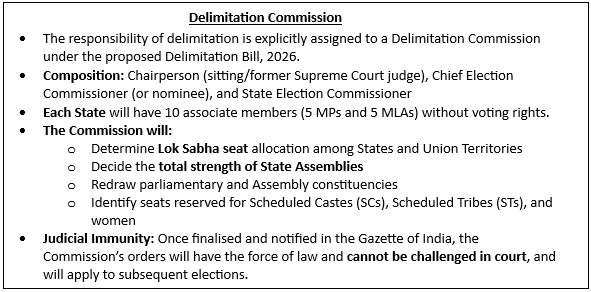
- Second, it names the Delimitation Commission as the constitutionally mandated authority for the exercise.
- Third, and most consequentially, it deletes the third proviso entirely, lifting the freeze on both seat allocation and constituency boundaries that has been in place since 1971.
- Delimitation Commission Given Constitutional Status: The Bill amends Articles 82 and 170 to name the Delimitation Commission as the constitutionally mandated body for delimitation, replacing the existing formulation, which leaves the designation of the authority to Parliament by law.
- Women’s Reservation: The Bill substitutes the entire Article 334A, as introduced by the 106th Amendment and the Nari Shakti Vandan Adhiniyam, 2023, marking a major shift in the implementation of women’s reservation.
- Earlier, the 33% reservation for women was contingent upon delimitation after the first Census post-Act, delaying its implementation. The Bill removes this condition and requires only that a delimitation exercise be conducted, without linking it to any specific Census.
- Read with the proposed Delimitation Bill, 2026, which allows delimitation based on the 2011 Census, the reservation can now be implemented before the 2029 general elections.
- The 15-year sunset clause remains, counted from the commencement of the 106th Amendment (2023), with Parliament empowered to extend it.
- Safeguards for Tribal Representation: Amendments to Article 332 ensure that the Scheduled Tribe representation is not diluted, particularly in Arunachal Pradesh, Meghalaya, Mizoram, Tripura, and Nagaland.
Challenges
- Federal Structure Concerns: Since the Bill’s circulation, public debate over its timing and intent has been swift and sharp, with Opposition leaders calling it a threat to India’s federal structure.
- Gerrymandering Concerns: A similar pushback was mounted during delimitation in Jammu and Kashmir (2022), which saw allegations of gerrymandering. With the new Bill, these concerns are magnified, as a nationwide exercise based on incomplete and uneven census data (with the 2021 Census still pending) carries risks at a much larger scale.
- Redistribution of Political Power: While the stated objective is to implement women’s reservation before the 2029 general elections, the underlying consequence may be a fundamental redistribution of political power across states.
Significance
- More representative Lok Sabha: Raising Lok Sabha strength to 850 improves the population–representation ratio, bringing the system closer to the “one person, one vote” principle.
- Faster women’s reservation: Removing earlier delays enables 33% women’s reservation to be implemented in the next general election, instead of waiting until the 2030s.
- Updated seat allocation: Redrawing constituencies on current data corrects the outdated 1971-based seat distribution and reflects present-day demographic shifts.