
SYLLABUS
GS-2: Statutory, Regulatory and various Quasi-judicial Bodies; Functions and Responsibilities of the Union and the States, Issues and Challenges Pertaining to the Federal Structure.
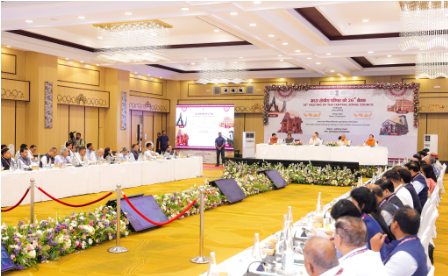
Context: The Union Home Minister recently chaired the 26th meeting of the Central Zonal Council (CZC) in Bastar, Chhattisgarh.
More on the News
- The meeting was attended by the Chief Ministers of 4 Central Zonal Council states – Chhattisgarh, Madhya Pradesh, Uttar Pradesh, and Uttarakhand.
- The meeting was organised by the Inter-State Council Secretariat, functioning under the Ministry of Home Affairs, with the Chhattisgarh Government as the host.
Key Highlights of the Meeting
- The Union Home Minister stated that India has made major progress in eliminating Left Wing Extremism (LWE) and said that while the country has become “Naxal-free”, the focus must now shift towards accelerating development in regions that have remained affected by extremism for decades.
- The meeting emphasised stronger inter-state coordination on issues relating to internal security, cybercrime, narcotics control, border disputes, and law and order.
- The Council reiterated the importance of cooperative federalism, consensus-based governance, and coordinated efforts between the Centre and States towards the vision of “Viksit Bharat”.
About Zonal Councils
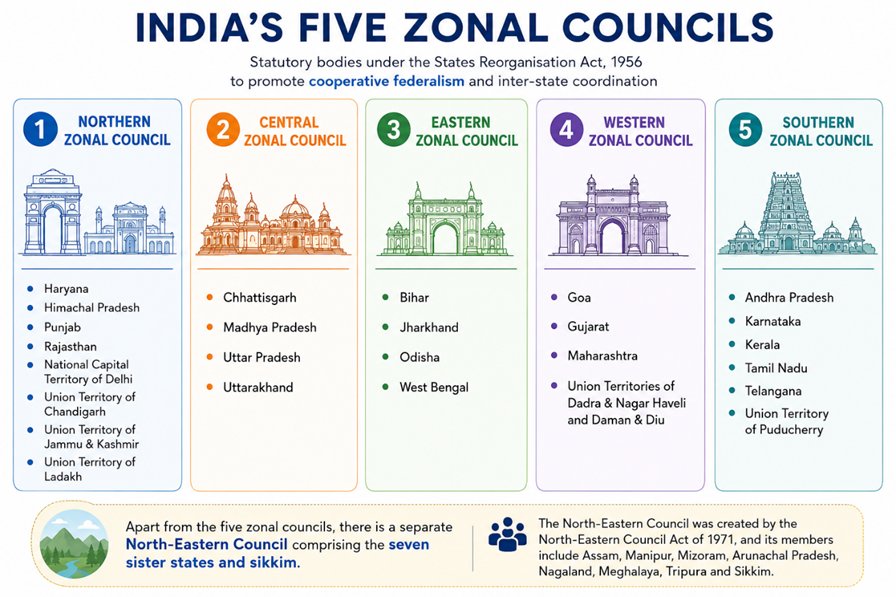
- Zonal Councils are statutory advisory bodies established under the States Reorganisation Act, 1956, following the recommendations of the States Reorganisation Commission (Fazl Ali Commission).
- They were created to promote:
- cooperative federalism,
- national integration,
- inter-state coordination,
- and resolution of regional disputes through dialogue and consensus.
- India has five Zonal Councils — Northern, Central, Eastern, Western, and Southern — while the North Eastern Council functions separately under a different statutory framework.
- The North-Eastern Council was created by the North-Eastern Council Act of 1971, and its members include Assam, Manipur, Mizoram, Arunachal Pradesh, Nagaland, Meghalaya, Tripura and Sikkim.
- The Union Home Minister serves as the Chairman of all Zonal Councils, while Chief Ministers and two Ministers from the member States are the members in each Zonal Council.
- In case of UTs, there are two members from each UT.
- Each chief minister acts as a vice-chairman of the council by rotation, holding office for a period of one year at a time.
- Each Zonal Council has a Standing Committee comprising the Chief Secretaries of member states, which undertakes preliminary discussions and helps resolve issues before the Zonal Council meetings.
- The Inter-State Council Secretariat under the Ministry of Home Affairs acts as the nodal body for organising and coordinating Zonal Council meetings.
Significance of Zonal Councils in Indian Federalism
- Strengthening Cooperative Federalism: Zonal Councils provide an institutional platform for regular dialogue and coordination between the Centre and States.
- Peaceful Resolution of Inter-State Issues: They help address disputes relating to boundaries, water sharing, transport, and security through consultation and consensus-building.
- Improving Policy Coordination: The Councils facilitate coordinated implementation of national schemes and the sharing of best governance practices among states.
- Enhancing National Integration: Regular political and administrative interaction among states helps reduce regionalism and strengthen national unity.
- Addressing Regional and Security Challenges: Zonal Councils play an important role in coordinated responses to challenges such as Left Wing Extremism, cybercrime, disaster management, and regional development gaps.